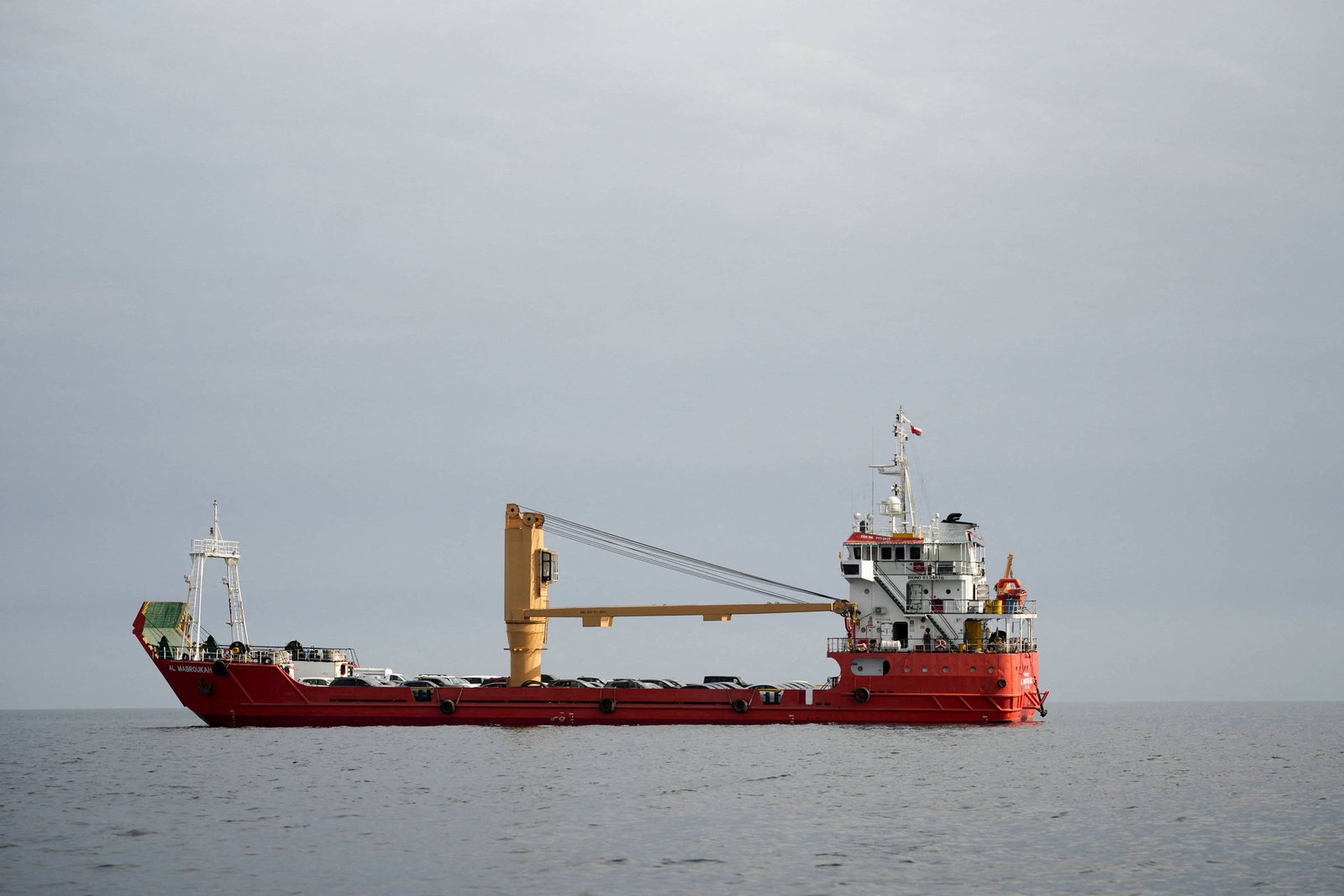
The president of United States, donald trumpstated this Sunday (12) that he ordered the beginning of a naval blockade of the Strait of Hormuzafter the failure of negotiations with the Iran node Pakistan.
Hours later, the US Central Command, responsible for operations in the Middle East, said it will execute a complete blockade of all ships entering or leaving Iranian ports from 11 am this Monday (13), Brasília time.
“The blockade will be carried out in an impartial manner against vessels from all countries entering or departing ports and coastal areas of Iran,” the US military said, stating that it will not impede the navigation of boats “crossing the Strait of Hormuz from or bound for non-Iranian ports.”
In turn, Iran’s Revolutionary Guard responded by saying it had traffic in Hormuz “under control.” “The enemy will be trapped in a deadly vortex in the strait if they make a wrong move,” the naval command of the regime’s elite unit declared in a social media post. The body also stated that it will consider the approach of military vessels to the strait as a violation of the ceasefire declared on Tuesday (7).
Trump has also threatened to destroy the country’s power plants and other civilian energy infrastructure if a resolution is not reached. “I could wipe out Iran in a day. I could have all the energy infrastructure of them, all their plants, all their electricity generation plants”, he said in an interview with Fox News.
In the same conversation, he stated that the US needs to reevaluate NATO (Western military alliance that, despite being led by Washington, is a frequent target of Trump) and that the 50% tariffs already announced against countries that supply weapons to Iran could include the China. “If we catch (China) doing this, they will get a 50% tariff, which is a staggering amount,” he said.
On his social network, Trump accused Iran of promoting “global extortion” by threatening the security of the Hormuz crossing, one of the most important for the transport of oil in the world. According to him, the Iranian justification for the possible presence of mines in the strait creates deliberate insecurity and impedes free movement.
“Effective immediately, the United States Navy, the best in the world, will begin the process of blocking all ships attempting to enter or exit the Strait of Hormuz,” he wrote. “I have instructed our Navy to seek out and intercept all vessels in international waters that have paid tolls to Iran. No one who pays an illegal toll will have safe passage on the high seas,” it said, adding that any Iranian who fired at them or peaceful vessels would be “sent to hell.”
The Republican also said that the Negotiations lasted around 20 hours in the Pakistani capitalbut they failed at the central point: the Iranian nuclear program. According to Trump, Tehran has refused to abandon its atomic ambitions, which, in his assessment, makes any broader agreement unfeasible.
He again stated that Iran “will never have a nuclear weapon” and blamed the regime for causing “anxiety, displacement and suffering” on a global scale.
To the peace negotiations in Islamabad ended without the warring countries reaching an agreement, throwing the future of the fragile ceasefire between the two opposing countries in the war in the Middle East into uncertainty.
American Vice President JD Vance, who led the US delegation, stated that Iran chose not to accept American terms, including a ban on building nuclear weapons. “We need a firm commitment that they will not seek nuclear weapons and that they will not seek the means that would allow them to obtain them quickly.”
In turn, the President of Iran’s Parliament, Mohammad Bagher Ghalibaf, stated this Sunday that Washington was unable to build a trustworthy relationship. “My colleagues in the Iranian delegation presented constructive initiatives, but ultimately the other side was unable to win the trust of the Iranian delegation in this round of negotiations,” he said in a post on X.
In what was the highest-level meeting between Washington and Tehran since the 1979 Islamic Revolution, the delegations held three rounds of talks — the third only ended in the early hours of Sunday (12), Saturday night in Brazil.