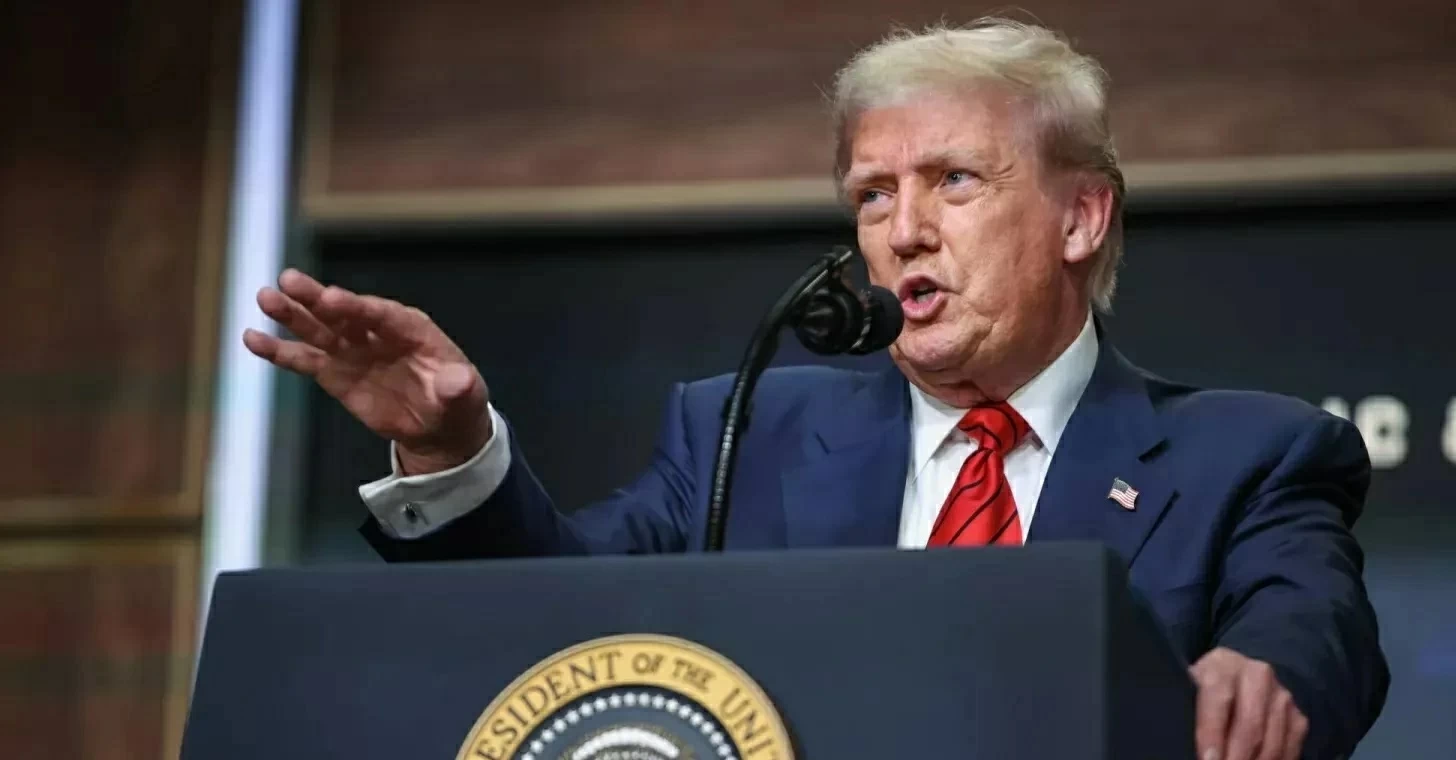
US President Donald Trump confirmed that he had not received any official notification from Iran regarding the suspension of negotiations with the United States, denying his prior knowledge of any such decision, following media reports that Tehran had frozen the talks in protest against the Israeli attacks in Lebanon.
Trump said in statements to NBC News that he had not heard anything from the Iranian side confirming the suspension of the talks, noting that Washington had not received any official response regarding these circulating reports.
“Silence is better”
The American President believed that public talk about the negotiations exceeded the required limit, considering that remaining silent may be the best option at this stage.
He said: “We talked too much, and I think silence would be a very good thing, and this may continue for a long time,” adding that the lack of communication does not worry him even if the reports that Iran has suspended the talks are true.
Siege “like steel”
Trump stressed that the policy of economic pressure imposed on Iran will remain in place, stressing that the American blockade is “like steel” and will remain tight during the next stage.
He added: “We can wait a long time, and they are the losers,” stressing that time is not working in Tehran’s favor in light of the continuing economic losses it is incurring.
He also described the blockade as “impregnable,” saying that the United States is able to wait no matter how long the crisis lasts, because Iran – in his words – is losing huge amounts of wealth as economic pressures continue.
There is no automatic return to the military option
At the same time, Trump ruled out linking the faltering negotiations to the possibility of returning to the military option, explaining that silence or a cessation of communication does not necessarily mean directing strikes against Iran.
He said: “Silence does not mean a return to attacking Iran, but we will continue the policy of siege,” referring to his administration’s adherence to tools of economic and diplomatic pressure instead of direct military escalation.
Disagreements hinder agreement
Trump’s statements come at a time when diplomatic efforts between Washington and Tehran are facing increasing faltering, amid ongoing disagreements over a number of thorny issues, most notably the Iranian nuclear program and the missile program.
Iranian media reported on a decision taken by the Iranian negotiating team to suspend talks and exchange messages with the United States through mediators, in protest against the expansion of Israeli military operations in Lebanon, while Iranian warnings continue about the repercussions of regional escalation on the chances of reaching a new agreement between the two countries.
US President Donald Trump denied today (Monday) that negotiations with Iran have been frozen, affirming that he has not heard from Iran that negotiations have been suspended.
Trump told NBC: “It’s appropriate for Iran to say they have suspended message exchanges because they are better at negotiating than fighting, but they haven’t informed us of that,” adding: “We can wait a long time, and they are the losers.”
Trump reaffirmed his commitment to silence as the best approach, which does not mean returning to bombing Iran, but he will maintain the blockade.
He emphasized: “Our blockade on Iran is like steel and will remain tight,” indicating that the suspension does not mean he will start dropping bombs everywhere in Iran, but he will keep the blockade in place.
Earlier today, Iran halted message exchanges with the United States through intermediaries, following Israeli attacks on Lebanon, according to the semi-official Iranian news agency Tasnim.
The agency clarified that Tehran stopped message exchanges with the United States through intermediaries due to the attacks on Lebanon, which it considered a violation of the ceasefire with Washington, noting that as long as Israeli operations continue in Lebanon, and given that Lebanon was among Iran’s conditions for a ceasefire, the Iranian negotiating team will suspend talks and message exchanges through intermediaries.
It added that Iranian officials and negotiators emphasized the “urgent need to stop Israeli military operations in Gaza and Lebanon, and the necessity for Israel to fully withdraw from the areas it occupies in Lebanon,” stating that “there will be no talks unless Iran’s demands in this regard are met.”
The agency also indicated that Iran intends to completely close the Strait of Hormuz and activate other fronts, including the Bab el-Mandeb Strait, in order to punish Israel and its supporters.
Iranian Foreign Minister Abbas Araghchi had stated earlier today that the ceasefire between Iran and the United States is a “comprehensive ceasefire on all fronts, including Lebanon, and any violation on one front is considered a violation of the ceasefire on all fronts,” holding the United States and Israel responsible for any consequences that may arise from that.
In contrast, Israel has escalated its military operations in Lebanon and issued a warning to residents of the southern suburbs of Beirut, demanding their immediate evacuation, following attacks launched by Hezbollah on Israel.