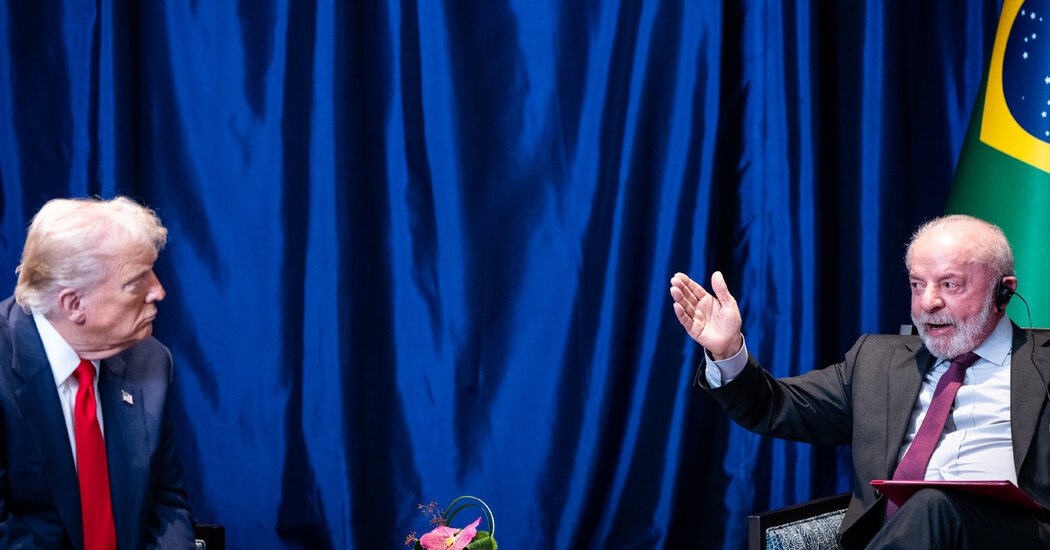
President Trump hosted President Luiz Inácio Lula da Silva of Brazil at the White House on Thursday, at a moment of a fragile truce after a tense year of U.S. tariffs and public insults between the leaders of the Western Hemisphere’s largest nations.
Mr. Trump said on social media that he and Mr. Lula had discussed “many topics,” including trade, but the two leaders did not make the joint appearance before reporters that had been on their schedule.
Mr. Trump wrote that the meeting went “very well,” and he called Mr. Lula “very dynamic,” but he offered very few details about what the two discussed.
The president made the post — which did not specify a reason the joint appearance had not been held — after Mr. Lula spent roughly three hours at the White House.
Mr. Lula later offered a generally positive review of the meeting. “I leave the U.S. with an important step forward in consolidating the democratic and historical relations with the U.S.,” he told reporters at the Brazilian Embassy in Washington.
He added that the two largest democracies in the Western Hemisphere, the United States and Brazil, “can serve as an example to the world.”
Mr. Lula said he and Mr. Trump had spoken about trade, crime and critical minerals.
Mr. Trump has subjected Brazil to a whiplash of measures, only to abruptly walk back several of the harshest penalties. Mr. Lula, a leftist, has condemned Mr. Trump’s policies toward Iran and Cuba, along with his recent critical comments about Pope Leo XIV.
The relationship between their countries has been marked by significant moments of acrimony. Mr. Trump used tariffs to try to force Brazil to drop its prosecution of his political ally Jair Bolsonaro, the former right-wing Brazilian president who was ultimately convicted of plotting a coup to retain power after losing the previous election to Mr. Lula.
Mr. Trump also imposed sanctions on the Brazilian Supreme Court justice overseeing Mr. Bolsonaro’s case. Mr. Lula rejected Mr. Trump’s moves as violations of Brazil’s sovereignty.
The United States eventually rolled back the tariffs on many key Brazilian exports, and Mr. Trump and Mr. Lula, who met late last year on the sidelines of a summit in Asia, have achieved a diplomatic détente of sorts in recent months. (At the U.N. General Assembly last year, the two men embraced and had a brief exchange. “He seemed like a very nice man,’’ Mr. Trump said.)
Bruna Santos, the director of the Brazil program at the Inter-American Dialogue in Washington, described the relationship as “controlled turbulence.” She added, “We all know they aren’t always seeing eye to eye, but they need each other.”
Analysts expected one topic at the meeting on Thursday to be the Trump administration’s potential designation of Brazil’s two biggest drug gangs as terrorist groups, after lobbying by two of Mr. Bolsonaro’s sons, including Flávio Bolsonaro, who is running for president.
Security is a cornerstone issue for voters in Brazil’s pivotal election in October, with polls showing Mr. Lula and Mr. Bolsonaro deadlocked.
A terrorist designation could put a bigger spotlight on the issue and, analysts say, potentially help Mr. Bolsonaro, who has criticized Mr. Lula over his handling of crime.
The Brazilian government has proposed a security agreement with the United States to take on criminal groups, but, Ms. Santos said, there are fears that a U.S. designation could “open the door for military intervention.’’
Mr. Lula told reporters that in raising the issue of organized crime, he told Mr. Trump that Brazil was willing to organize a working group of South American nations. “We can solve in a few years what we didn’t solve in a 100 years,” he said.
The two leaders had also been expected to discuss U.S. investigations against Brazil over its trade practices, which could potentially lead to more tariffs.
On critical minerals, the United States has been pressing Brazil to enter an agreement to produce millions of tons of the elements needed to help power the economies and battlefields of the future, according to U.S. and Brazilian officials.
Mr. Lula has been resistant to a deal, according to officials, because Brazil wants to control its resources and be able to sell them to countries beyond the United States. Brazil possesses one of the largest reserves of critical minerals, which include elements highly sought after by the United States.
China, which has the largest reserve of critical minerals, has threatened to halt exports during trade battles, which has led the United States to seek minerals elsewhere, including in Brazil.
“The U.S. sees it as the one place where China can basically shut down parts of our economy, and Brazil is one of the few options for breaking the Chinese monopoly,” said Ricardo Zúniga, a former top official for Latin American affairs in the Obama administration.
Mr. Trump is scheduled to meet with President Xi Jinping of China next week in Beijing.
The meeting on Thursday had originally been scheduled for March, but it was postponed because of the conflict with Iran.
Mr. Trump, in trying to punish Brazil last year for pursuing the elder Mr. Bolsonaro, called the prosecution “political persecution” and a “serious human rights abuse.” Mr. Trump also posted a letter he had written to Mr. Lula on Truth Social, his social media platform, saying, “It is a Witch Hunt that should end IMMEDIATELY!”
Mr. Lula responded by unveiling a video featuring a new government theme: “‘Brasil’ belongs to Brazilians, and it’s spelled with an S for Sovereignty.” The tariffs triggered a defiant sense of national pride and a mix of economic anxiety among the business community. They also improved Mr. Lula’s standing in the polls, though his popularity has since waned.
In October, rollbacks and exemptions by the Trump administration eventually weakened the tariffs, which were invalidated by the U.S. Supreme Court in February.
Mr. Bolsonaro was sentenced to 27 years in prison, though he is serving his punishment at a residence for health reasons.
Mr. Lula told reporters on Thursday that all issues were open to negotiation, but that Brazil would not allow any interference in its internal affairs or threats to its democracy.
He said he had also joked with Mr. Trump about how he hoped the U.S. president wouldn’t cancel the visas of Brazilian soccer players coming to the United States to compete in next month’s World Cup.
Mr. Trump, Mr. Lula said, simply laughed.
Erica L. Green contributed reporting.