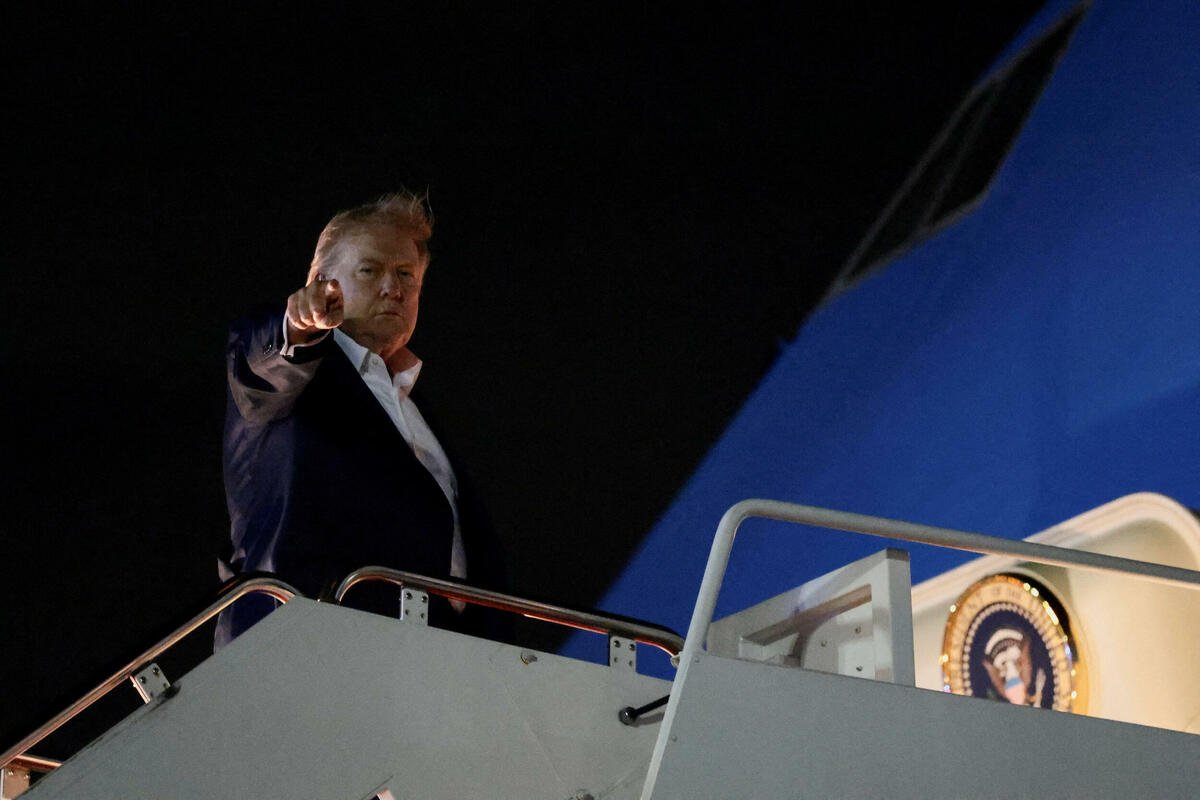
President Donald Trump arrived in France today for a meeting with an ideologically diverse group of world leaders who have at least one thing in common: all of them either found themselves the target of Trump’s anger, or were forced to go through unpleasant situations with the American leader.
Several G7 leaders have faced Trump’s wrath for questioning his war with Iran. Trump clashed with some over tariffs. And the leaders of Japan and Germany had to endure his clumsy remarks about dark moments in their countries’ history.
During the three-day talks in the French Alps, the leaders are expected to discuss the newly reached agreement aimed at ending the war with Iran, China’s trade policy and Russia’s war in Ukraine. It will also be an opportunity for them to assess their relationship with Trump at a time when the American leader seems more determined than ever to act independently on issues of global importance.
The dynamics of the summit are not much different from a family holiday gathering where “the uncle you don’t really like” is present, said Max Bergman, an analyst at the Center for Strategic and International Studies.
“And nobody wants confrontation, even if things get pretty passive-aggressive at times,” Bergman said. “But, you know, there’s always the possibility that things will break and things can get pretty dramatic.”
The following is a review of some of the more significant moments of public friction and awkward exchanges between Trump and his fellow G7 leaders.
Starmer is not Churchill in Trump’s eyes
Trump’s criticism of British Prime Minister Keir Starmer focused on the UK’s reluctance to help US military strikes on Iran, Britain’s immigration policy and the country’s renewable energy strategies.
But his sharpest criticism of Starmer came after the Labor leader initially refused to allow US warplanes to use a British base in the Indian Ocean to bomb Iran. “This is not Winston Churchill we’re dealing with,” Trump said of Starmer, making it clear he doesn’t see him anywhere close to the British World War II-era prime minister.

Trump lashed out at the prime minister in the early days of the war with Iran after the United Kingdom put the aircraft carrier HMS Prince of Wales on high alert for a possible deployment to the Middle East.
“We don’t need people joining wars after we’ve already won them!” Trump said on social media.
The prime minister that Trump likes to call the governor
Trump has been angry about the trade imbalance with Canada, he often expresses his views on the annexation of Canada and its transformation into the “51st state”, and he also started calling Prime Minister Mark Carney “the governor”.
His harshest rhetoric towards the leader of America’s northern neighbor came after Carney, at the World Economic Forum in Davos, Switzerland, condemned the coercion of big powers on smaller countries, without mentioning Trump by name.

“Canada exists because of the United States,” Trump said in Davos. “Remember that, Mark, the next time you make a statement.”
Carney tried to remain calm despite Trump’s provocations. The prime minister told reporters earlier this month that Trump is an “extremely active user of social media” and that he will not respond to everything he posts.
Trump mocks Macron’s marriage and questions France’s reliability
During an Easter lunch at the White House in April, Trump criticized the resistance of France and other NATO countries to help the US-Israeli war against Iran.
In the midst of that digression, Trump mentioned a viral video from last year that appeared to show Macron’s wife, Brigitte, punching the French president in the face as they got off a plane during a visit to Vietnam.
Trump told the crowd that Brigitte treats Macron “extremely badly” and said that the French president is “still recovering from the right-hand blow to the jaw”.

Macron then told reporters that he and his wife were just joking and assessed that Trump’s comments were “neither elegant nor appropriate.”
Trump regularly regales audiences with tales of his deal-making prowess, recounting conversations he had with Macron about trade disputes and imitating Macron’s responses in an exaggerated accent. In Trump’s version, Macron always gives in quickly.
The prime minister Trump says lacks courage
Until recently, Italian Prime Minister Giorgio Meloni enjoyed great respect from Trump.
In October, Trump was full of praise for the conservative prime minister when world leaders gathered in Egypt for a summit on post-war Gaza, saying she was a “very successful, very successful politician” and “beautiful”.

However, Trump has since changed his tone since Italy refused to help the US in the war against Iran, and the Prime Minister criticized Trump for clashing with Pope Leo XIV over that conflict.
“Do people love her? I can’t believe it,” Trump said about Melona to the Milanese newspaper Corriere della Sera. He added: “I thought he had guts. I was wrong.”
An unpleasant historical reference in the Oval Office
Trump has not publicly criticized the Japanese prime minister since Sanae Takaichi took office in October.
However, some of his comments during Takaichi’s first visit to the White House put the Prime Minister in an uncomfortable situation.
When asked by a Japanese reporter why he did not inform allies in Europe and Asia before the US attacked Iran, Trump casually mentioned Pearl Harbor to justify his decision.
“Who knows better than Japan what a surprise is?” Trump said as Takaichi stood next to him. “Why didn’t you tell me about Pearl Harbor, okay?”

Trump’s remark surprised many in Japan, where they have become accustomed to American presidents avoiding harsh discussions about Japan’s surprise attack on the US Pacific Fleet in Hawaii, which launched the US into World War II. His predecessors instead focused on deepening ties with Japan, which became an ally after the war.
Takaichi, an outspoken conservative, received both praise and criticism in Japan for not reacting to Trump’s comments, instead letting them pass with a look at the ministers sitting nearby.
The chancellor’s criticism of the war with Iran infuriated Trump
German Chancellor Friedrich Mertz infuriated Trump in April when he said Iran was “humiliating” the US and criticized it for entering the war without any strategy, saying it also made ending the conflict more difficult.
The following day, Trump retaliated on social media, saying that Mertz “should devote more time to ending the war between Russia and Ukraine” and “solving problems in his country, especially immigration and energy.”
A few days later, the Pentagon announced that it would withdraw about 5,000 American troops from Germany, and Trump hinted that he would seek to “significantly further” reduce the American military presence.

Trump also had an unpleasant exchange with Mertz when the chancellor visited the White House last year, on the eve of the solemn anniversary of D-Day, the beginning of the Allied operations that led to the liberation of Western Europe, the defeat of Nazi Germany and the end of World War II.
Mertz was referring to the anniversary as he argued that the US was once again in a position to help end a conflict of enormous importance to Europe – Russia’s war against Ukraine – when Trump interrupted him to say that D-Day was “not a pleasant day for you”.
The chancellor reminded Trump that that day also marked the beginning of the “liberation of my country from the Nazi dictatorship.”
Trump admitted that Mertz had a point.
Download the application and follow the news


FOLLOW US ON

News