The transportation reform metropolitan is one of the most ambitious works planned by the Yamandú Orsi government and its completion fuels public discussion. Once the debate on the tunnel was over on July 18, the Executive Branch is focused on getting the project down to earth to translate it into the necessary tenders that, if everything goes well, would be ready in the second half of this year.
In this framework, a delegation from the Ministry of Transportation headed by Minister Lucía Etcheverry and the technical coordinator of the project, Gonzalo Márquez, appeared before the Transportation commission of the Chamber of Deputies.
In that instance, Márquez defended the choice of BRT (bus rapid transit) over trams mainly for cost-efficiency issues. and explained, with examples, that the speed of the different modes of transportation depends more on the infrastructure (exclusive lanes, traffic lights, intersections, etc.) than whether it is a bus or a car.
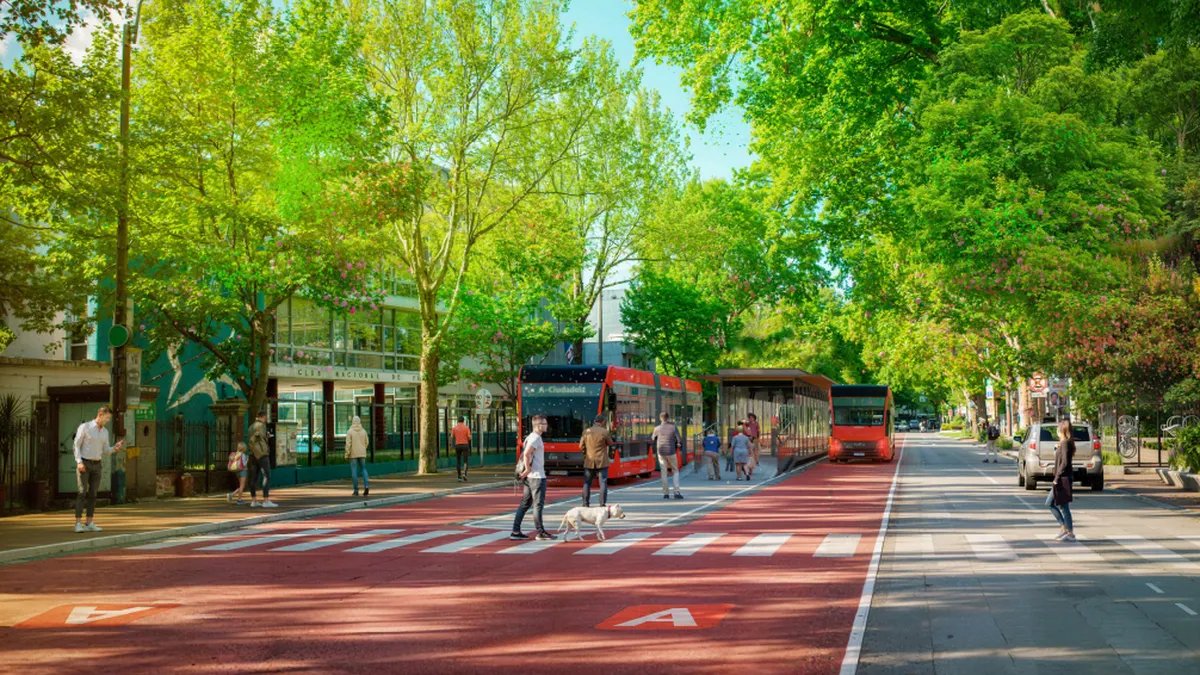
The objective is for the articulated buses with capacity for 220 people and about 26 meters long to move at an average of 25 kilometers per hour along the corridors.. That depends on the infrastructure and the distance between the stops. The systems (trams or buses) that reach faster speeds are because they have stops separated by greater distances, something that does not happen in the case of the Uruguayan metropolitan area.
“So, we can see that there are trams that move at 16 km per hour, for example, the Rio de Janeiro tram, and there are trams that move at 22, 23 km, and BRT that also move at 16 km per hour and others at 25 km per hour. That is, Speed is not something intrinsic to whether it is a tram or a BRT; It is intrinsic to how the circulation modality is“, he explained and added that that is why investment in infrastructure is key.
The runners
The project coordinator presented the two large corridors (October 8-Camino Maldonado and Italia Avenue-Giannattasio) as a first stage of the project. According to the presentation made, This stage “benefits 25% of network users” and “involves 22% of the total lines.”
The corridor of October 8 It is the one with the greatest demand for public transport with an average of 4,300 passengers per hour by direction while Italia Avenue is the second in demand with about 2,500 passengers per hour per direction (Graceful is the second).
However, The one on Avenida Italia is the one with the “greatest potential” to attract users of private vehicles. because it is where people move the most by car and where the “greatest demographic dynamics” occur. That is, in Márquez’s words, one of the “reasons why it makes sense to act there.”
“Avenida Italia is the third most important corridor of metropolitan public transport, but it shares with 8 de Octubre a condition that is one of those that lead to the first package of interventions that is proposed considering these two branches, which is its convergence in the central area of the city, unlike the logic of the west corridor itself, which has a different logic”explained Márquez to justify the choice of these two runners.
The 8 de Octubre corridor will go from Zonamérica to Ciudad Vieja (it is about 23 kilometers and it is being evaluated to extend it to Pando) and will have an exclusive central circulation throughout the project. This will involve diverting private traffic at some points to parallel streets and some changes in the direction of those streets.
“In particular, 8 de Octubre has a key condition, which is that a pair of circulation roads can be formed from Rousseau, turning the arrow to Rousseau, then connecting with Joanicó, Urquiza and, even, with Colonia through the 8 de Octubre tunnel, which creates a 10 km road pair. This is something like enlarging the capacity of 8 de Octubre Avenue, because we cannot enlarge it; but We can use that parallel road pair to divert private traffic there,” Márquez explained.
That runner will have 41 stops that will require validation of the ticket before entering and will have two uneven passages: one on José Batlle y Ordoñez Avenue (formerly Propios) and another on Luis Alberto de Herrera. The objective is that there are some 30 frequencies per hour and, therefore, the buses pass every two minutes.
The other corridor will go from El Pinar to Plaza Independencia (it is 30 kilometers) also with exclusive circulation but with a lower frequency: 15 frequencies every hour (buses every four minutes).
In that case they will be 48 stops closed with ticket validation before boarding and will have three uneven passages: Batlle y Ordoñez, Luis Alberto de Herrera and Bolivia. The cycle path remains in the central bed, according to the presentation of the Ministry of Transportation.