
Giff
Johnson RNZ Pacific Marshall Islands
correspondent
Analysis: Tokelau – made up of
three atolls with a total population of about 1500 people –
benefited hugely from joining a Pacific tuna cartel in
2012.
The impact of being part of the Parties to the
Nauru Agreement (PNA) was so significant that revenue
generated from its lucrative fishery quickly accounted for
as much as 40 percent of the national budget for this
non-self-governing territory of New Zealand.
But all
that came to a halt early this year, when the PNA terminated
Tokelau’s participation in PNA’s Vessel Day Scheme (VDS)
that manages the purse seine industry in Pacific waters,
where over half the world’s tuna is caught.
Up until
now, the termination of Tokelau’s participation with the
eight-member PNA has been shrouded in mystery. New Zealand
government officials have repeatedly stated that “Tokelau is
seeking readmission to the PNA Vessel Day Scheme” and that
New Zealand supports Tokelau’s efforts.
But documents
obtained this week, including correspondence between Tokelau
and PNA fisheries leaders, tell an entirely different story,
with one former Tokelau leader citing New Zealand’s
“interference” in Tokelau’s fisheries management that
undermined Tokelau’s participation in the PNA.
In
response to an inquiry, a spokesperson from the Ministry of
Foreign Affairs and Trade (MFAT) said on Thursday: “There
has been no material change to the management of Tokelau’s
exclusive economic zone (EEZ) and offshore
fisheries.
Advertisement – scroll to continue reading
“While New Zealand remains responsible for
Tokelau’s EEZ under international law, Tokelau has
consistently managed the day-to-day operation of its
offshore fisheries within the EEZ. This has not
changed.”
Tokelauan and PNA fisheries officials tell a
different story. They describe New Zealand action starting
in 2024 to increasingly oversee Tokelau’s Fisheries
Management Agency – action that Tokelau officials themselves
pointed out to the PNA because it threatened the basis on
which Tokelau, as a territory of New Zealand, had been
accepted into the PNA in 2012.
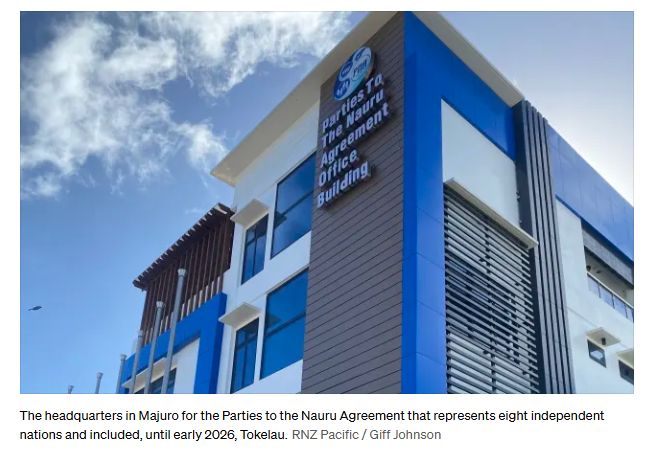
All eight members of
the PNA, established in 1982, are independent Pacific
countries.
“Tokelau’s participation in the PNA
arrangements had been premised on its ability to exercise a
sufficient degree of operational autonomy over the
management of fisheries within its Exclusive Economic Zone,”
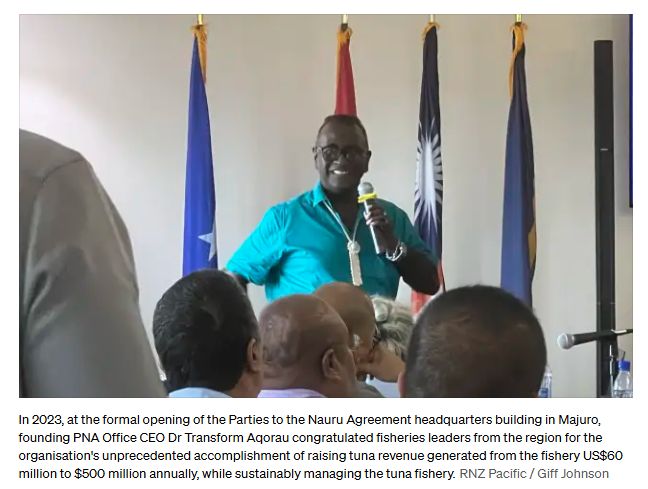
Dr Transform Aqorau, the founding CEO of the PNA Office in
Majuro, said this week.
“This autonomy had enabled
Tokelau to participate directly in the Vessel Day Scheme and
related PNA arrangements, while also supporting its
aspirations for greater economic independence,” he
said.
“However, the position changed when New Zealand
increased its oversight of Tokelau’s fisheries management
and operations. Tokelau advised the PNA that this had
materially constrained its ability to make independent
decisions concerning its fisheries.”
PNA-related
officials note that New Zealand officials have been lobbying
PNA members to reinstate Tokelau since its membership was
ended early this year.
But Aqorau said “the principal
obstacle is not Tokelau itself”.
“Tokelau has been a
valued and respected participant and has benefited
significantly from its involvement in the VDS. The
difficulty arises from New Zealand’s intervention in the
management to Tokelau’s exclusive economic zone and the
conditions it appears to have imposed on Tokelau’s
administration and delegation.”
Kiribati Fisheries and
Ocean Resources Minister Ribanataake Tiwau, who chaired the
PNA in 2025, confirmed this in a November 2025 letter to PNA
ministers from the eight island nation
members.
“Tokelau’s participation with PNA was related
to New Zealand having allowed Tokelau, at the time,
increased autonomy in its fisheries management, with a view
to Tokelau moving toward economic independence,” said Tiwau.
“It seems now, however, that New Zealand has changed its
policy approach from allowing Tokelau increased authority,
back to its status as a non-self-governing territory of New
Zealand.”
PNA leaders in late 2024 and again in 2025
gave Tokelau more time to try to resolve this issue with New
Zealand in order for it to continue its status as a party to
PNA’s Vessel Day Scheme.
“Despite our efforts, Tokelau
has been unable to resolve these issues,” then-Tokelau
Fisheries Minister Otinielu Tuumuli said in a 13 November
2025 letter to the PNA chairman Tiwau from
Kiribati.
“New Zealand has recently increased its
oversight of fisheries management and operations within the
Tokelau EEZ. This development has further limited Tokelau’s
ability to make independent decisions regarding its
fisheries.
“This means that for Tokelau’s continued
participation in the Vessel Day Scheme (VDS), New Zealand
will require a level of access to the VDS, facilitated
either directly by New Zealand officials or through a
Tokelau employee,” the then-Tokelau fisheries minister
said.
“I want to clarify, this is not how Tokelau has
been operating to date – the Fisheries Management Agency and
its advisors have worked to distance themselves from New
Zealand officials’ interference.”
Following the
letters from the Tokelau fisheries minister and the PNA
chair, Kiribati’s fisheries minister Ribanataake Tiwau, a
special meeting of the PNA on 27 November 2025 reached
agreement to draft a termination letter for Tokelau’s
participation in the PNA at the earliest opportunity. It
happened earlier this year.
The then-fisheries
minister of Tokelau, who retired from parliament earlier
this year, said this situation with New Zealand had led to a
wholesale turnover of staff at Tokelau’s Fisheries
Management Agency at the end of 2025.
Feleti Tulafono,
the long-time director of the Fisheries Management Agency,
retired at the end of 2025 and the two fisheries advisors
who had been involved with Tokelau since it took up
membership in the PNA in 2012 also wrapped up their service
to the agency, said Tuumuli.
Aqorau said the issue of
a country outside of the PNA group accessing internal
information and data is a non-starter for all the
parties.
“The PNA is an arrangement among Pacific
Island resource owners and depends upon members being able
to discuss commercially, politically and strategically
sensitive matters in confidence,” he said.
“PNA
countries will be extremely reluctant to reopen Tokelau’s
participation if doing so provides New Zealand, whether
directly or indirectly, with access to internal PNA
information and decision-making.”
All of this is
“regrettable,” Aqorau said, “because Tokelau itself has
contributed positively to the PNA and has derived
considerable economic and institutional benefits from the
VDS. The decision was therefore not intended as a punishment
of Tokelau. Rather, it reflected the practical reality that
Tokelau could no longer participate in the same autonomous
manner in which it had operated previously.”
But the
New Zealand Ministry of Foreign Affairs and Trade suggests
the situation is a matter solely between Tokelau and the
PNA. “We understand the Government of Tokelau is seeking
readmission to the PNA Vessel Day Scheme as a priority,”
said the Ministry of Foreign Affairs and Trade spokesperson
Thursday.
“New Zealand is fully supportive of
Tokelau’s efforts to regain their full participation in the
Scheme.” The spokesperson added that the New Zealand
government “remains committed to its longstanding support of
Tokelau’s participation in the PNA Vessel Day Scheme, which
provides a significant source of income for
Tokelau.”
Aqorau commented on a statement from New
Zealand’s Ministry of Foreign Affairs and Trade that
Tokelau’s participation was “terminated” and that New
Zealand stood ready to support Tokelau in reversing the
decision.
“I would … say that this presents only
part of the picture,” Aqorau said.
“Tokelau’s
participation was terminated because the conditions that had
made its participation possible had fundamentally changed.
Those changes resulted from New Zealand’s increased control
over Tokelau’s fisheries management, not from any hostility
by PNA members towards Tokelau.”
The
former PNA Office CEO says he doubts PNA members will agree
to Tokelau’s return unless New Zealand “restores genuine
operational autonomy” to its fishery sector.
“The
lobbying (by New Zealand officials) may continue, but the
issue goes directly to the integrity, sovereignty and
security of the VDS itself,” he said.
Tokelau has
never publicly disclosed its VDS income, but with an
allocation estimated at 1000 vessel days per year, available
pricing indicates Tokelau earned at least US$8 million per
year, New Zealand journalist Michael Field said in an
article posted to The Pacific Newsroom on Facebook
recently.
This amount was over 40 percent of its
annual budget, Field said.
“For more than a decade,
Tokelau used its tuna-rich waters to build a path toward
economic independence,” Field wrote, adding it appeared “New
Zealand has quietly reversed that course.”
“At stake
is control of a vast Pacific fishery, millions in revenue,
and uncomfortable questions about whether colonial habits
ever really
disappeared.”
New Zealand’s public broadcaster, providing comprehensive NZ news and current affairs, specialist audio features and documentaries.
Radio New Zealand is a Crown entity established under the Radio New Zealand Act 1995. Radio New Zealand News are vital elements in our programming, providing impartial news and information to New Zealanders every day. Radio New Zealand (RNZ) provides listeners with exciting and independent radio programmes in accordance with the Radio New Zealand Charter.