Madrid/At the beginning of 1924, a group of veterans of the ’95 war took up arms in the fields of Cienfuegos. They were commanded by a bad-tempered colonel and doctor named Federico Laredo Brú. President Alfredo Zayas, an old political fox who did not like to waste gunpowder on parades, did not send them the Army. He went himself to the La Pastora farm with a secretary, an assistant and a small leather suitcase that, according to gossip, was full of bills.
Zayas and Don Fico locked themselves alone in a secluded hut; The rebels returned calmly to their homes and never heard a word of what was said between those four walls of board and guano. That rebel colonel learned his lesson better than anyone. Twelve years later he had to sit in the presidential chair to demonstrate that on this island you could also fight the leaders with the patience of a schoolteacher and common sense that was resistant to barracks.
His rise to power occurred through the false door of history. At the end of 1936, the military commanders agreed with Colonel Fulgencio Batista to liquidate President Miguel Mariano Gómez in any way necessary. The House processed the accusation, the Senate issued a ruling of impeachment on the eve of Christmas Eve, and Laredo Brú, who held the vice presidency, assumed the head of state. In the Havana newspapers everyone bet that that old mambí would be a simple Columbia puppet. They missed the shot.
When Batista put his bombastic Three-Year Plan before him, Don Fico weathered the storm by letting it pass without killing the bull or the bullfighter. When Congress and the head of the Army himself tried to impose a murky law on bonds for public works, he imposed a presidential veto without shaking his pulse. The legislators ended up overcoming the veto by a two-thirds vote, and the insular party immediately baptized Senator Guillermo Alonso Pujol as “Mr. Bono” for his hallway maneuvers. From that country entangled between compadrazgos, Creole mischief and long knives came the Constitution of 1940.
That mirror is missing from today’s Cuban opposition, still lost in quarrels, measuring moral purity and distrusting each other more than the dictatorship itself.
That mirror is missing today’s Cuban opposition, still lost in quarrels, measuring moral purity and distrusting each other more than the dictatorship itself that suffocates it. The generation that wrote the Charter of ’40 did not come down from a patriotic altar nor did they live in the limbo of civic virtues. In the same meeting room sat Orestes Ferrara, Gerardo Machado’s chancellor during the worst days of the tyranny, a few meters from Jorge Mañach and the ABC boys, the same ones who had executed Clemente Vázquez Bello and mined the galleries of the Colón cemetery to blow up the entire Machado cabinet during the funeral.
There were Blas Roca and Juan Marinello, disciplined spokesmen of the Soviet doctrine, along with Eduardo Chibás, who just six years ago was asking in the street for the head of Ramón Grau San Martín under the refrain of “Kin Kon, let Ramón go”, and who in 1940 shared a bench with the doctor on 17th Street. They had persecuted each other to the death, they had been imprisoned and they had shot each other. Despite everything, they shared a certainty that today seems forgotten: without a pact between adversaries there is no possible republic, only an endless relay of jailers.
Reconciliation did not start in a parliamentary forum; It began with the return from exile. The repression after the general strike of March 1935 had emptied the country of civic leaders, scattering hundreds of Cubans to the boarding houses of Miami, New York and Mexico. Recently installed in the Palace, Laredo Brú entrusted the Secretary of State to Juan J. Remos. An opposition delegation led by Sergio Carbó and Eusebio Mujal arrived at his office demanding minimum guarantees of return.
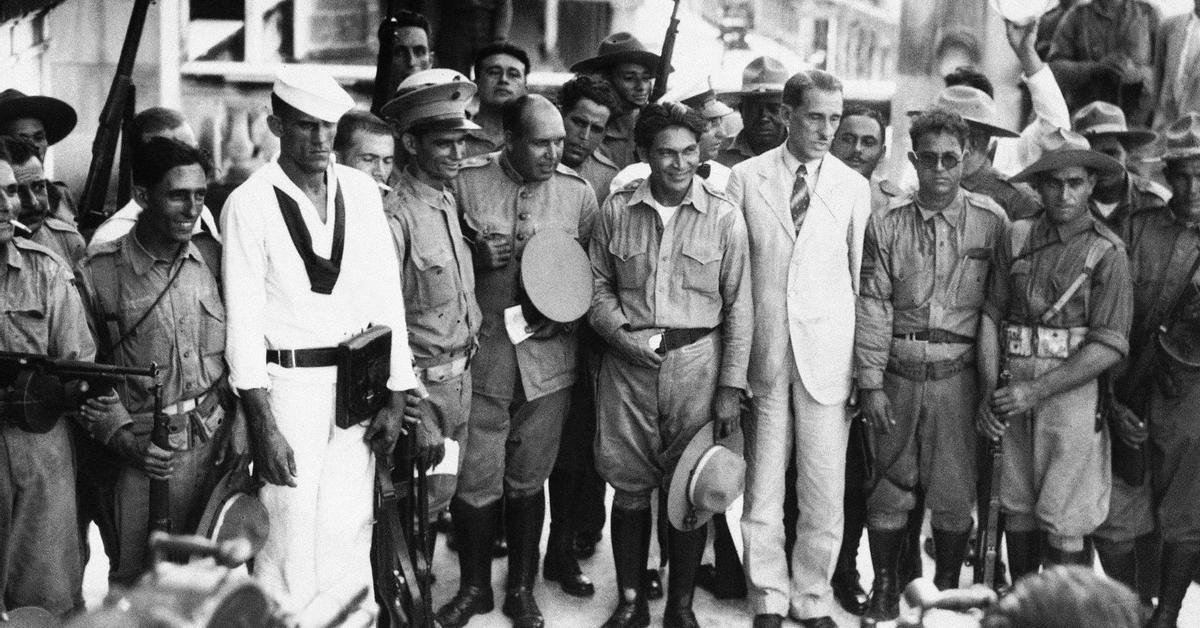
Remos sent two letters, one to the civilian president and the other to the military chief, seated the parties at the same table and published the photograph of the meeting in the national press. The exile began to return. Soon, the Sugar Coordination Law achieved the miracle of bringing the landowners, the settlers and the combative union leader Jesús Menéndez around the same board to set the rules of the milling and wages. The country learned to divide bread before starting to argue about principles.

/ Public domain
The Gordian knot was untied on the Párraga farm, in Wajay. In that country estate, under the discreet arbitration of Laredo Brú, Ramón Grau San Martín and Fulgencio Batista sealed the call for a constituent assembly with a handshake. It took a stomach to sustain that look: Batista had liquidated the ephemeral Grau Government in January 1934 and, since then, the stenographer sergeant turned colonel tutored the residents of the Palace at will. However, both understood the limit of personal acrimony.
The elections were called with full guarantees for all currents, legalizing the communists who until the day before were operating in the shadows. The polls did not grant the crown to anyone; They gave a dispersed majority to the opposition bloc and forced Tyrians and Trojans to discuss every comma and every point of the articles.
The country learned to divide bread before starting to argue about principles
The road was about to break at more than one bend. When the sessions opened in the Capitol, the presidency fell to Grau San Martín. Weeks later, Mario García Menocal’s Democratic-Republican Party broke opposition discipline to lean towards the government side. Grau slammed the door and resigned, threatening to sink the assembly in a swamp of mutual reproaches.
The game was saved by Carlos Márquez Sterling, a pragmatic jurist who knew the labyrinths of regulatory law inside out. Márquez Sterling took the hammer of the presidency, calmed wounded vanities and directed the debates. Even the most rabidly conservative chroniclers of the time had to recognize the height with which Blas Roca and Salvador García Agüero defended their jurisdictions without dynamiting the chamber. The lesson is clear for the present: messianic leaders tend to run aground in processes when the script does not favor them; The continuity of a cause requires clear procedures, respect for forms and men willing to subordinate the ego to collective destiny.
After three months of feverish discussions, no one left the room with the program intact, but neither side left empty-handed. The conservative sectors protected private property, eradicated arbitrary confiscation and demanded prior cash compensation for any expropriation for public utility. The labor bench inscribed in stone the workday of eight hours a day and forty-four hours a week with pay of forty-eight, the month of paid rest and the mandatory judicial file for dismissal.
Women achieved full civil capacity for married women and legal equality for children born out of wedlock. Article 20 declared all discrimination based on sex, race, color or class illegal and punishable. And where the ideological abyss was unbridgeable, the constituents appealed to prudence: they defined the Magna Carta as an index and a program, referring the harshest issues to the development of secondary laws. It was the supreme triumph of agreeing how to continue living in disagreement.
Conservative sectors protected private property, eradicated arbitrary confiscation and demanded prior cash compensation for any expropriation.
That masterpiece of republican consensus carried its own weakness. The Congress of the following years was slow to dictate the complementary laws that should set the machinery in motion: the National Bank, an elemental piece of financial sovereignty, did not see the light of day until the end of 1948. Then, on March 10, 1952, the same Batista who had accepted the civil channel broke his oath and assaulted power with bayonets, opening the crack through which the totalitarian nightmare would later creep in. An agreement without vigilant institutions and without alert citizens sooner or later degenerates into a provisional truce.
That is the living debt that the experience of 1940 owes to today’s Cubans. Inflammatory slogans, tribal revenge or one-man projects are not enough to put an end to this regime. It requires a minimum agreement as lucid and earthly as the one woven on the Párraga farm. This path requires reestablishing bridges with emigration without demanding ideological tolls, because the nation is one or it is nothing.
It also requires designing an institutional solution for the military and bureaucratic establishment, showing them that democracy does not come to exterminate them, but to subject them to civil law. And it forces, above all, to understand that in the future reconstruction no one is superfluous: liberals, social democrats, conservatives, those disillusioned with the system and members of the old regime who accept the rules of the game will have to sit down. There is no need to profess affection; It is enough that they learn to respect each other. In 1940, the Cubans had just shot themselves to death and knew how to re-found the republic. We, faced with the ruins of the present, have no forgiveness if we do not try.