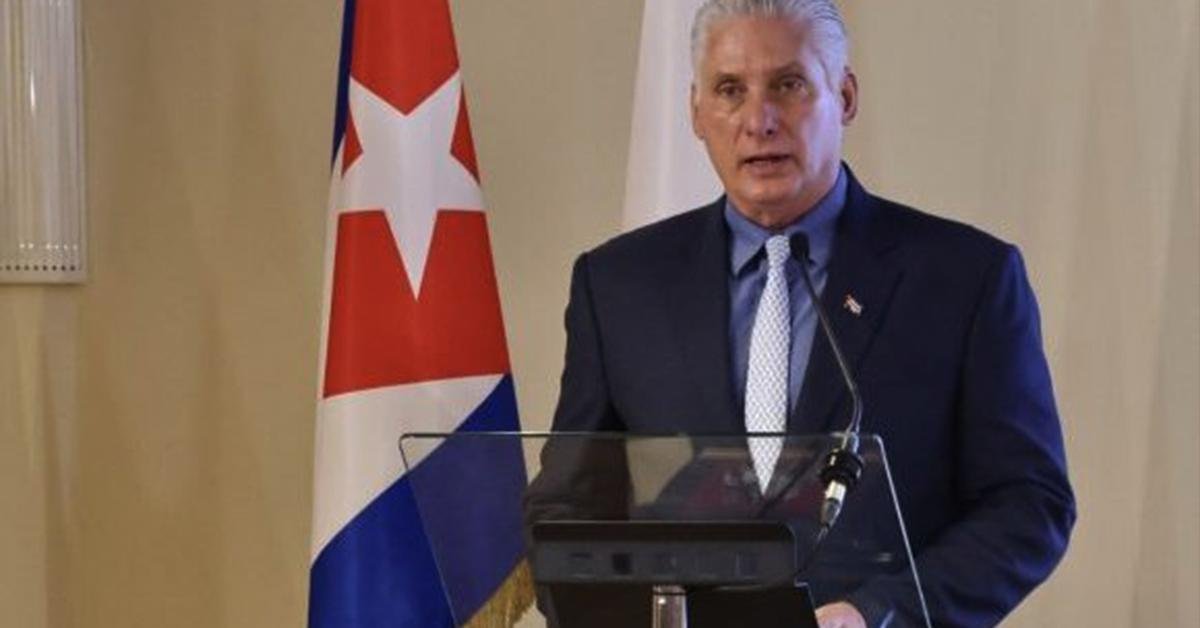
Madrid/The first interview by Miguel Díaz-Canel to an American media since 2023, the prestigious weekly Newsweekdoes not contain any great revelation. Not even at a key moment for relations between both countries, when talks between both countries could lead to a friendly agreement or a “takeover,” as US President Donald Trump has said.
Faced with this possibility, the Cuban president resorts to rhetoric and affirms that, if military aggression occurs, the regime will counterattack, fight and defend itself. “And if we fall in combat, dying for the country is living,” he said, using the motto popularized by the Castro guerrillas during the Revolution. Díaz-Canel gives long answers – the outlet clarifies that he has only lightly edited the transcription to clarify some issues – but he essentially limits himself to repeating what he has said so many times.
He affirms that Cuba wants a good neighborly relationship with the United States and that its Government is willing to reach pacts, but that it is aware that it must prepare for the worst.
“We have a defense doctrine called the ‘war of all the people’, which is not an aggressive doctrine, but a defensive one, with the participation of all the people,” he maintains. However, he adds, “in recent months and weeks, you have heard all this rhetoric from an official representative of the United States Government announcing military aggression against Cuba, establishing deadlines for the duration of the Cuban Revolution and setting deadlines to resist before we are invaded.”
“The loss of life and material destruction would be incalculable. Such an act of aggression would be extremely costly in every sense, and is not what our people deserve”
If that happens, he observes, “the loss of life and material destruction would be incalculable. Such an act of aggression would be extremely costly in every sense, and it is not what our people deserve,” he considers, while highlighting the vulnerable nature of the Island in comparison to American power. “Cuba does not represent a threat to the United States, much less an ‘extraordinary and unusual’ threat, as has been alleged,” he said.
In his opinion, furthermore, the words of the Trump Administration represent full recognition of the hostility towards Cuba. “They say: ‘We have exerted all possible pressure against Cuba,’ thus recognizing the existence of a brutal blockade, which they now deny, and then immediately add: ‘Therefore, our only option is to invade and annihilate it.’” The president also emphasizes that in recent times Washington has held talks with the leaders of Venezuela and Iran to reach agreements and, in the midst of them, has broken the diplomatic channel.
With these precedents, Newsweek He does not hesitate to ask the Cuban president if he sees himself as Nicolás Maduro or Ali Khamenei. “I’m not worried about my personal safety,” he maintains, implying that the system will remain intact even if he is gone. “The leadership of the State, the party and the Cuban Revolution is collective. And decisions are made collectively.”
Díaz-Canel ratifies the closed nature of the regime by highlighting its “monolithic unity”, “ideological cohesion” and “revolutionary discipline”, although he errs in the social diagnosis, without the interviewer questioning, when he speaks of “there is a broad connection with the people”, at a time in which the population has reached such a limit that it is not uncommon to find many already saying out loud that they prefer that anyone – from the United States to China or Russia – administer the country as long as the blackouts.
The Cuban president talks about the issues that are on the table and that are the same ones that he mentioned when he acknowledged conversations with the United States. “We can reach agreements on issues such as migration, security, environment, science and innovation, trade, education, culture and sports. We can also attract investments from American companies to Cuba and develop trade between both countries,” he points out. He also mentions the possibility of cooperating in more economic areas if things prosper, but says that it must always be with respect for sovereignty, the political system and self-determination.
“In American society, there are sectors that are firmly opposed to any type of dialogue with Cuba”
Díaz-Canel believes that more than the US Government, the real obstacle to the negotiations not advancing whenever they occur is, first of all, “in American society, there are sectors that are firmly opposed to any type of dialogue with Cuba”, he alludes, without explicitly mentioning it, to a part of the exile sector opposed to the agreements.
Newsweek He asks the president to evaluate the success of the communist system, observing the current situation in the country, and Díaz Canel admits that it is not possible to feel “completely” satisfied. “We have not yet been able to achieve everything we have dreamed of and envisioned as a nation. We have things to conquer, perfect and advance in, areas where the blockade plays a fundamental role in what afflicts us and holds us back,” he says, after dedicating almost 700 words to praising the “achievements” of the Revolution. In his opinion, however, the greatest achievement is having reached the age of 67 against so many adversaries.
Díaz-Canel only talks about the opposition when he is urged to dedicate a few words to it, but at all times he avoids confronting it dialectically. “There is a lot of media manipulation and a lot of pressure. We are currently facing an ideological, cultural and media war. There is massive media intoxication. A lot of hate has been sown, especially on digital networks. However, we continue to fight, dream and maintain our commitment to the continuous improvement of our socialist construction process,” he concludes before another eternal response about the cosmetic changes that have been approved in recent years and ending with another classic: “What would Cuba be like if it took advantage of its full potential and how much could Cuba contribute to the rest of the world, if it weren’t for that blockade?