Change font size:
Prime Minister Edi Rama accuses Tehran of exploiting anti-government protests over the Trump-linked Zvërnec project, while Iran says Tirana is using it as a scapegoat.
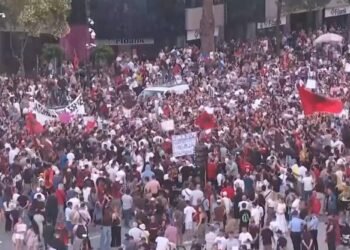
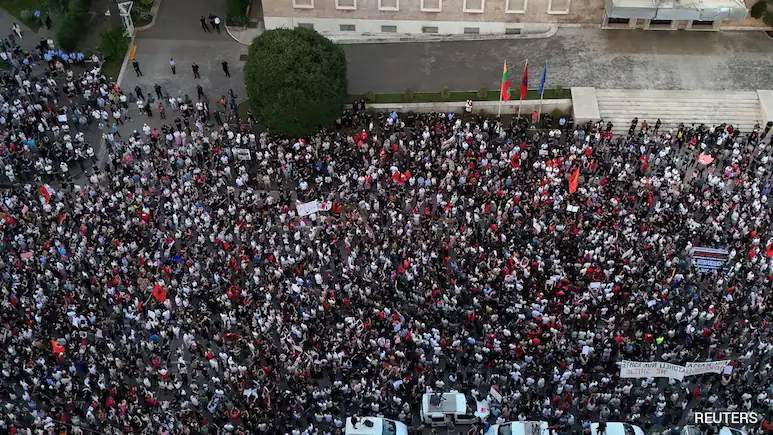
Tirana Times, June 10, 2026. What began as an environmental protest against a controversial tourism project in the protected area of Zvërnec has entered a new, more explosive phase after Prime Minister Edi Rama accused Iran of trying to exploit the demonstrations and turn them into a broader campaign against his government.
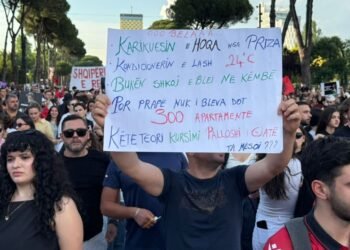
The dispute escalated after Esmaeil Baqaei, the spokesman for Iran’s Foreign Ministry, commented on the protests in Tirana and used slogans heard in the streets, including “No to corruption,” “We want justice” and “Rama go.” Rama responded sharply on X, saying the “government of the ayatollahs in Tehran” had now officially joined the protest.
For Rama, the Iranian reaction was not simply a diplomatic provocation. It was evidence, he said, that foreign actors were trying to use a domestic environmental dispute to damage Albania’s stability, its image as a safe destination for foreign investment and its relations with strategic partners.
The Iranian accusation was not the first attempt by Rama to place the protests in a foreign-policy frame. In the early days of the unrest, the prime minister also appeared to point to Greece, suggesting that Greek media outlets and online platforms with large followings had amplified the protesters’ message and had joined domestic opponents of the Zvërnec project.
In a social media post cited in local reporting, Rama said that, “for the first time in 35 years,” Greek media and pages with millions of followers in Greece had become aligned with what he called “the eagles,” an ironic reference to the protesters. He argued that Albania was aiming for the “Olympus of tourism” through a major investment involving American and Qatari partners, and suggested that opposition to the project was linked to foreign discomfort with Albania’s tourism ambitions.
Analysts have questioned that argument, saying it lacks evidence and risks distracting from the domestic causes of the protests. A senior foreign policy expert at the Albanian Institute for International Studies said the suggestion that Greece would fear competition from Albanian tourism “does not appear to be based on facts and is difficult to take seriously.” Greek media coverage of a large protest in a neighboring country, the expert added, does not in itself amount to interference.
According to a local analyst, the broader narrative of blaming external enemies has deep historical echoes in Albania. It recalls the early 1990s, when, in the final convulsions of the communist regime, the authorities sought to explain domestic unrest by pointing to Albania’s foreign enemies. Critics say the revival of such language today risks deepening polarization and shifting attention away from the central questions raised by the protesters: transparency, public accountability, environmental protection and the rule of law.
The protests have also been described by Elez Biberaj, a longtime former Voice of America editor and analyst, as part of a broader civic awakening rather than a narrow dispute over a single investment project. In an analysis titled Albania’s Civic Awakening: A Year After Rama’s Landslide, the Illusion of Invincibility Breaks, Biberaj argues that the unrest began with concerns over the Zvërnec and Sazan projects but has grown into a wider reckoning with what many citizens see as an unaccountable and exhausted system.
Biberaj writes that the demonstrations are not a referendum on the Trump family and are not a rejection of foreign capital. Rather, he argues, protesters are rejecting the way such projects have been advanced: without sufficient transparency, consultation, environmental safeguards or respect for property rights. In his formulation, the protests are not anti-Trump or anti-American, but anti-kleptocracy.
That reading places the government’s foreign-blame narrative in sharper contrast with the social composition of the protests. Biberaj describes a movement that is not organized by a political party or driven by a single ideology, but by a coalition of students, environmental activists, property owners, workers, pensioners and young professionals. Their demands, he says, revolve around accountability, transparency, the rule of law and a governing model capable of restoring public trust.
For Biberaj, the political significance of the protests lies less in whether they immediately force a change of government than in the fact that they have broken what he calls the illusion of Rama’s invincibility. A society that had grown cynical, he argues, has rediscovered its voice, while a government accustomed to control has been confronted with the limits of that model.
At the center of the controversy is the planned development in Zvërnec, a sensitive coastal area near Vlora. The project has drawn public anger because of its location in a protected natural zone and because of reports linking it to members of the Trump family and foreign investors. For many protesters, the issue has become a symbol of what they see as a wider pattern of opaque decision-making, the capture of public assets and disregard for environmental protection.
But Rama has framed the protests differently. He argues that the original environmental concern has been overtaken by political forces and foreign narratives. In his response to Iran, he said Albania was “too small to fall into this big trap,” warning that the country could scare away foreign investors and fall behind its regional competitors in tourism.
The prime minister also linked the campaign against the Zvërnec project to what he described as anger at Trump. He said international media, groups and individuals were flooding social media with half-truths that were being inflated into “the biggest lies.” His message was clear: opposition to the project, in his view, is no longer only about nature, but also about geopolitics, anti-Trump sentiment and Albania’s position in a polarized international debate.
Rama’s harshest words were reserved for Iran. He said Albania would not take lessons on sovereignty from a government whose operatives, according to him, had been caught carrying out cyberattacks against Albanian public services and institutions — attacks that led Albania to cut diplomatic relations with Tehran. He also accused Iran of using bots, fake profiles and deepfake videos to add “poison” to the digital confusion surrounding the protests.
Iran rejected Rama’s accusations. Baqaei told the Albanian prime minister not to use others as a “scapegoat” and said he should listen to the anger of his own citizens. The Iranian spokesman suggested that the protests reflected genuine public dissatisfaction and accused Rama of trying to avoid responsibility by blaming outside forces.