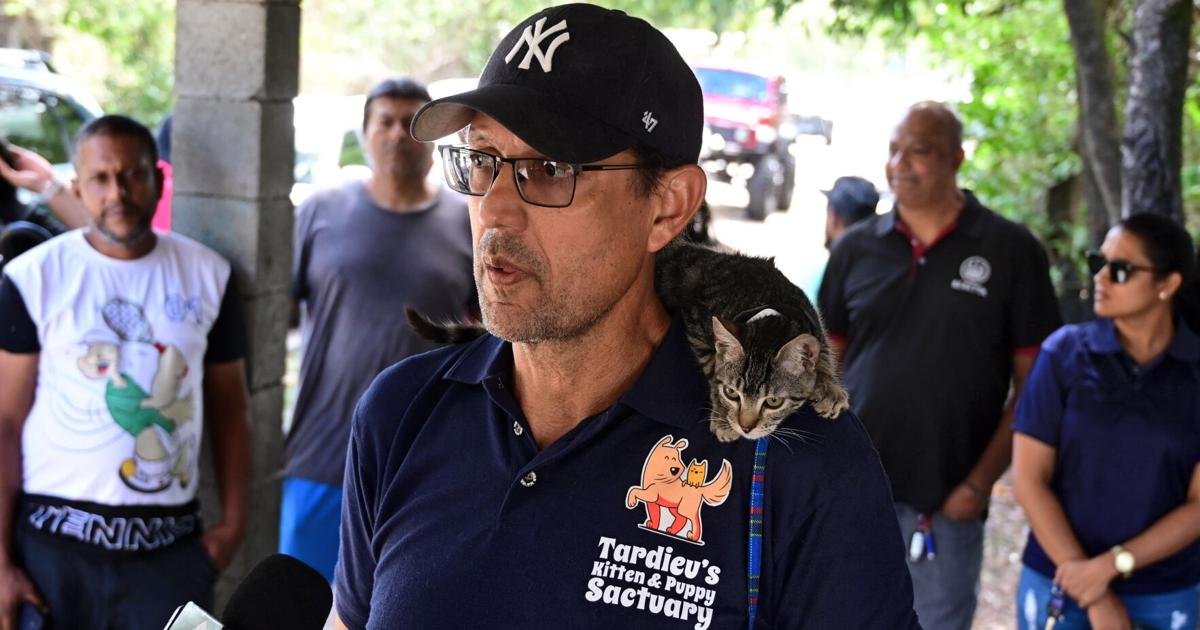
CONCERN over reports that stray cats in Caroni were to be poisoned prompted animal welfare advocates and concerned citizens to gather at the Caroni Bird Sanctuary yesterday, where urgent calls were made for humane and sustainable solutions to address the issue.
Those in attendance warned that poisoning, which had been used in the past, was not only cruel but ultimately ineffective in controlling stray populations. The activists spent their time feeding and rescuing some of the stray cats.
Leading the call of the group of about 12 was Clifford Tardieu of the Tardieu Kitten and Puppy Sanctuary in Valencia, who urged authorities and members of the public to abandon the practice and instead pursue long-term strategies.
Tardieu, who rescued three kittens that had been dumped at the sanctuary mere moments before speaking with the Express, said the animals were vulnerable and unlikely to survive without intervention, describing the act of abandonment as part of a wider, persistent problem. He said the group had heard ‘through the grapevine’ that people had planned to poison the cats that roam the sanctuary.
He cautioned that poisoning caused prolonged suffering, as animals did not die instantly, and warned of its ripple effects on the environment. Scavenging animals, including birds such as vultures and even crabs, could ingest poisoned carcasses and die, while toxic substances could seep into the soil and disrupt the ecosystem.
“So it becomes a trickle-down effect…not just an issue with the cats any more…but one where the entire ecosystem becomes vulnerable because of one action,” he explained.
He also questioned why someone would choose to poison any living creature.

FEEDING TIME: Abandoned cats feed on cat food provided by animal lovers at the Caroni Bird Sanctuary yesterday. —Photos: JERMAINE CRUICKSHANK
“What kind of person poisons an animal? To poison an animal or anyone, you’d have to camouflage the poison with food. That camouflaging, that hiding the taste of the poison, it shows that person is not right upstairs (mentally). It kind of lends itself to an evil background. So somebody who can fool an animal into eating something and actually wanting to kill it can do something else to other animals, or even people or children. So poisoning an animal means that that person has to have that belly…that lack of conscience to poison an animal because it doesn’t die just like that. It takes a long time. It takes a while to die. It suffers,” he stressed.
Tardieu also pointed out that even if the current population of stray cats were eliminated, the problem would quickly return due to continued dumping of unspayed and unneutered animals. He noted that many existing stray cats had already been sterilised, meaning their removal would create space for fertile animals to reproduce rapidly.
Instead, he placed strong emphasis on collaboration between the Government and private sector to develop a network of properly managed animal shelters across Trinidad and Tobago. He said these facilities could provide safe, humane environments for rescued animals while easing the burden on existing rescuers.
He outlined a vision for large, enclosed sanctuaries—potentially the size of a football field—featuring trees and small structures to allow animals to live in more natural surroundings while receiving food, medical care and, where necessary, humane euthanasia for those beyond saving.
“What if we built a little sanctuary, maybe the size of a football field? There is plenty land here…We build an animal sanctuary for all these animals to be housed, not in cages but like a nice big enclosure…and this area is one of the few areas where tourists come with their US dollars and use it as currency. Foreign exchange is brought in by the Caroni Sanctuary. And many of the tourists come and feed these stray animals and interact with them when they are here…For a fee maybe? Not only would it be good for the environment, but it can be a further way to generate revenue. And from there we can get persons who can nourish, medicate, treat, and if it comes to it, perhaps put to sleep (euthanise) the sick and the ones that cannot be saved…wouldn’t that be a better solution than getting rid of the cats via poisoning?” he asked.
Tardieu suggested that multiple sanctuaries located in areas such as Arima, Valencia, San Fernando and Mayaro would help decentralise the system, prevent overcrowding and reduce the likelihood of further dumping in any single location. He added that such facilities could also have tourism value throughout Trinidad, offering visitors an opportunity to engage with animal welfare initiatives.
He stressed that spaying and neutering remained the most effective long-term solution, noting that all 256 cats currently housed at his sanctuary had been sterilised. However, he said many rescuers—estimated at around 100 across Trinidad and Tobago—were struggling due to limited resources.
Tardieu called for increased Government support to offset the cost of spay and neuter programmes, alongside greater private sector involvement to provide funding and logistical assistance.
Bird Sanctuary Tours:
We are not involved
Nanan Caroni Bird Sanctuary Tours, in a Facebook post yesterday, commented on the issue, stating it had been made aware of an alarming situation that may occur regarding the abandoned cats.
“We are in no way involved with that act. We are part of the solution: organising feeding areas, advocating for adoption, supporting monitoring, and facilitating safe access for intervention. That kind of cooperation is essential,” the post stated.
The company reported that it has implemented the Caroni Cat Programme: Trap, Neuter, Return.
“This is combined with veterinary care, monitoring, and collaboration with stakeholders,” the post added.
If you have any information about any harmful acts, please contact us at 681-8274, 681-1671, 776-2046.
On the question of cats being poisoned at Caroni Bird Sanctuary, the company stated, “There is no verified evidence of intentional harm.
“What we do know is that unmanaged populations lead to suffering, and that’s what we are addressing with a structured humane programme,” the post added.
On the high number of cats at the Sanctuary, the company stated this is largely due to abandonment and uncontrolled breeding over time.
“Feeding alone doesn’t solve that. It actually stabilises and can increase numbers if not managed properly,” the post stated.
The company stressed that removal alone doesn’t work and this “creates a vacuum effect where new cats move in”.
“The only proven humane method is sterilisation and population control,” the post stated.
The company said because of the wildlife a programme is needed.
“This is a sensitive ecological site. Managing the cat population protects both the cats and the wildlife,” the post stated.
On the protesters, the company stated, “We share the same concern regarding the welfare of the cats. We’re inviting everyone to work together on a structured, humane solution.”
An official from Nanan Bird Sanctuary told the Express the cat population at the Sanctuary was estimated at between 50 and 75.
A criminal offence
In a press release issued yesterday, the Ministry of Agriculture and Fisheries reminded the public that, pursuant to the Summary Offences Act Chap. 11:02, and the Animals (Diseases and Importation) Act Chap. 67:02, cruelty to animals is a criminal offence.
“The ministry condemns cruelty to animals as it is both heinous and inhumane,” the release stated.
While it did not mention the information relating to the poisoning of cats at the Caroni Sanctuary, it did call on anyone who may have information about animal cruelty to contact the police or the ministry.
“The ministry reiterates its unwavering commitment to the protection and welfare of all animals across Trinidad and Tobago. Members of the public are urged to remain vigilant. Anyone who witnesses acts of animal cruelty or has information regarding intended acts of cruelty to animals is encouraged to report such incidents immediately. Reports can be made to the ministry via the following toll-free numbers: 1-868-877-8888/1-868-877-6253/1-868-772-2474. Alternatively, individuals may contact the Trinidad and Tobago Police Service. The ministry appreciates the continued cooperation of the public in safeguarding animal welfare and ensuring that offenders are held accountable under the law.”