Thomas Greg & Sonsthe company from which Gustavo Petro’s last administration took away the passport business to promote a public scheme in alliance with Portugal, will once again produce travel documents for Colombians.
The Foreign Ministry declared a manifest urgency through Resolution 12973 of September 17, 2026 with the Temporary Union of Travel Documents 2027 for 240,352 million pesos until December 17, 2027.
“We sign a 15-month temporary contract that ensures the issuance of passports under conditions of security, efficiency and reliability. I want to be very precise on this point. This is a temporary solution. “It is clear that our responsibility as a government towards Colombians is permanent,” the chancellor announced this Tuesday. Omar Bula from the Casa de Nariño.
The decision was made due to the provisional suspension of the agreements that support the model between the National Printing Office and the Revolving Fund of the Chancellery, with assistance from the Casa da Moeda of Portugal, an entity that has been producing the notebooks since April 2026 with the support of the French state company IN Groupe. La Imprenta de Colombia had been in charge of personalization, custody, and delivery.
The Administrative Court of Cundinamarca ordered the agreements to be suspended provisionally while it received a detailed report on the implementation of the model. This report was presented jointly by the Printing Press and Portugal and in its content it credits the progress and conclusion of the first phase, however, the Foreign Ministry disauthorized it.
Without there having yet been a substantive decision on the model, the Government of Abelardo De La Espriella went ahead and on September 22 sent a request for a quote to Thomas Greg for the provision of the service of supply, personalization, custody and distribution of the notebooks. On October 14, it received the proposal presented by Thomas Greg together with Thales DIS Colombia SA, under the Temporary Union of Travel Documents 2027. This was approved requesting authorization for future validity.
The Foreign Ministry defends its position by indicating that the fifth ordinal of the ruling of the Court of Cundinamarca ordered the entity to adopt and execute all the administrative and contractual measures necessary to guarantee the uninterrupted provision of the service.
In this sense, the entity assured, through a statement, that the inventory of notebooks will be exhausted in November 2026. In addition, it warned that linking an operator who must certify a plant and register a new design with the International Civil Aviation Organization (ICAO) is a process that takes several months.
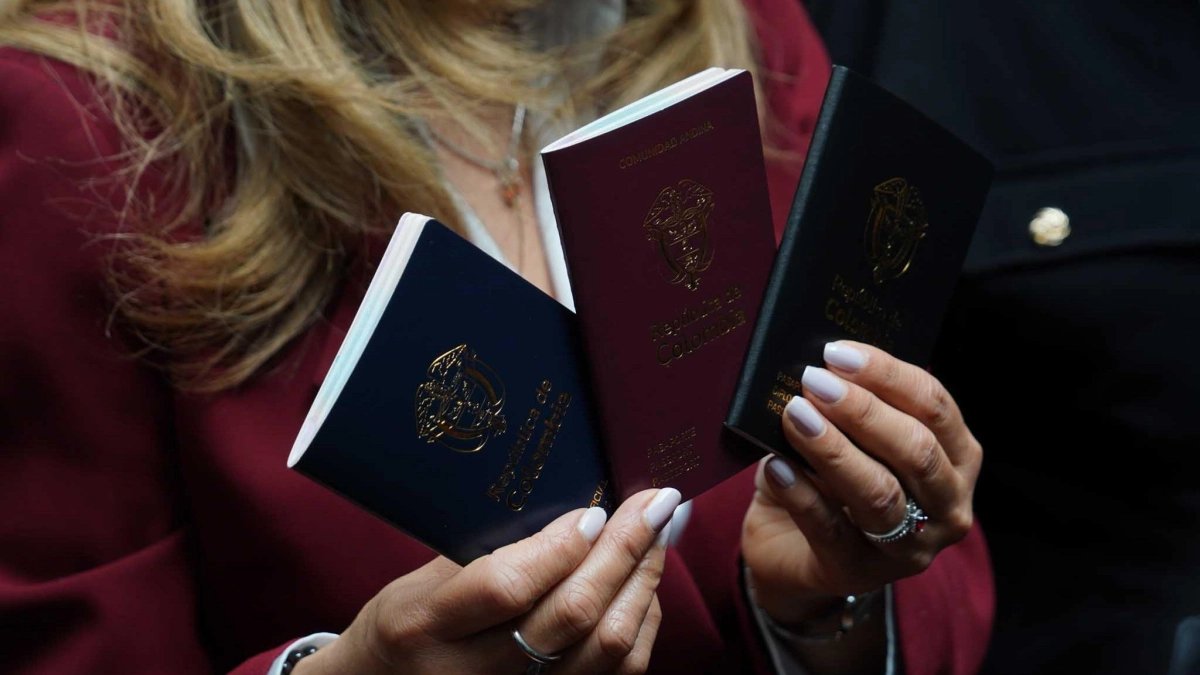
Another of the Government’s justifications is that two Colombian passport designs are currently circulating, both valid. According to the Foreign Ministry, incorporating a third transitional design would force the immigration authorities of other countries to verify three types of documents issued by Colombia.
Likewise, the entity pointed out that the Temporary Union proposal maintains the same unit values from previous periods, without readjustments for inflation or exchange rates. “There is not a single item with an increase and the rates paid by citizens are not modified,” said the Foreign Ministry.
The entity also revealed that the declaration of manifest urgency does not suspend the ordinary public bidding process announced a month ago. In that sense, the measure will remain in force until the Court lifts the precautionary measure or the contractor selected in the ordinary process comes into operation.
“All actions are published in SECOP II and, in accordance with article 43 of Law 80 of 1993. The Foreign Ministry reiterates its commitment to the uninterrupted provision of a service on which millions of Colombians depend,” reads the Ministry’s press release.
Informed sources consulted by this newspaper indicated that an intense legal battle could now begin over the legality of the manifest urgency. Some consider that there would be no legal justification, since there is a contract concluded with the Casa da Moeda of Portugal for the next 10 years and the precautionary measure of the Court of Cundinamarca did not have the scope to terminate the contract, which has already given rise to investments in the Colombian Printing House. In this scenario, the control bodies could review the actions of the Government and the legal bases of the declaration.
The third clause of manifest urgency (Contract No. 959-2026) establishes that any extension will be subject to “the circumstances that gave rise to it subsisting.” The parties may suspend the contract for reasons of force majeure.
This is the fourth manifest urgency that the Foreign Ministry signs with Thomas Greg & Sons in less than four years. During Gustavo Petro’s administration, three were signed with three different foreign ministers (Álvaro Leyva, Luis Gilberto Murillo and Rosa Villavicencio), to ensure continuity in the production and issuance of passports while the model with Portugal was structured.
JUAN PABLO PENAGOS RAMÍREZ
Political Writing