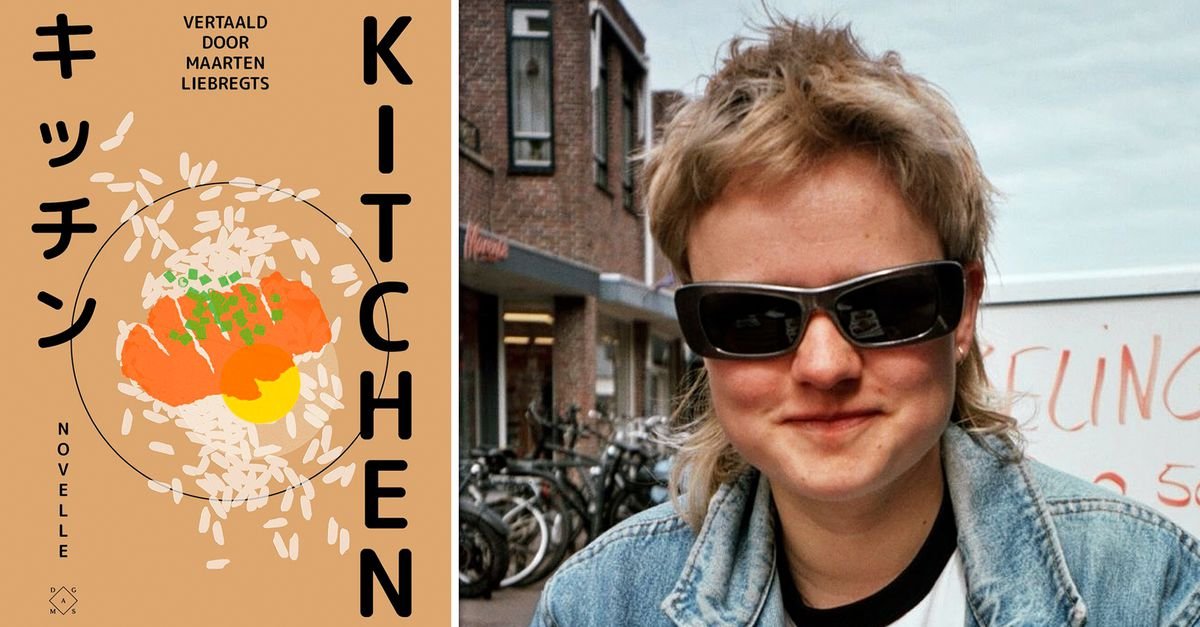
“Then I Kitchen by Banana Yoshimoto, I found that I had lost it, probably because I gave it away so many times to friends. It really is one of my favorite novels. In my new copy I have again dog-eared every three pages. Some people think that’s not allowed, but I think a book should live. You can fold it completely, smell it, feel it. I might as well have given this book one big dog ear.
It is not only a hymn to the kitchen, but also to the feeling of coming home that comes with a kitchen. It’s about habits, getting together, but also about cooking as a way to take care of yourself. I think it’s great that a debut so fearlessly chooses the small. It feels simple, clean and sweet, while Yoshimoto still writes about deep, difficult, human things.
Kitchen is about Mikage, a young woman who mourns her deceased grandmother. She is taken in by a family she doesn’t really know well: a boy who works in the flower shop where her grandmother liked to visit, and his mother Eriko, a trans woman. Eriko is my favorite character. Mikage has clearly never met anyone who is trans and she is so charmed by Eriko that the reader falls completely in love with her. You feel everything: this is someone who makes the world stand still for a moment when she enters somewhere.
Mikage’s story is followed by a shorter novella about Satsuki. A magical event allows her to better understand the loss of her loved one. Mikage’s story is deeply human, Satsuki’s story is more folkloric or spiritual. Together they lift the book into a whole that is greater than a personal account of loss: Yoshimoto describes a world that opens up when you are struck by loss.
This was the third or fourth time I read the book. The first time was in the fall of 2022, just before I moved from Utrecht to Amsterdam. When I lived in Amsterdam I immediately read it again. A few months ago my relationship ended and I moved back from Amsterdam to Utrecht. When I reread the book afterwards, I discovered that I was going through the same kind of process in parallel with the main character: looking for the security of a kitchen or a house.
Kitchen is also a kind of ode to the rituals that you can build up for yourself when you have been affected by a great loss. How to survive against the odds. There is something universal about that. We are used to following stories in which events seem to follow each other coincidentally or randomly, without zooming in on the fact that everything is random – good luck and bad luck. Yashimoto emphasizes that you can choose to continue to see happiness, as long as you continue to allow yourself to do so.
This is an incredibly resilient book and a reading experience that I wish for everyone. I’m going to give this away again. Do you want him?”