The conservative majority on the U.S. Supreme Court has effectively neutralized a hugely significant piece of voting rights legislation designed to ensure African-American representation in Congress, and the resulting consequences could be wide-reaching and election-changing.
In a divided 6-3 decision, the top court ruled Wednesday that a congressional map in Louisiana was unconstitutional because the state gave too much consideration to race when drawing up its voting districts.
The justices ruled that a “minority-majority” district in that state, where most voters are Black, violated the U.S. Constitution’s Equal Protection Clause because it unfairly sorts citizens based on race.
Justice Samuel Alito, writing for the majority in this case, said that while race-based election rules may have been appropriate in the past, there has been “vast social change,” especially in the South, and therefore such considerations are not as necessary now.

Justice Clarence Thomas, who has long railed against race-based laws, said the court’s decision will “largely put an end to this disastrous misadventure in voting-rights jurisprudence,” in which Black voters receive special consideration owing to past Jim Crow-era laws that shut most of them out of the electoral system.
In her dissent for the three liberal justices, meanwhile, Justice Elena Kagan wrote that the court’s “gutting” of election laws puts past Black electoral success “in peril.”
That’s how Matthew Lebo, a political science professor at Western University in London, Ont., sees it, too.
“The most significant voting rights legislation in American history has been made nearly completely impotent,” Lebo said in an interview with CBC News.
“The justices are pretending racism is dead. Well, the effect is the country’s representation is going to look more and more like it used to with discriminatory practices in voting and representation.”
The court’s decision, coming as it does during primary season when party candidates are picked for November’s midterm elections, is sending shockwaves through political circles.
Florida, which was already considering changing its maps to give Republicans even more of an advantage in that state, is now on solid legal ground as it aggressively redraws its districts and dilutes Black voting power.
Indeed, only hours after the court released its decision, the Florida House passed a gerrymandered map.
On Thursday, Louisiana took the extraordinary step of suspending primaries while it weighs new maps that could reduce Black representation. Other Southern states are also considering changes. Overall, as many as 15 House districts currently represented by Black members of Congress could be targeted.
As with many issues in the States, race is a major consideration in politics.
According to a Pew Research report from June 2025, the vast majority of Black voters are Democrats, while Republicans are generally white. Dismantling Black-majority seats could mean fewer Democrats in Congress, which in turn could give President Donald Trump’s party an advantage.
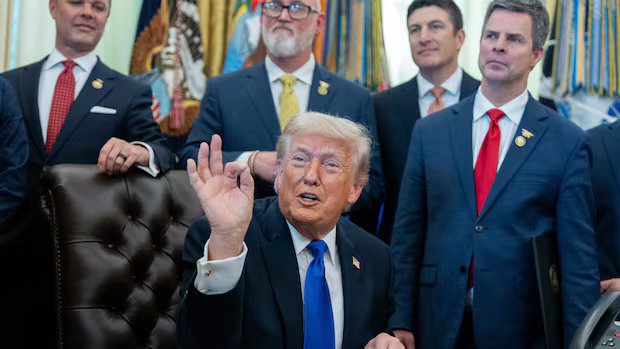
That could explain why Trump was so effusive in his praise of the Supreme Court’s decision. “That’s the kind of ruling I like,” he said.
What is the Voting Rights Act?
Former president Lyndon B. Johnson and his mostly Democratic allies in Congress passed the Voting Rights Act in 1965 as part of a comprehensive package of civil rights legislation to end segregation-era policies that subjugated African-Americans.
The law was designed to force states to uphold the 15th Amendment, which guarantees that the right to vote will not be denied based on race.

Johnson’s bill eliminated discriminatory practices, such as poll taxes and literacy tests, that had prevented most Black people from exercising their right to vote. Although Mississippi had the highest Black population of any state in the 1960s, the U.S. Commission on Civil Rights noted that in 1964, only 6.7 per cent of eligible Black voters were registered to vote.
The law, subsequently rewritten and expanded in 1981, worked as intended: the disparity in registration rates between white and Black voters dropped dramatically in the following decades.
How does this decision change the law?
Wednesday’s Supreme Court decision focuses on one particular part of the act — Section 2 — that allows concerned voters and the federal Department of Justice to challenge redistricting maps and voting laws that deny or dilute the voting power of minority communities.
That section, which guarantees voters the right to “elect representatives of their choice,” allowed for the creation of principally Black districts where voters of colour have a chance to send a Black congressperson to Washington, preventing all-white delegations from states with sizable minority communities.
Over time, more people of colour were elected.
According to figures compiled by the Pew Research Center, the current 119th Congress is more racially and ethnically diverse than any other on record.
But the top court said Section 2 should be more limited in its application moving forward to prevent maps like the one in Louisiana, which has now been deemed “an unconstitutional gerrymander” because race was too much of a factor in deciding its boundaries.
Following Wednesday’s ruling, the only way to invoke the Voting Rights Act and get a judicial remedy is to prove explicit discriminatory intent on the part of those drafting these maps — and that could be difficult.
What’s the practical effect of this decision?
“Now, states can dilute the voting power of a minority population with impunity by spreading them around in all of the various congressional districts,” Lebo said.
“Louisiana will go back and redraw its map, and there will probably be zero minority-majority districts as a result,” he said, predicting that, nationwide, there will be more white lawmakers and fewer from minority communities.

After Texas sparked controversy for securing five additional House seats by redistricting its congressional maps, California responded with some gerrymandering of its own. Andrew Chang breaks down how gerrymandering works and how it could affect the outcome of the 2026 midterm elections.
Images provided by The Canadian Press, Reuters and Getty Images
In places where Black voting power cannot be entirely diluted, Lebo said GOP-controlled states will probably pursue “packing” instead.
That’s the concept of drawing up districts that “pack” Black voters into as few districts as possible so that most seats have a white majority and are, in turn, more reliably Republican.
Florida’s new congressional district maps make changes along these lines.
The state’s boundary overhaul disperses Democratic voters into areas where Republicans are dominant, giving the centre-left party less of a chance.
If past patterns hold, the changes there could give Republicans 24 of the state’s 28 congressional seats.

What do the candidates say?
In an interview with CBC News, Democratic candidate Allen Spence, who is running for Congress in southwest Florida, says candidates like him are on edge.
Florida’s new districts were hastily drawn without public input and a court challenge is still possible. He doesn’t really know where to campaign right now because the boundaries are so uncertain.
Overnight, areas that looked like friendly territory for him, like majority-Hispanic Lehigh Acres near Ft. Myers, Fla., were removed from his district, he said, while others where he hasn’t had much of a presence were added.
“It’s very hard to run a campaign,” he said. “Candidates really don’t have any certainty.”

Spence says the Democrats need to prompt an electoral “revolution at the ballot box” to swamp the Republicans and pass national legislation banning gerrymandering altogether.
“We need to get these people out, that’s what I want,” he said of the Republicans.
Others see the Supreme Court’s decision as a noble effort to remove race from politics.
Josh Williams, a Black Republican running to represent a majority-white district in Ohio in Congress, said the idea that Black people need “special districts carved out just for them is complete nonsense.”
“It’s a violation of the law and blatantly unconstitutional,” he said in a social media post.

Where else could this have an impact?
Besides Florida and Louisiana, other Southern states are weighing changes to their maps to eliminate Black-majority districts, hoping the GOP can gain more seats and stave off electoral ruin in the midterms, even with recent polls suggesting that Trump’s approval rating is at a record low for his second term.
Sen. Marsha Blackburn of Tennessee, who is running for governor, urged Republicans in her state to give themselves another district there.
“I’ve vowed to keep Tennessee a red state, and as Governor, I’ll do everything I can to make this map a reality,” she said, posting an image of a map where the majority-Black district in Memphis, Tenn., is gone and the Democrats are entirely wiped out.
Other states that Democrats fear could be targeted include Alabama and Mississippi.