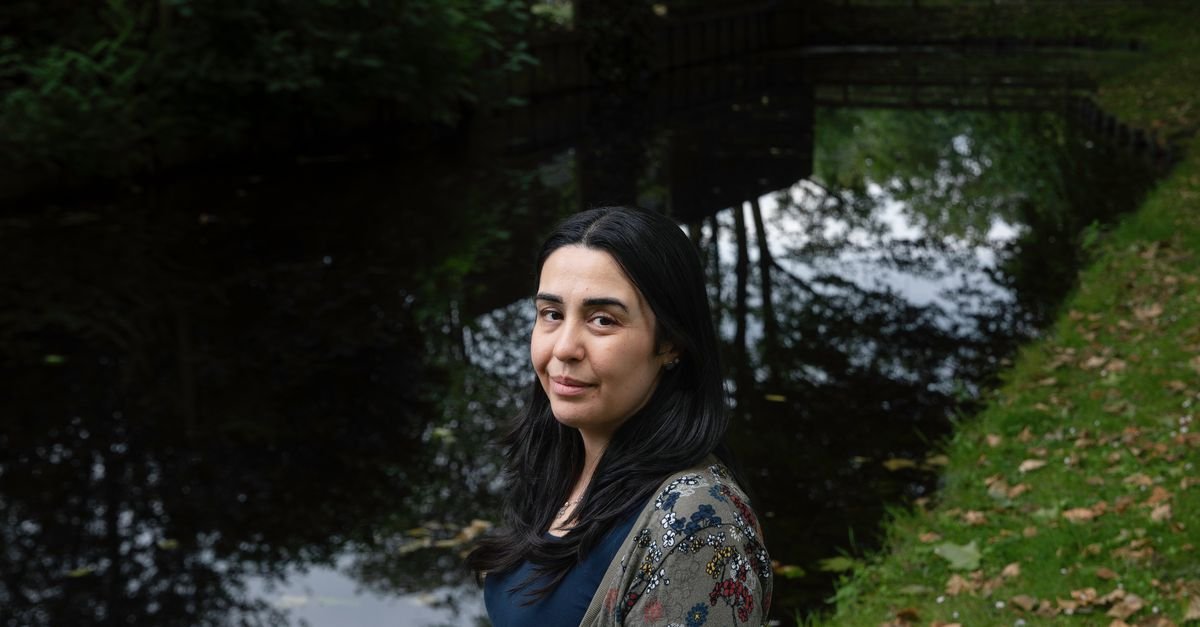
Every evening, Walaa video calls her daughters in Syria. The eldest is ten, the youngest four. Sometimes her youngest looks at the screen in silence. “I have been away for so long now,” says Walaa, as she drinks a glass of orange juice in a snack bar in a shopping center in Gouda, “that the youngest is starting to forget me.”
The 38-year-old mother thought she was doing something good for her family when she left Syria in 2024. The plan was simple: first get asylum in the Netherlands, then bring her husband and two daughters over. “That’s how it always went, with other Syrians,” she says. “One travels forward, then you apply for family reunification.” Usually the men traveled forward. But because Walaa managed to get a European study visa and her husband did not, she went.
COA and aid organization Vluchtelingenwerk are very concerned about the impact this will have on asylum seekers like Walaa
Two and a half years after her arrival, Walaa still lives in an asylum seeker center and is still waiting for her second hearing at the Immigration and Naturalization Service (IND). After she arrived, the Assad regime fell in Syria. The Netherlands halted the assessment of applications from Syria. She’s been waiting ever since.
From Friday the wait will be even longer.
The European Migration Pact will then come into effect, the largest reform of the European asylum system in a quarter of a century. The intention is to process new asylum applications much faster. But for applicants who are already in the Netherlands, a total of approximately fifty thousand asylum seekers, the pact has the opposite effect.
Also read
The Senate agrees to the EU migration pact and stricter national rules, asylum seekers will already notice this in mid-June
:format(webp)/s3/static.nrc.nl/wp-content/uploads/2026/05/26190534/260526VER_2034003010_-1.jpg)
New applications are given priority
The IND will give priority to new asylum applications submitted from June 12, under the new rules of the pact. Shorter decision periods apply. Only a quarter of the available IND employees are still allowed to deal with the fifty thousand ‘old’ cases that have already been submitted. The waiting times for these cases will therefore increase further. Minister Bart van den Brink (Asylum, CDA) has said that it will take another three years before the entire overdue ‘stock’ is cleared.
It is, said a COA supervisor this week A.Das if you have a store with an old cash register with a long line of frustrated customers in front of it. And that a new, super-fast cash register will also be installed, but this is only intended for customers who have just entered the store.
COA and the aid organization Vluchtelingenwerk are very concerned about the impact this will have on asylum seekers like Walaa, who will be hit twice. In addition to waiting even longer, they will also have to deal with stricter rules.
Everything I hear is always bad news. So I close my ears, I just ignore it
She has already heard, says Walaa in the snack bar, that it will all become more difficult for her. She tries to think about it as little as possible. “Everything I hear is always bad news. So I close my ears, I just ignore it. Otherwise I won’t be able to cope.”
She tries to clear her thoughts by working; she sends the money she earns to her family. Her husband earns around 90 euros per month in Syria.
She feels at home in Gouda. “They are nice to new people here,” she says. “I now have more Dutch friends than Arab ones.” She made it in the De Walvis community center, where she volunteered to cook for the elderly. “They were so kind to me, some of the elderly even started learning English so they could talk to me.”
Meanwhile, problems at home are increasing. “In Syria they know that I am here alone. They talk to my husband about it. ‘Why is your wife there and do you have to take care of the daughters?’, his family asks. The more they talk, the more frustrated he becomes.” Walaa explained to her husband “that we are now at the back of the queue in the Netherlands”.
Also read
The IND is not making any decisions on Syrian asylum applications for the time being. What does this ‘decision stop’ mean for Syrians?
:format(webp)/s3/static.nrc.nl/wp-content/uploads/2024/12/10170211/data125448545-0a0647.jpg)
Looking for A status
The introduction of the migration pact has major consequences for Walaa’s desire to bring her family to the Netherlands. First she must be granted asylum. This has become increasingly difficult for Syrians since the end of the war: only 6 percent of applications are granted. Walaa could well belong to the exceptional group: she belongs to a small religious minority, the Ismailis, who are still in danger in Syria.
If she were granted asylum on this basis, it would have meant that she could be reunited with her family in the Netherlands until Friday. But the introduction of the migration pact changes that. This will give the Netherlands a ‘two-status system’, which divides refugees into two groups. People who are personally at risk of persecution in their country are given A status. They can still bring their families over. People who are granted asylum because the situation in their country is unsafe, without being persecuted themselves, are given a B status. And for that group – which varies from a third to a half of all recognized refugees – family reunification is being restricted.
:format(webp)/s3/static.nrc.nl/wp-content/uploads/2026/06/08154910/090626BIN_2034224239_walaa4.jpg)
Walaa hopes to qualify for A status.
Photo Hedayatullah Amid
They must first wait two years before they can even submit an application for family reunification. After that, they must still have their own income and a home. Many refugees will not be able to meet these conditions.
For Walaa it is a prospect she does not want to think about. “I have to have an A status,” she says. She has therefore given an additional reason for her flight. She is also said to have had a conflict in Syria with a fighter from an Islamic militia, who is said to still pursue her. She is still looking for old police documents to prove the conflict. This would also put her at personal risk, which would make her eligible for A status.
That is exactly what the IND and the judiciary have warned about. Due to the big difference between A and B refugees, everyone will soon want to be an ‘A’. While previously only rejected asylum seekers appealed against the IND, it is expected that people who are granted asylum will soon also continue to pursue legal proceedings for a better status. This will make courts, asylum lawyers and the IND much busier. The IND assumes that three-quarters of all B refugees will go to court. The judiciary expects 19,000 additional cases per year as a result of the migration pact, including the new status system.
For now, Walaa can do nothing but wait. “I am increasingly worried about my family, because it is not safe for them in Syria.” One day the wait will be over, she says. That’s also what she says to her daughters. “Every night I promise them: if you wait long enough, you will be here with me.”
Also read
The Senate ‘takes the plunge’ and expects ‘a lot of misery’, but almost certainly supports the European Asylum and Migration Pact
:format(webp)/s3/static.nrc.nl/wp-content/uploads/2026/05/19162650/190526DEN_2033841427_migratiepact2.jpg)