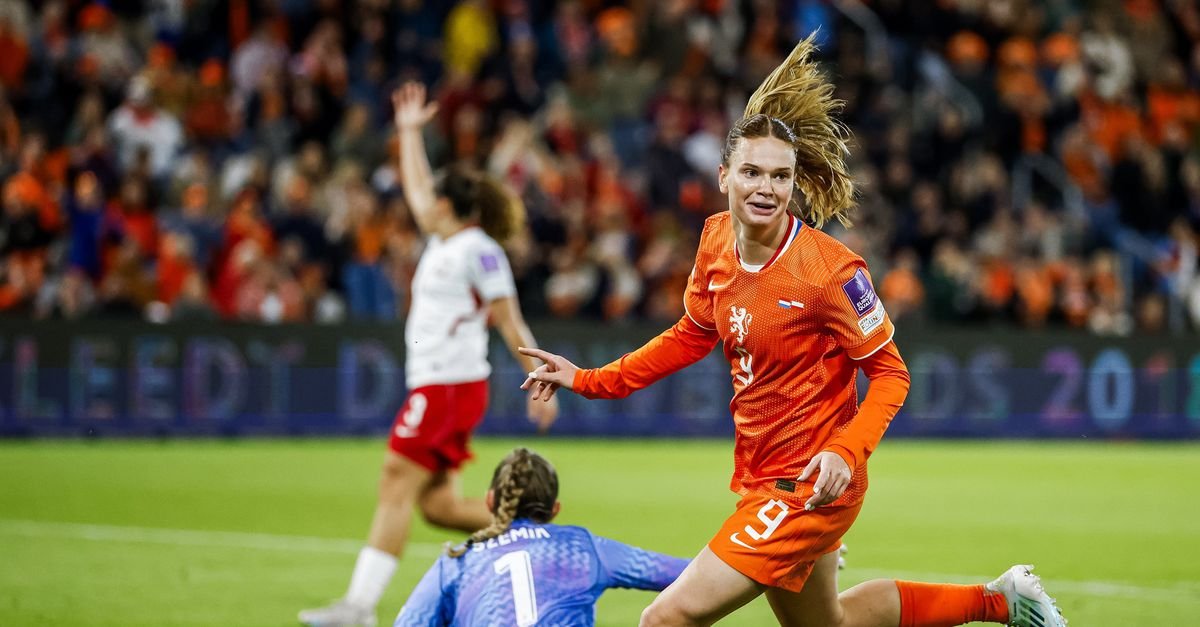
Until a week ago, the Dutch national team was still in excellent shape, but after the last two group matches in the World Cup qualification, the Dutch team failed to qualify directly for the final tournament in Brazil next year.
After the unexpected good performance against highly regarded France in April – a win and a draw – the Netherlands was the leader in the group and then had the fastest route to the World Cup in its own hands. The team of national coach Arjan Veurink only had to win the last two group matches.
But that’s where things went wrong just as unexpectedly. Last Friday, the Dutch team suffered a painful defeat against Ireland with poor play. In Cork it became 3-2. Because France won 2-0 against Poland, the Netherlands suddenly found themselves third in the group.
There was a theoretical rematch on Tuesday evening, at home against Poland in the Heracles stadium in Almelo. In a much better match they won convincingly – 3-1. But because France also managed to win its last match, at home against Ireland (1-0), this was not enough to regain the lead and therefore force direct qualification. Moreover, the Netherlands had also lost valuable points in the home match against Poland (2-2) at the beginning of March. “We left it behind on several occasions,” said national coach Veurink afterwards.
Damner on the lightning start
Although there are still plenty of opportunities to qualify for the World Cup in Brazil – next autumn there will be play-offs for all three teams that finished under France – the unexpected misstep against Ireland was a dampener on the lightning start that Arjan Veurink made with his partially renewed Oranje.
After obtaining the European title with England last year in Switzerland – he was the assistant of success coach Sarina Wiegman for many years – it was up to 39-year-old Veurink to do it for the Netherlands failed EC rinse away quickly. Months before that tournament, he had been recruited by the KNVB to succeed Andries Jonker immediately after the European Championship.
Veurink started his campaign energeticwhere he resolved to give young talents the opportunity to prove themselves in the Dutch team. From his first practice matches in the autumn, he wanted to build a new team that was capable of competing with the world’s top within two years.
The new national coach regularly called up young players, who had sometimes already been tried out by his predecessor Jonker. And he had six talents make their debut in the ten matches under his leadership. Especially in the two games against France, it was clear that the new guard showed more enthusiasm and courage than some of the more experienced players. Veurink had been forced to do this because no fewer than seven stars had been injured.
Also read
With two 19-year-olds in defense, the battered Dutch team manages to pull off a stunt against superpower France
:format(webp)/s3/static.nrc.nl/wp-content/uploads/2026/04/14225026/140426SPO_2033002290_Oranje3.jpg)
Dilemma between young and old
During the matches of the past few days it became clear that Veurink does not really want to make a decision about his ideal starting eleven. On Friday against Ireland, he again relied on his recovered captain Dominique Janssen (31 years old, 136 international matches) in the heart of the defense, at the expense of the only 19-year-old Renée van Asten who had done so well against France. The defeat was certainly not solely her fault, but it was also visible that Janssen was not always completely sharp and sometimes reacted too slowly when the Irish broke out.
Janssen was allowed to start again in the first half on Tuesday evening against Poland. And although the Dutch team got off to a good start, with good combination play, danger up front, often fed by the emerging wingers Lynn Wilms and Marisa Olislagers, it was striking that Janssen was again sometimes sloppy in her passing and ball controls.
Despite many beautiful, dangerous attacks, the Netherlands found it difficult to score. It only worked once in the first half, with two other exponents of the new Orange playing a leading role. On a cross from 22-year-old left winger Esmée Brugts, the energetic midfielder Wieke Kaptein (20) headed in nicely and hard.
Immediately at the start of the second half, national coach Veurink chose to change captain Janssen – she was replaced by her now biggest and youngest competitor in defense: Renée van Asten. And it quickly became apparent that the Dutch team was playing more energetically.
Another substitution, after 75 minutes, also marks the dilemma facing the new national coach: the experienced Lineth Beerensteyn (29 years old, 125 international matches) was replaced by Liz Rijsbergen. The 24-year-old PSV attacker had previously been called up for the selection, but only made her debut in Ireland on Friday evening. This evening in Almelo she impressed again with her work ethic and drive for the goal. On a beautiful through ball from Kaptein – outside the shoe – Rijsbergen managed to score the 3-0 six minutes after coming on.
The national coach himself sees the choices between old and new, between experienced and young, as a gift rather than a problem. He speaks of a “luxury position”, with multiple choices for different positions on the field, he said afterwards at his press conference. Such as “the battle” between Dominique Janssen and Renée van Asten in the center back. “That is nice and good and belongs to a team in transition.”
Esmée Brugts, who won the Champions League with Barcelona two weeks ago, also sees the emergence of new, strong players as an advantage. “The coach does indeed have a luxury problem, but that is actually a good thing. The fact that the young girls can come along so well makes me very happy and shows that we have a very bright future.”