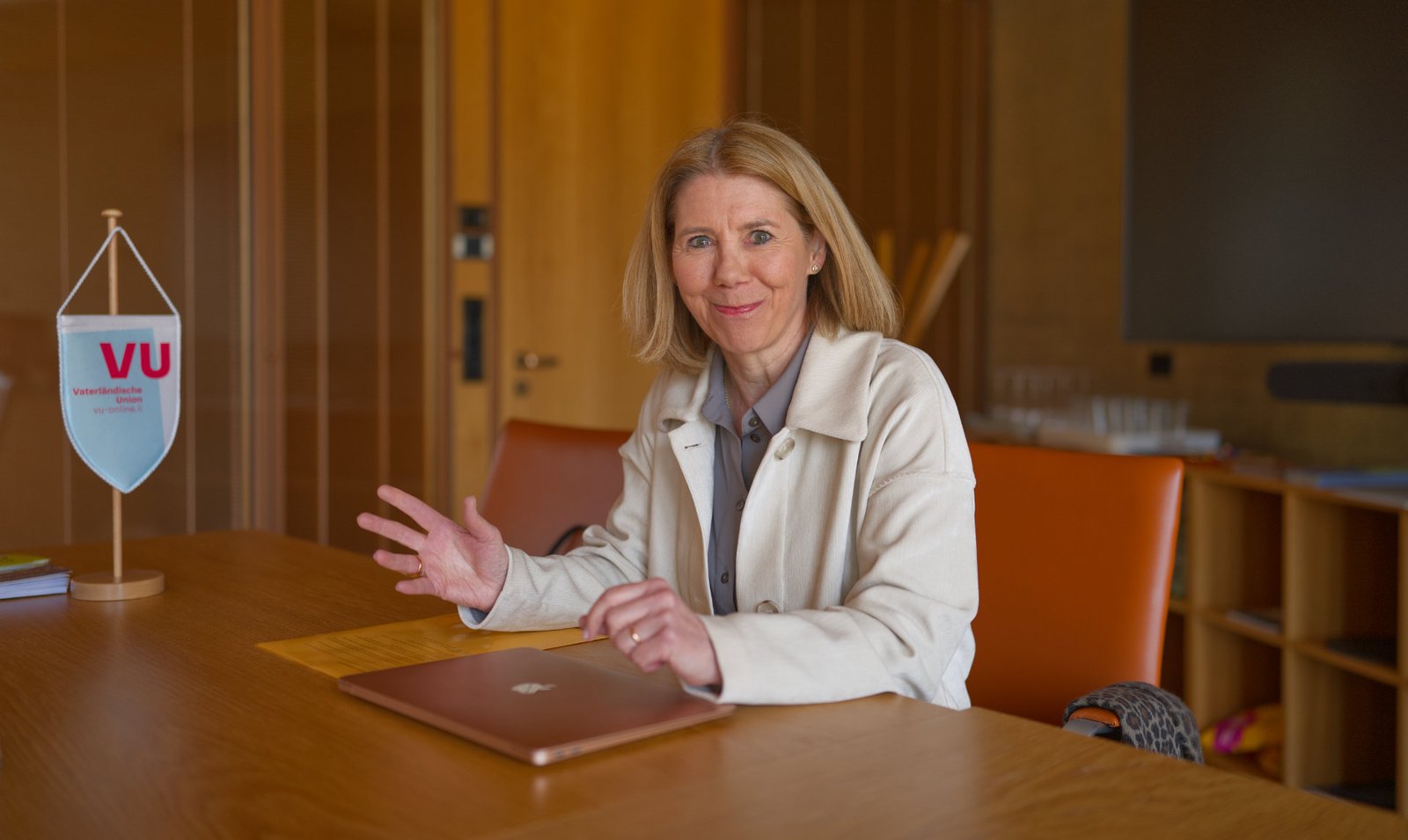
A year ago, Dagmar Bühler-Nigsch took over the position of parliamentary group spokeswoman for the Fatherland Union. In the interview, she takes stock: about a well-organized parliamentary group, hot debates – and about what she has planned for the remaining three years.
Dagmar Bühler-Nigsch had four years of experience in the state parliament when she took up the position of VU parliamentary group spokeswoman in spring 2025. The new role brought new tasks – and a good start, as she says today.
“You can say that the start of the new faction was successful. The VU group is well organized and structured in the way we work. I think all group members have found their place.”
The parliamentary group deliberately acted cautiously in submitting proposals in the first few months: they wanted to give the new government time to get used to it. «It was important to us that we let the government get there«, explains Bühler-Nigsch. At the same time, it was also important to form the newly formed parliamentary group – with experienced heads and fresh faces – as a working unit.
She was positively surprised by the pace of the new ones: «I was really happy about how quickly and how actively the new guys learned the ropes.» Within a very short time, the newly elected representatives got involved in debates and worked out their topics.
Broad expertise in the group
According to Bühler-Nigsch, what particularly strengthens the group is the thematic breadth of its members. It is made up of experienced representatives who have been in the state parliament for a long time, but also have expertise in financial and regulatory issues as well as in education and socio-political issues.
«It’s a good feeling when you know you have the competence. We are particularly broadly positioned in education, social policy, finance and law.«
This mix, she emphasizes, cannot be planned: «You have no control over who is ultimately elected.» She is confident that the composition turned out so well.
Not everything went smoothly from the start. There could have been better coordination between the parties when allocating commissions and delegations at the opening of the state parliament. The DpL parliamentary group had accused the VU of not having sufficiently discussed seating arrangements.
“Everyone should have sat down at the table and done the division together. Things like that can still be optimized.”
She maintains that partisan political wrangling on such issues is not in her interest. Adapting the state parliament’s rules of procedure could also provide more clarity here.
Cooperation in the state parliament: trust is growing
The cooperation between the factions has developed positively. «IOn the whole it works well« says Bühler-Nigsch.
An unexpected sign of cross-party cooperation was the joint postulate of the VU and DpL for the preservation of the Steg customs house, which the government wanted to sell. Bühler-Nigsch makes it clear: It was not a political signal, but rather politically based. In addition to Roger Schädler, Sebastian Gassner (FBP) and Marion Kindle-Kühnis (DpL) also actively contributed to the state parliament debate, so the postulate emerged from this and all three parties were invited to take part.
Unlike the coalition partner, Bühler-Nigsch is in favor of restraint in introducing proposals. She warns against a rush to transfer money: “You should only submit proposals if you see real added value – and not unnecessarily burden the government and administration with additional resources.
The aim of the opposition is to make a name for itself through initiatives and to put their issues on the agenda – that is their job. The coalition, on the other hand, should support the government and constructively point out the need for improvement.
State parliament reform: report available
The reform of the state parliament is a matter close to Bühler-Nigsch’s heart. There is currently a report from experts that is now going through the parliamentary groups. The state parliament presidium then decides on how to proceed and whether a separate commission should advance the issue.
«We would like to take concrete steps. I am confident and really hope that we can make some progress in this legislature.«
The central element for them: the adjustment of the state parliament’s rules of procedure – in order to create more transparency, more efficiency and clearer rules of the game.
State Hospital: Stopping was the right thing to do
The state hospital was the topic of the most recent state parliament session – there was a debate for four hours. Bühler-Nigsch supports the government’s decision to pause the project and re-examine the site.
Three years ago, in May 2023, there was a variant report that also provided for a cancellation and restart. At that time, planning costs of 3 million francs were incurred. “That would have been the right time to call it quits,” says Bühler-Nigsch. The planning costs would now be 4.7 million francs.
The analysis until autumn 2026 is sensible and justifiable. Then a clear decision is needed: «I don’t want compromises. A hospital must be created that really impresses us. Otherwise it will always catch up with us.«
Transport policy: Unterland needs answers
The first blast for the city tunnel took place in Feldkirch last Friday. When this is completed, traffic in the Liechtenstein lowlands will be massively changed. This is a central issue for Bühler-Nigsch.
«We can’t just see the big picture – we also need short-term measures.«
She expects concrete proposals from the Ministry of Infrastructure – within the framework of the existing mobility concept 2030, but also beyond. As an example, she cites the two-lane expansion of the Rhine bridge in Vaduz or relief in Bendern as possible relief measures.
Outlook: Less bureaucracy, more progress
Bühler-Nigsch has clear priorities for the remaining three years: advance the state hospital and state library, implement solutions for traffic relief, state parliament reform – and reduce bureaucracy in projects that have already been decided.
Specifically, she names projects in Malbun, the cross-country skiing center in Steg, and the climbing hall in Vaduz. All legally approved projects – which are nevertheless repeatedly complicated and delayed by requirements, especially from the Office for the Environment.
«Malbun is no longer an untouched landscape. There have already been interventions. This is our sports facility »
Bühler-Nigsch would like to see a more differentiated approach: projects should be able to move forward in areas that have already been developed. In untouched landscapes, however, the hurdles may be high. «I hope that we have less bureaucracy and don’t get in each other’s way.«