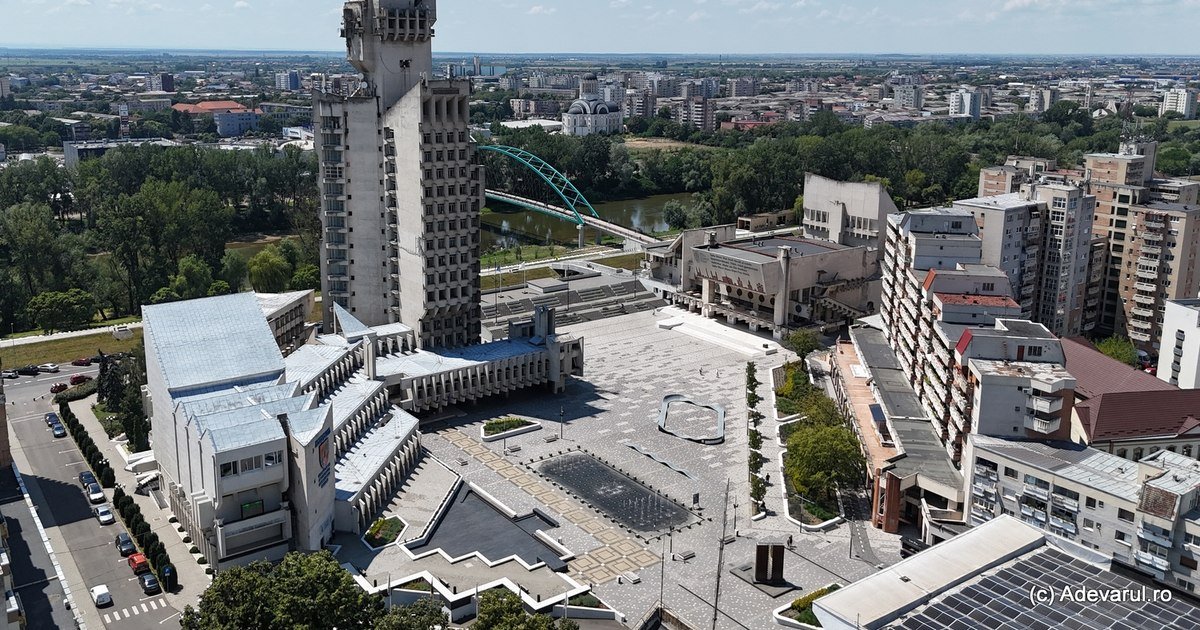
The tallest administrative building in Romania has dominated the panorama of the city of Satu Mare for four decades. Over 1,000 people worked on the construction of the palace on the bank of the Someș, almost 100 meters high.
The administrative palace in Satu Mare reaches almost 100 meters. Photo: Daniel Guță. TRUTH
The tallest administrative building in Romania dominates the panorama of the municipality of Satu Mare, located near Romania’s northwestern borders with Hungary and Ukraine. The story of the “palace” in Satu Mare began in the 70s, and four decades after its completion, the building remained a landmark of modernist socialist architecture.
The 70s represented for the community of Satu Mare one of the most dramatic periods in the city’s history. On May 14, 1970, the floods on Someș devastated the town and caused almost 60 victims. However, the same decade was also a period of reconstruction, which brought the city from the northwest of Romania one of the most extensive urban transformations in its history.
The center of the city of Satu Mare, rebuilt after the floods
A new civic center was built between 1972 and 1987 in the vicinity of the old city center dominated by the Roman Catholic Cathedral, built in the early 1900s.
The urban complex was designed by the architect Nicolae Porumbescu-Vaida and included a house of culture with 800 seats, an outdoor amphitheater, commercial spaces and new blocks with over 1,000 apartments. In its center stands the Administrative Palace, the political and administrative headquarters of the new Satu Mare county, a building with brutalist architecture, 97 meters high and with over 20 floors, completed in 1986.
“The PCR directives were very clearly drawn to the designers, in the sense that the Administrative Palace had to be built on the banks of the Someş River and was to be the political and administrative headquarters of the county. So, the works started in 1972, on the established site, but the builders faced problems right from the beginning. The area where the building was to be built was a sandy one and had to be consolidated. After all these problems were solved, they moved on to pouring the foundation. This ended after two years. The project continued with the construction of the actual building, which was supposed to reflect the harmony in which the ethnic Hungarians, Germans and Romanians live in the lands. This is also symbolized by the three towers of the palace.” noted researcher Claudiu Porumbacean, in a presentation published by the Satu Mare County Council.
The building – metaphor on the bank of Someș
Construction style, specific to many emblematic buildings erected at that time in the Eastern European states, it was inspired by the Brutalist current, which appeared in the early 50s in Great Britain, in the reconstruction projects after the Second World War.
It was later adopted by the socialist countries and reinterpreted in Romania by established architects, such as Nicolae Porumbescu and Mircea Alifanti, who added a local specificity.
“I had to “plaster” the surrounding space, think of it in metaphors, calculate its voids, which it must inevitably contain, to be filled with futurity. Life must not be wasted, the profession of an architect is a continuous plea for efficiency and form. Man must stand straight, not be bent by anyone or anything. Then comes the vertical of the construction, the vertical of the lark. In by the way, I’d like the lark to make its nest up there on the city tower, have you seen it?” architect Nicolae Porumbescu-Vaida reported in 1986.
Brutalism, embraced by Romanian architects
Some specialists considered the New Center in Satu Mare one of the most successful urban interventions made during the communist period. The art critic Constantin Hostiuc appreciated that the massive volumes of the buildings do not attack the surrounding space, but enter into a dialogue with the old center and become landmarks of the city. He noted the use of warm colors, wide windows and motifs inspired by traditional architecture, such as the peasant pitchfork, integrated by Nicolae Porumbescu-Vaida as a symbolic element of the ensemble.
Image 1/5:
Images from the construction of the Administrative Palace in Satu Mare Source CJ Satu Mare (3) jpg
Along with the Administrative Palace in Satu Mare, among the emblematic buildings of socialist modernism, with brutalist influences, are the Palace Hall, the Student House of Culture, the Polyvalent Hall, the Intercontinental Hotel and the “IL Caragiale” National Theater in Bucharest, the Romexpo complex, the Telephone Palace in Cluj-Napoca, the Administrative Palace in Botoșani, the House of Culture in Suceava and the House of Culture in Baia Mare. They were impressive in terms of size and composition, the abundantly used concrete being the representative material of the era, both in construction and decoration.
The work on the new civic center in Satu Mare was completed in the mid-80s. Several changes took place during construction.
“An amphitheater with 400 seats had to be built at the height of 66 meters, which was not realized. Another non-realization was the PCR Museum, which was to be located on the last level of the building. Initially, in the project, it was foreseen that there would be a bell at the top of the Administrative Palace, supported by four beams. But this was also not realized. Approximately 1,000 people worked, and its cost was somewhere around 54 billion lei, i.e. approximately three billion dollars, at the BNR exchange rate of 1985”, shows CJ Satu Mare.
The palace in Satu Mare comprises five buildings
According to the technical memorandum, the Administrative Palace consists of five interconnected bodies, with different shapes and sizes, erected on a relatively horizontal ground. The buildings range in height from one floor to 22 levels, and their structure is made of reinforced concrete diaphragms.
Image 1/13:
Satu Mare Photo Daniel Guță THE TRUTH (15) jpg
The main body, named T, is the tower of the complex and has the shape of the letter T. It is composed of three arms separated by joints, developed on 12, 14 and 22 floors, with a total height of 86.55 meters. In the central area are the service stairs and bathrooms, and the side arms are mainly occupied by offices.
The O+Ps body has a partial basement, ground floor and first floor and includes hallways, stairs, offices, a meeting room and a loggia. In the basement of area O there is a protocol room with an opening to the inner courtyard, and area Ps is supported by massive concrete pillars. After the redevelopment of the square, the free ground floor of this area became a pedestrian space.
Building C has basement, ground floor and two floors and is notable for its terraced form, each level receding towards the square from the lower one. Here are offices, meeting rooms, an exhibition hall, the thermal plant and technical spaces. The basements of the complex are used for archives, garages, technical spaces, sanitary groups and civil protection shelter.
“The architectural style is brutalism with traditional elements, taking the decorative elements specific to traditional woodworking and transposing them into concrete“, it is stated in the technical memorandum of the investment “Increasing the energy efficiency of the administrative headquarters of the Satu Mare County Council”.
Image 1/15:
Satu Mare Photo Daniel Guță THE TRUTH (46) jpg
The architectural heritage of socialist Romania. How the concrete palaces of the 60s rose
The interior spaces of the Administrative Palace preserve finishes and decorative details specific to the architecture of Nicolae Porumbescu: mosaic floors in the hallways and common spaces, wooden parquet in the offices, textured plasters, coffered ceilings and integrated lighting fixtures in the niches. In some spaces, lights and radiators are masked with decorative cherry wood grilles, harmonized with the doors and furniture, and in the central areas doors, joinery, carved elements and pieces of furniture considered valuable are preserved. However, the technical project shows that, over time, part of the original carpentry has been replaced with aluminum or PVC windows.
In 2025, the Satu Mare County Council launched the tender for the energy renovation of the Administrative Palace in 25 Octombrie Square. The investment, financed by PNRR and estimated at almost 24.6 million lei without VAT, aims to modernize the T, O+Ps and C bodies of the complex, but the works have not started yet.
The center of Satu Mare, dominated by the palace
The New Center of the city was built on the land between the old center and the bank of Someș. The T-shaped square includes in the foreground the Administrative Palace of Satu Mare county.
“The decorative elements capitalize on the tradition of wood art from Oaş and Maramureş. Its three towers symbolize the brotherhood of Satmara ethnic groups”, shows CJ Satu Mare.
In the civic center there is also the House of Culture of the Trade Unions, built in 1984, the Someșul department store, the Art Gallery, banking institutions, bars and shops, the bust of Corneliu Coposu, made by Radu Ciobanu in 1997, and an artesian fountain. The square is outlined by the river Someș, its cliff and bridges.
“Within the Centru Nou complex, the central position is occupied by the Administrative Palace, the tallest building in Romania of that period, a unique and daring technical and structural achievement, whose slender body, in the spirit of the tall towers of the Maramures churches, is still today a powerful urban signal, an authentic identity landmark of the city. The building thus has an indisputable architectural value, recognized at the international level”. show the assembly history.