When the Albanian government trumpets rising employment figures and a historic drop in unemployment, the facade looks great. However, as soon as the cold analysis of numbers and regional comparison comes into play, the facade begins to crumble.
The latest data from the OECD’s Economic Convergence report reveal a stubborn reality: Albania has entered a structural trap where a lot of work is done, but little is produced. The country officially ranks last in the Western Balkans for the productivity of its workforce.
Low labor productivity is an existential problem. It measures the extent to which employment growth translates into sustained improvement in living standards.
According to the report, one hour of work in Albania produces an economic value equal to only 17.6 USD in terms of purchasing power, which is only 25.6% of the average of the European Union, where the same hour of work generates 69 dollars.
This is the lowest level in the entire region. In contrast, North Macedonia leads with a productivity of USD 32.4 per working hour (46.9% of the EU average), followed by all other neighbors that are positioned significantly higher.
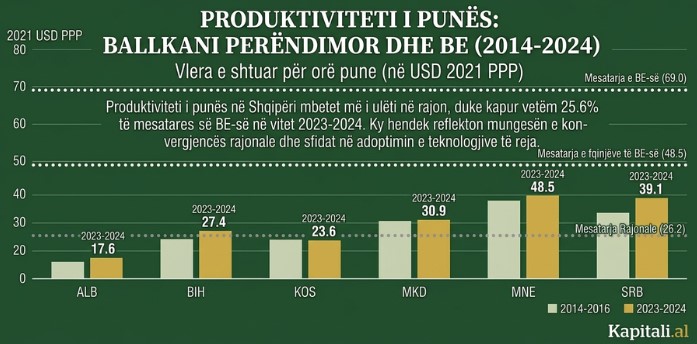
What makes this figure even more worrying is the time factor. Labor productivity in Albania has been stagnant for more than a decade. The increase in employment in Albania is not generating real welfare, because the country is simply adding low-wage jobs that do not produce real wealth.
The reasons for this stagnation are no mystery. Albania’s economic model continues to rely heavily on activities with little added value—such as fashion, mass construction, or basic tourism services—and on free labor, rather than competing through innovation.
Businesses are being slow to adopt efficiency-enhancing technologies, including artificial intelligence. Furthermore, there is a large skills gap in the labor market; the workforce often lacks the necessary qualifications to meet the demands of a high-tech economy.
In the final analysis, the Brussels charts offer a clear lesson for policymakers in Tirana. It is no longer enough to be proud of the fact that people have found work.
Without a deep reform in education, without market-related vocational training and without incentives that direct capital towards high-value industries, Albania risks being stuck at the bottom of the table.
In the great race towards European integration, the country may be busy working, but it continues to walk at the tortoise’s pace.