It’s not just in Irish politics that the old civil war divide is over. The ceasefire also now seems to extend to Brussels pubs.
De Valera’s, long a landmark on that city’s Place Flagey, closed earlier this year. Although there are plans to reopen under new management, it has for now gone the way of its near neighbour, the Michael Collins.
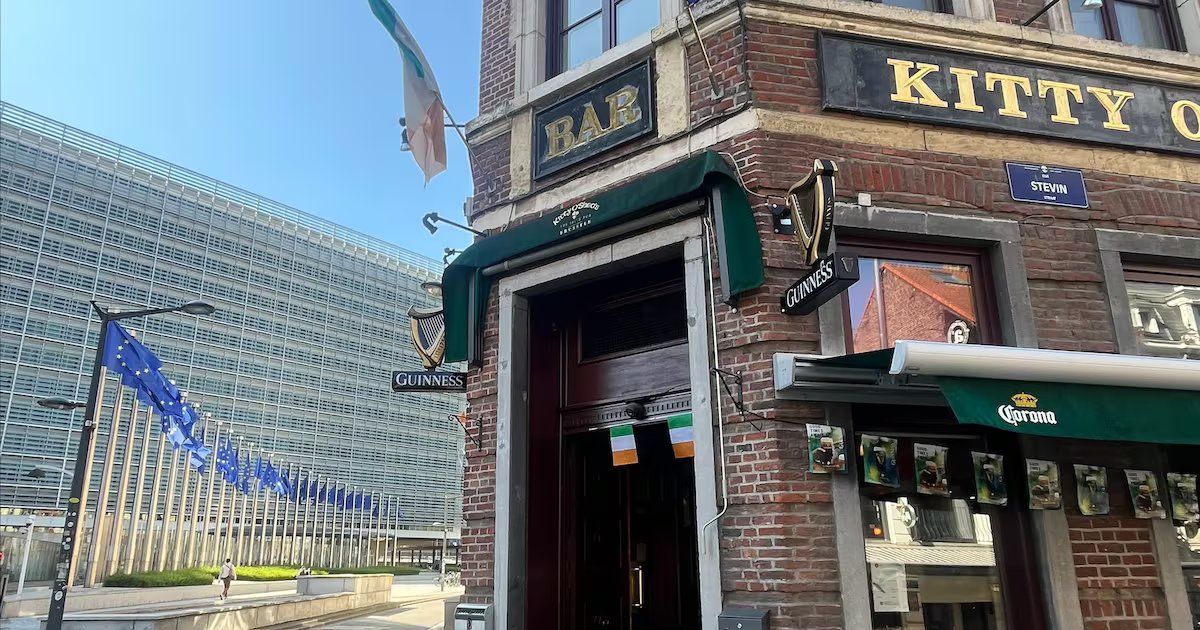
Kitty O’Shea’s, on the other hand, is still going strong, reflecting the durability of an even older split in Irish politics.
It’s strategically located just across the road from the Berlaymont building, the vast headquarters of the European Commission, where Ursula von der Leyen looks down from her 25 sq m bedsit on the 13th floor.
Closed for the moment, however, is Kitty’s neighbour The Old Hack, also synonymous in its own way with an English divorce case. That was yet another Irish pub, although the name reflected its popularity with EU journalists in general.
It also used to be a favoured haunt of Nigel Farage and his union-jack-waving colleagues, much to the dislike of barman Michael O’Neill, who eventually advised him to take his business elsewhere.
Speaking of haunts, the spectre of Farage looms over the forthcoming Irish presidency of the EU, which was the context for a press trip to Brussels this week. It will be Ireland’s eighth turn in the chair, but the last was way back in 2013, before Brexit, Covid and the first and second coming of Trump, among other shocks.
Europe and the world are very different places now. And yet the mood in Brussels, as detected during two days of press briefings at least, was poised between worried and smug.
On the plus side, Trump hadn’t done anything mad for several days. Also encouraging was continued evidence of the UK aiming to re-enter the EU by a back door. With the rest of the planet in turmoil, meanwhile, Europe looked more than ever like the adult in the global room.
It might be overstating things, as one MEP did when trumpeting the rush of trade deals being concluded, that the EU “has never been sexier”. But he made a more arguable case when adding that its attractions now include being “the greatest democratic power that still respects international law”.
This doesn’t make it any more popular as a news story, alas. Only three journalists report permanently for Irish outlets from Brussels, compared with 30 in the Dáil.
And that 1:10 ratio is a general rule across the Continent. There are 60 German EU journalists, for example, which sounds impressive until you learn that domestic politics in Germany has 600.
The stolid but Byzantine bureaucracy that makes Europe such a reliable trading partner is notoriously difficult to report. There’s a big drive now towards “simplification”, which has become a buzzword. But as one official put it, “simplification is quite complicated”.
To make the process more relatable, the EU speaks of various “omnibuses”, each carrying a package of simplifying reforms in a particular area.
Public transport seems to be a recurring theme in Eurospeak. There is also the “legislative train”, which graphically represents the EU’s work as a series of railway engines, each pulling a line of specialist carriages.

But for all the best efforts of transport metaphor, the trains and the omnibuses seem to run into each other a lot.
The difficulty of getting things done in Brussels was dramatically illustrated by the doomed attempts of some in our group to achieve progress in what Eurocrats would call the “Food and Feed Safety simplification omnibus”.
In simpler terms, having flown in late on Monday night, we were trying find a restaurant still open at 10pm.
There are not many of those in the European quarter. But armed with directions from the hotel receptionist, I was one of a hungry trio – we’ll call the others “Joe” and “Michael” – who set out into darkest Brussels in search of at least a takeaway.
Already doubting the directions, we soon reached a place where two possible routes diverged, neither promising much in the way of lights. Here, the intrepid Joe volunteered to take one route while we took the other, each party to text with any developments.
A weakness in this plan, it soon emerged, was that Joe’s battery was down to 2 per cent. So when we found a place – basic fast food – Michael had just enough time to pass on the co-ordinates before Joe’s phone crashed.
In the meantime, further exploring the neighbourhood, I found a better place. But by then Michael had to stay where he was until Joe’s arrival. Which failed to happen before – concerned that we were in a rough area and he was getting threatening looks – Michael jumped into a taxi and fled back to the safety of Kitty’s, unfed.
Joe arrived there too eventually, alive but also still hungry. Only The Irish Times had secured food. A halal chicken burger and chips, since you’re asking, and very good it was too.