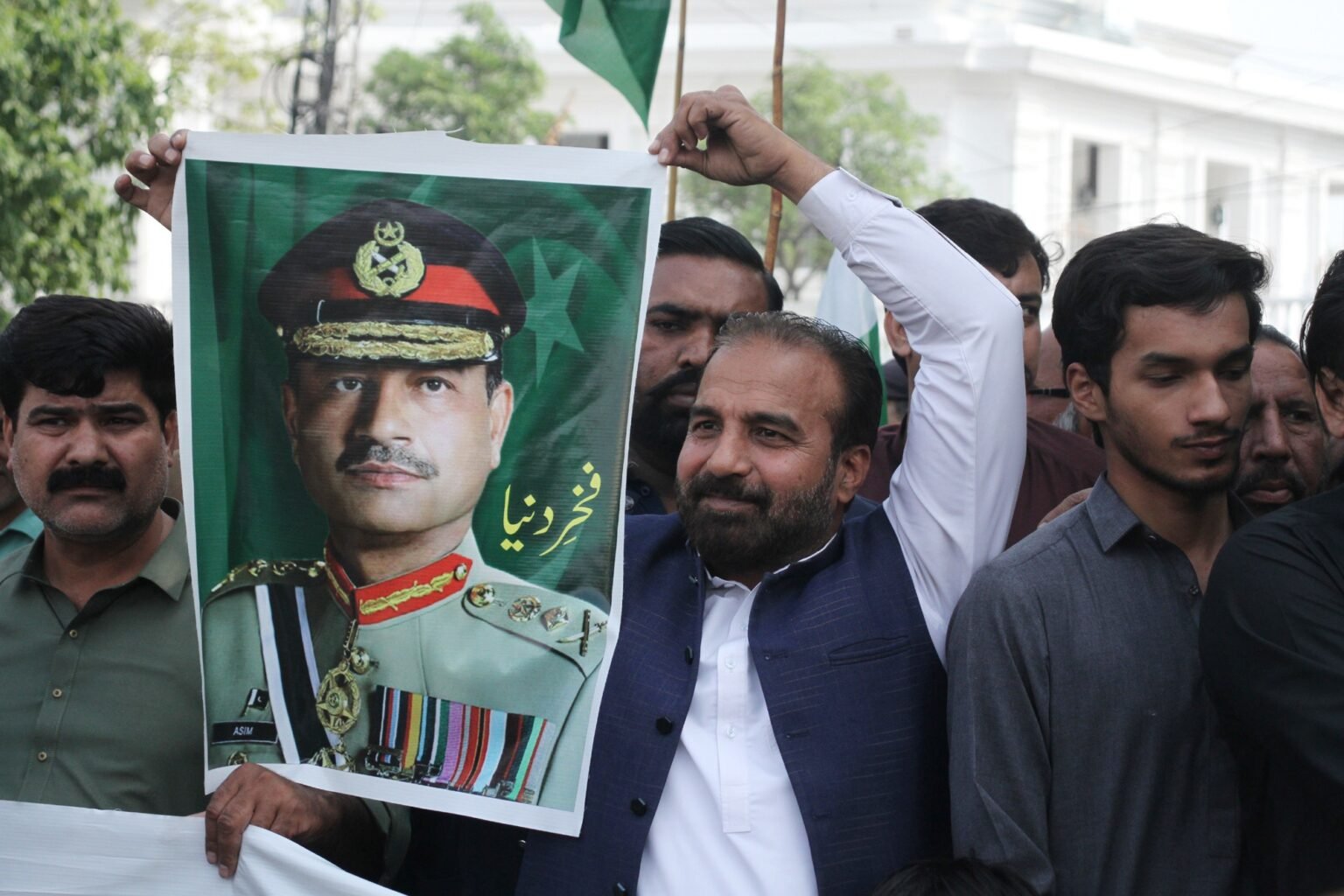
Asim Munir has a remarkable approach in brokering a peace deal between the US and Iran. Soon after presiding over the most important meeting between the sworn enemies in decades, Pakistan Army Chief of Staff Munir spent several days in Tehran meeting not only with Iran’s political leadership but also with Iran’s security forces and Revolutionary Guards.
Munir, who is the most powerful person in Pakistan, was in phone contact with the White House all the time, people close to the field marshal said. He has built a strengthened relationship between the US and Pakistan, building on cooperation that has included deals in amorphous minerals, cryptocurrencies and real estate in Manhattan, as well as Islamabad’s nomination of US President Donald Trump for the Nobel Peace Prize.
Pakistan as a surprising leading broker
With little experience in previous US-Iran negotiations, Pakistan has emerged as a surprise lead mediator, but faces its biggest test since attempts to revive talks collapsed this week. Munir joined a long line of mediators, from European countries to Qatar and Oman, who have tried, with limited success, to mediate a resolution to the long-standing hostility between the United States and Iran.
Pakistan’s approach differs markedly from the methods of previous mediators in talks over Iran’s nuclear program, such as the nearly two years of grueling negotiations in Geneva and Vienna that sealed the 2015 nuclear deal Tehran signed with the Barack Obama administration.
The European representatives who brokered that agreement also followed the interests of their countries, as they would be represented in the agreement. All depended on large teams of experts, who sat for hours. Trump later canceled that deal.
Munir, for his part, has combined ties to Iran’s security establishment along with personal ties to the US president, who last week described the Pakistani as “fantastic”. He also has good ties to Iran’s Revolutionary Guards and understands their language, according to Ali Vaez, an Iran specialist at the International Crisis Group.
Vaez said that by staying for days in Tehran, contacting diplomats and the military establishment, Munir was trying a system-wide approach to mediation.
– It helps in creating a consensus, because there is no center of power in Iran that feels left out – Vaez points out.
Munir’s efforts to bring the warring parties back to the negotiating table stalled on Tuesday when Iran resisted pressure to return to Islamabad for talks with the United States. That failure showed the scale of Munir’s task as he faces warring parties with deep distrust. His efforts have been hampered by Trump’s insistence that the US naval blockade of Iranian ports will remain until a deal is reached, as well as Tehran’s refusal to fully open the Strait of Hormuz.
Trump agreed to extend the ceasefire, citing a request from Munir and Pakistani Prime Minister Shehbaz Sharif. But there has been little progress on key points of contention – Iran’s nuclear program and the issue of highly enriched uranium.
Pakistani officials insist they are still working to bridge the divide. But Munir must deal with an unpredictable and bellicose US president and a belligerent regime in Tehran that believes it has the upper hand.
“Unless Trump withdraws the American naval blockade, I don’t see how the Iranians would agree to participate in peace negotiations,” Vaez emphasized.
Most past mediators between the US and Iran have failed to achieve lasting results. After Trump left the 2015 nuclear deal during his first term, the EU and the so-called E3 – Britain, France and Germany – later facilitated indirect talks between the Joe Biden administration and Tehran, but failed to renew the deal.
When Trump returned to office and decided to hold indirect talks with Tehran, Oman became a key facilitator. But Trump wanted a quick deal and demanded that Iran give up its ability to enrich uranium, a red line for Tehran. Twice during the talks, Trump ordered attacks on the Islamic Republic.
Since the US began military action in February, the Persian Gulf countries have come under fire, and Pakistan has become involved in the diplomatic dispute. Islamabad has deepened its ties with Tehran, despite the two sides exchanging cross-border attacks in 2024. Pakistan’s intelligence services have been working closely with the Revolutionary Guards to root out Baloch separatists and smuggling routes along the 900km shared border, Pakistani officials said.
During his tenures as head of Pakistan’s Inter-Services Intelligence Agency and military intelligence wing, Munir became familiar with Iran’s various power bases. This month he visited the joint headquarters of Iran’s military command in Tehran and met with its chief, Major General Ali Abdullahi.
The field marshal’s rise into Trump’s orbit has been more remarkable, aided by a series of US-Pakistan deals and Pakistan’s refusal to criticize the president during the war against Iran, even as he condemned Iran for its attacks on Gulf states.
Munir offered to act as a mediator last summer, shortly after the United States joined Israel’s 12-day war against Iran for bombing Iranian nuclear facilities, people familiar with the talks said. He recently met with President Trump and attended a meeting with the late Ayatollah Ali Khamenei.
Pakistan’s ‘charm offensive’ ramped up
But Pakistan’s “charm offensive,” according to current and former Pakistani and American officials, is tempered by the lingering fear that Trump might turn on Islamabad, tighten sanctions on Pakistan’s ballistic missile program and remove a $7 billion IMF bailout.
Munir also has to deal with Iran’s wariness of Pakistan’s role, analysts say, linked to Islamabad’s dependence on the United States and relations with Saudi Arabia, with which Pakistan signed a mutual defense treaty last year. Fears are growing in Tehran that the US is using the talks as a ploy to prolong the war, as Trump has maintained a naval blockade and boasted this week that Iran had agreed to most of his demands. Tehran scoffed at Trump’s comments, and Iran’s top negotiator, Mohammad Bagher Ghalibaf, said this week that he would not negotiate “under the shadow of threats.”
“The Iranians will give Munir a hard time and ask why he is insisting so strongly on mediation – is it sincere or part of a ploy to get them to lower their guard,” said Wali Nasr, a former US official and professor at Johns Hopkins University.
Nasr said the Pakistanis were serious interlocutors, “but what they cannot deliver are any guarantees about Trump’s behavior.” Munir knows the Revolutionary Guards and can speak “the language of the military to the military,” Nasr added, but “he didn’t have a deep relationship with them.”
Since Munir returned to Islamabad last week from Tehran, Pakistani mediators have told the White House and regional allies they are confident Iran will attend the talks, two people familiar with the matter said. In anticipation, authorities blocked off parts of the city. Hoping for an interim deal, they prepared to shower Islamabad with signs celebrating the “Islamabad Peace Accord,” one official said. When those efforts failed, Pakistani officials made no public comments about Trump’s naval blockade — Iran’s key stumbling block — and instead appeared to blame Tehran.
Islamabad took a similar approach when Israel’s continued offensive against Hezbollah in Lebanon threatened to derail the US-Iran ceasefire. Sharif has publicly stated, in line with Iran’s interpretation, that Lebanon is included in the ceasefire. But Islamabad has not responded openly to the US and Israeli claim that it is not, as Israel has launched a massive bombing campaign in Lebanon. Instead, Munir, Sharif and Foreign Minister Ishaq Dar privately urged the US and European governments to pressure Israel to halt the attack, people familiar with the situation said. Pakistan’s muted silence has raised questions about Islamabad’s neutrality within Iran and countries that support mediation efforts, two regional diplomats said.
Trump’s posts on the Truth and Reconciliation Network vilifying Iran, his threats to destroy “the entire civilization” and claims that Iran was begging for a deal also made the process much more difficult, according to regional diplomats. US Vice President JD Vance’s visit to Pakistan earlier this month pales in comparison to the 19 days former US Secretary of State John Kerry spent in Vienna working on the 160-page 2015 nuclear deal.
The Pakistanis are mostly trying to convince the Iranians to accommodate the American position, not necessarily coming up with creative ideas on how to bridge the differences. They are not as experienced as the Qataris or the Omanis and are prone to trying to encourage one side or the other to show flexibility – rather than coming up with their own solutions.