Pataz registers 315 homicides per 100 thousand inhabitants, the highest rate among the districts analyzed at the national level between September 2025 and August of this year. The registration occurs in a province where the dispute around mining activity and the presence of criminal organizations have sustained a scenario of violence that is no longer limited to its territory.
In recent weeks, this violence has also reached people linked to mining activity in Pataz in Trujillo. At dawn on August 30, an armed group intercepted the truck in which mining businessman Jenss Marty Lara Tantaquilla was traveling along with four other people. His companions were murdered and Lara remained kidnapped for more than 30 hours until he was released. A week later, on September 7, Homero Valdemar Armas Villalobos, brother of the district mayor of Pataz and linked to the mining sector, was shot to death as he left a restaurant in Víctor Larco.
The violence recorded in Pataz also finds a correlation in the figures, according to an analysis carried out by the Peruvian Institute of Economics (IPE). Ananea, in Puno, occupies second place with 145 homicides per 100 thousand inhabitants, less than half of what was registered in Pataz. They are followed by Inambari, in Madre de Dios, with 115; Bellavista, in Callao, with 90; Zarumilla, in Tumbes, with 86; and Papayal, also in Tumbes, with 83.

Information on the districts with the highest homicide rate per 100 thousand inhabitants. Source: IPE
The distribution also exposes different dynamics behind the territories with higher rates. Pataz, Ananea, Inambari and Laberinto – the latter with 75 homicides per 100 thousand inhabitants – are districts where there is the presence of informal or illegal mining. Unión Asháninka, in Cusco, which registers a rate of 69, is located in an area linked to coca crops; while Zarumilla and Papayal are part of a border territory used as a corridor for drug trafficking. The list is completed by Supe, in Lima, with 56; and Casa Grande, in La Libertad, with 49.
More than two years under emergency
The exceptional intervention in Pataz began on February 14, 2024. Since then, two state of emergency declarations and 18 extension decrees have been issued. Four expansions were approved this year alone. The current one, established by DSN° 113-2026-PCM, began on August 4 and will end on October 2.
During this period, the measures have varied in duration, but the emergency regime has not been interrupted. The current provision keeps the Armed Forces in charge of controlling internal order, with support from the National Police, in addition to mandatory social immobilization for seven hours each night.
The Chamber of Commerce of La Libertad has asked the Executive to process a new extension before the expiration of the measure, with the argument of avoiding a vacuum in security and territorial control actions.
Illegal economies and territorial control
Limited access, the concentration of gold extraction and the coexistence of legal and illegal activities are some of the characteristics that differentiate Pataz. “Obviously the high concentration of illicit activity plus criminal groups has been the ideal space for them to consolidate in the area and obviously to impose their rules to continue consolidating their presence and income. They resort to different mechanisms to be able to do their thing and obviously one of these is violence,” explained César Ipenza, spokesperson for the Illegal Mining Observatory.
The presence of other mining districts among the highest rates does not mean, however, that they reproduce the same dynamics. In Ananea, Puno, Ipenza identifies a greater presence of local and family actors against the criminal organizations that operate in La Libertad. “I believe that the common rules are areas of high mineral extraction where corruption prevails and where the State has also been somehow incapable of controlling the supply chain throughout the entire activity,” he commented.
The relationship between illegal economies and the listed territories is not limited to mining either. During the interview with El Comercio, Iván Arenas, a specialist in illegal economies, commented that it is not only about territories where the State is absent. Institutions can maintain a presence through authorities and public entities, but remain permeated by the same activities that they should combat. “In other words, it is not that the State is not present, the State is present, but what is happening is that it is present in part of everything. Here it is more complex because you have the State involved in the issue (of illegal economies),” he said.

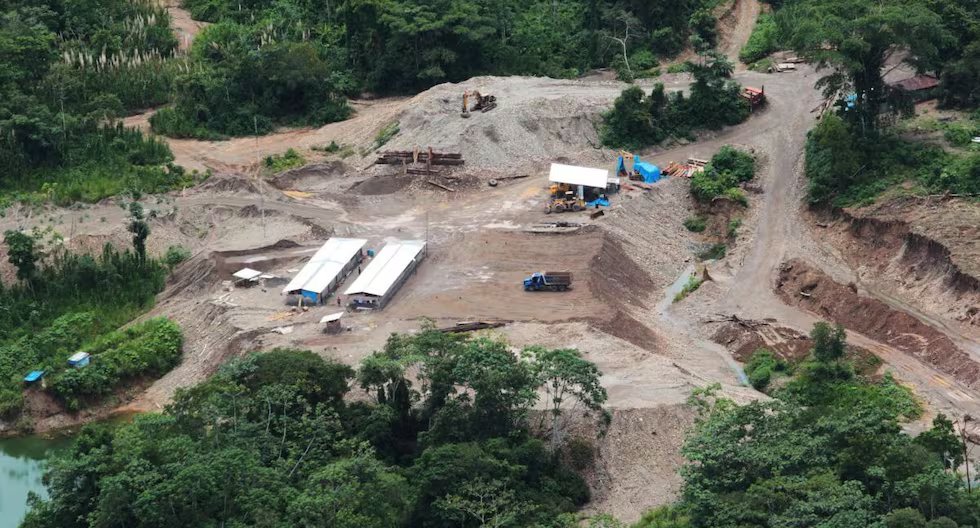
There are processors and miners that buy mineral in Pataz without guarantees of traceability. Photo (Andean)
For Arenas, the strategy applied in Pataz is also limited by the area in which the Unified Command operates. Currently, its intervention is concentrated in the district, despite the fact that illegal activities extend to other parts of the province. “Because it is necessary to at least extend that to the province of Pataz. I know that it is much more, let’s say, risky and more expensive due to time and logistics, right? But it must be expanded,” he said. The specialist proposed that the response move progressively towards an intervention by corridors, which makes it possible to cover the routes and territories through which these activities are articulated.
The presence of law enforcement is only part of the response. For Ipenza, police and financial investigation is also required to allow the inputs to be followed, identify the actors involved and reconstruct the money routes. “There is no sustained and articulated work in a multisectoral manner,” he warned. Monitoring, he added, must also cover the mechanisms used to introduce illegally sourced gold into formal circuits and not be limited to the place where the mineral is finally extracted.