According to a Reuters report, Since the end of October, Ukraine has intensified its attacks against Russian oil facilities. Among the bombed plants were refineries in Ryazan, Yaroslavl and the Volga region.
Nine of the country’s 35 main refineries suffered operational interruptions or emergency situations during the last week, the report states.
In addition, it details that the affected facilities have a joint nominal capacity of about 300,000 tons per day, equivalent to 2.2 million barrels. At this point, it should be noted that Russia’s total primary refining capacity is about 930,000 tons per day.

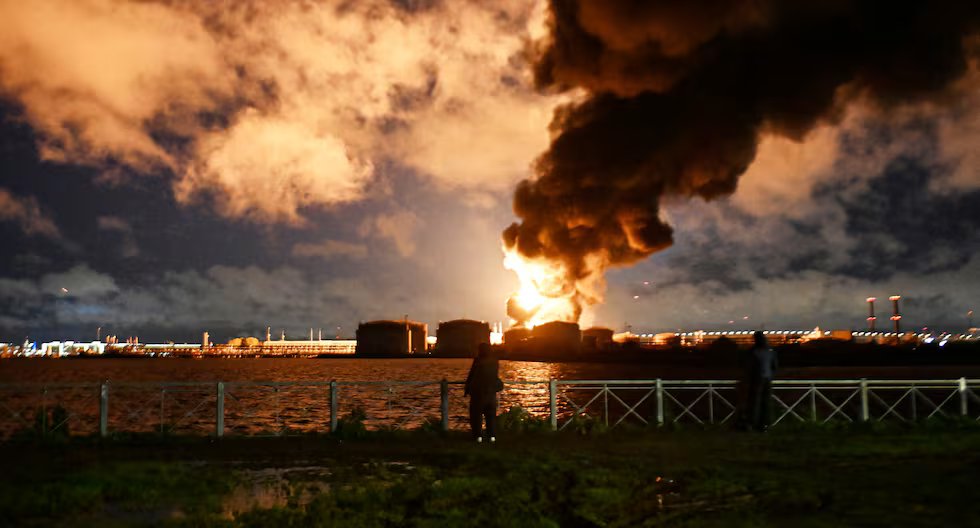
Smoke rises over St. Petersburg following an airstrike on the city’s oil terminal on October 18, 2026, amid the Russian invasion of Ukraine. (Photo: AFP).
/ STRINGER
Reuters maintains that at the end of October, Russian refineries were processing about 700,000 tons, or 5 million barrels per day. Two oil industry sources consulted by the agency estimate that The effective reduction in crude oil processing could reach 200,000 tons per day.
Reuters highlights that The attacks aggravate Moscow’s difficulties in meeting domestic demand for fuel.
The Ukrainian offensive intensified after the ceasefire on energy facilities that US President Donald Trump had announced between Moscow and kyiv at the end of October failed.
The Ukrainian president, Volodymyr Zelenskyjustified the continuity of the attacks against refineries such aso response to Russian bombings against power plants, energy networks, heating and water supply systems Ukraine.
Can social unrest become a problem for Putin?

Ukrainian attack with drones against a refinery in Moscow, on the same day as the main day of the parliamentary elections in Russia. (EFE/Official account in X of the Minister of Foreign Affairs of Ukraine, Andrii Sybiha).
In dialogue with The Commerce, Francesco Tucci, director of the Communication and Journalism degree at the Peruvian University of Applied Sciences (UPC), warns that The attacks could become a growing problem for Putin if they are sustained over timesince its effects could extend from the functioning of military operations to the daily life of the Russian population. However, he asks that the 30% figure be taken with caution and remember that Russia has demonstrated an important capacity to adapt during the war.
For Tucci, the reduction in refining capacity does not necessarily mean that Russia is close to suffering economic paralysis.
“The time factor is key. If Russia manages to quickly compensate for losses through reparations or alternative mechanisms, the impact will be temporary. and will not have prolonged consequences on your economy.”maintains the analyst.
However, The scenario changes if Ukraine manages to maintain a constant offensive against energy facilities. In that case, the damage could accumulate and progressively compromise Russia’s ability to sustain the operation of its oil industry.
“This type of interruption can become a problem that lasts over time, because it can simultaneously affect fuel income, the logistics of war and, I would say most importantly, the daily life of the population,” explains.
It refers that A prolonged reduction in supply can make transportation, the distribution of products and the movement of people more expensive.

Russian President Vladimir Putin attends the summit of the Collective Security Treaty Organization (CSTO) countries at the Grand Kremlin Palace in Moscow on November 11, 2026. (Photo by Pavel Bednyakov / AFP).
/ PAVEL BEDNYAKOV
However, Tucci believes that It is still premature to anticipate a social reaction against the Kremlin. Remember that, since the beginning of the invasion, a part of the Russian population, especially the middle and upper sectors, has shown resistance to getting directly involved in the conflict. As an example, he mentions the departure of numerous men of military age from the country when the war began.
He also explains that the Russian Government has developed mechanisms to maintain the recruitment of soldiers, offering important economic incentives to those who voluntarily join the armed forces.
For the analyst, if the Ukrainian attacks continue and their effects begin to be felt more directly among citizens, greater social unrest could appear. But he warns that Putin’s Government has tools to contain possible manifestations of discontent.
He considers that the Kremlin could resort to censorship, repressive measures and nationalism to neutralize possible expressions of discontent against the Government.
The pressure on Russian military logistics
The attacks against the refineries also have a military objective: hinder the supply of fuel and increase the cost of maintaining the operations of Russian forces on the war front.
Tucci explains that the supply of diesel, aviation fuel and other petroleum products is important to sustain military operations. Added to this is that Russia must allocate additional resources to protect energy facilities located far from combat zones.
However, the specialist warns that a reduction in refining capacity does not automatically mean that Russian forces will run out of fuel or that their military operations will be paralyzed.
“This type of attack puts pressure on logistics and the ability to carry out operations, but it does not paralyze them.”. “Lower refining capacity does not automatically equate to grounded attacks or planes without fuel.”precise.
According to the analyst, so far there are no signs of a general interruption of Russian military supplies. Supply may have slowed down, but it is not stopped.
Russia tries to protect its refineries, but drones complicate its defense

A long-range drone during assembly in a workshop of the company Fire Point, manufacturer of the FP-1 deep attack drones, in an undisclosed location in Ukraine, on January 29, 2026. (Photo by Serhii Okunev / AFP).
/ SERHII OKUNEV
Another challenge for Moscow is to prevent Ukraine continue reaching your energy facilities. Tucci considers that Russia has allocated part of its air defense systems to protect refineries and other related infrastructure, but warns that Intercepting drones represents a particularly complicated and expensive task.
The analyst explains that Russian defense systems, traditionally based on missiles and other protection mechanisms, are not always effective against this type of attack.
Despite the difficulties posed by the Ukrainian attacks, Tucci calls for not underestimating Russia’s ability to adapt to the changing conditions of the conflict. Remember that Moscow has faced international sanctions, losses of military equipment and difficulties protecting its strategic facilities, but has managed to maintain military pressure on Ukraine.
“This background shows an extremely high Russian capacity for adaptation. However, there are also limits”he maintains.
He adds that Russia began the invasion with the expectation of ending the conflict in a few weeks, but had to modify its strategies due to the prolongation of the war.
“It has lost many tanks and other resources, but it is still in the conflict. It continues to attack and cause significant damage and casualties to Ukraine. We must be very careful with this capacity for adaptation that we have been seeing since the beginning of the war”he points out.
Finally, Tucci warns that the prolongation of the conflict also raises questions about Russia’s political future and the scenario that could open up after Putin. It indicates that it cannot be ruled out that an eventual succession will be led by leaders who are even more nationalist and radical than the current president.