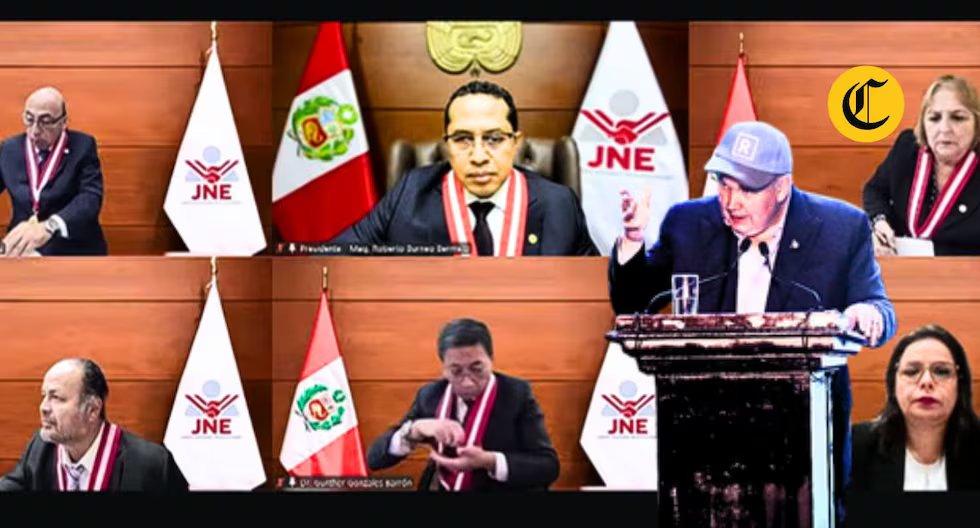
The appeal was presented last Tuesday before the JNE. There it is questioned that the plenary session of the electoral body introduced “an impediment” that was not known in the Regional and Municipal Elections 2026 (ERM 2026), so “the principle of prohibition of arbitrariness has been violated as the rules of the electoral process have been altered once the voting day has ended.” The case is already in the hands of the electoral authority, having opened a jurisdictional file for evaluation (File ERM.2026-068324).
However, three specialists consulted by The Commerce They warned that this appeal for reconsideration in favor of López Aliaga would not proceed, both for a matter of form and substance. The issue is key because, as the leader of Renovación Popular himself has announced, the group will seek to even take the case to court. This will be the path I would follow.
The Lizana Puelles case and what is coming
In the opinion of Fernando Rodríguez Patrón, expert in electoral issues and associate of the Aklla Peru Institute, the Constitution establishes that the resolutions of the JNE plenary session are unchallengeable. This aspect would mean that the appeal filed by the representative of Renovación Popular would have no margin or real possibility of succeeding, due to a matter of form.
Added to this is that, in essence, the request raised would imply that the electoral authority does not observe article 194 of the Constitution, which expressly prohibits the re-election of mayors. “Neither in form nor in substance would this document from Renovación Popular be protected; under no circumstances,” Rodríguez Patrón told The Commerce.
Now well. Given the possibility of choosing judicial means, Rodríguez explained that in 2005, in the Lizana Puelles Case, the Constitutional Court established that, although the decisions of the JNE are irrevisable, this does not constitute a patent of marque. However, he also specified that a constitutional protection process is only appropriate when fundamental rights are violated.

JNE announced that it will not deliver mayoral credentials to candidates for first councilor who have been mayors in the previous period, as in the case of Rafael López Aliaga. (Photo: YouTube)
Along these lines, he considered that the amparo would also have no legal basis in this case, as it did not affect a fundamental right, even more so if López Aliaga was able to participate in the elections as a councilor. In addition, he warned that a process of this nature could take years to resolve.
Regarding a possible precautionary measure, which is certainly more expeditious, Rodríguez recalled the controversy that arose in the case of Duberlí Rodríguez’s party, in which the JNE filed a lawsuit for a jurisdictional conflict against the Judiciary to defend its sphere. This is still in process. “If a precautionary measure orders the delivery of credentials to López Aliaga, what would be the position of the JNE?” questioned Rodríguez Patrón.
For his part, José Manuel Villalobos, a lawyer specializing in constitutional and electoral law, considered that the brief presented by the group will be declared inadmissible. He explained that, on previous occasions, reconsideration appeals filed against agreements of the JNE plenary session have been rejected, because the legal framework does not contemplate this figure.
He recalled that, in 2005, an extraordinary resource was created to evaluate resolutions of the JNE plenary session. However, this mechanism was eliminated in January 2018. The resolution that revoked it warned that, during its twelve years of validity, the resource ended up being distorted.
“The legal framework does not contemplate a reconsideration of the jury’s rulings that are issued in the last and final instance. What happens is that those who interpose it confuse and seek to apply the law of general administrative procedure to an electoral court,” commented Villalobos.
The specialist pointed out that the appeal will first be brought to the attention of the plenary session and put to a vote. Based on the antecedents, he estimated that the decision will be to declare it inadmissible.
Along similar lines, constitutional lawyer Alejandro Rospigliosi Vega maintained that the JNE is the supreme electoral court and, therefore, has the last word on electoral matters. He considered that, if the organization has already ruled against the so-called “covert re-election”, that will be the criterion that will prevail. In his opinion, the reconsideration “will be rejected.”
Rospigliosi also referred to the possibility that Renovación Popular opts for a protection claim. He estimated that the hearing and the first instance ruling could occur towards the end of next year. By the time the case reaches a second instance and, eventually, the Constitutional Court, the municipal period could even have ended.
“It could not be that the JNE gives the mayor’s credential to a citizen in 2022 and, to the same citizen, gives the mayor’s credential in 2026, 2030, 2034, 2038. That would be generating perverse incentives for indefinite reelection. And we must not forget that a pillar of democracy is the alternation of power,” Rospigliosi remarked.