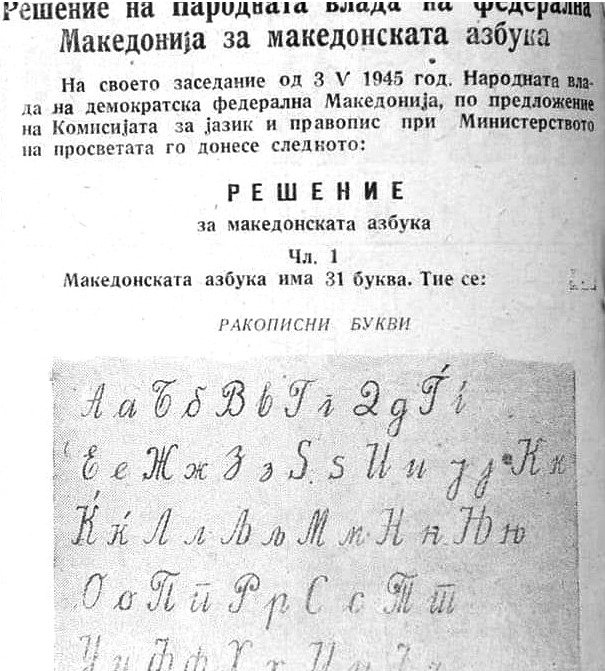
Eighty-one years since the printing of the Macedonian alphabet with 31 letters in “Nova Makedonija”
- When it comes to the Macedonian literary language and the alphabet, “New Macedonia”, as one of the pillars not only of the Macedonian statehood but also of the Macedonian language and culture, has an even greater historical role, because the first official Macedonian alphabet was published on its pages
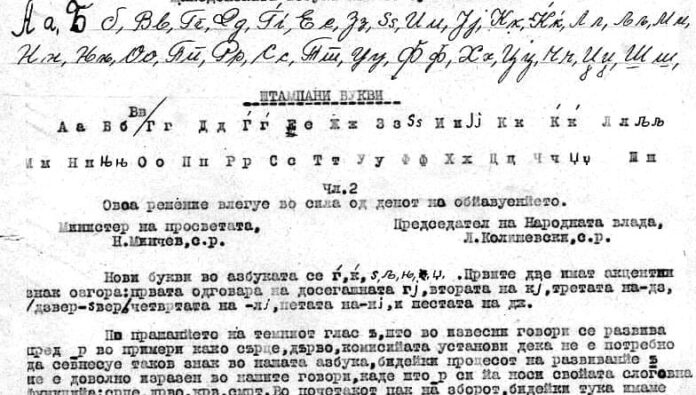
On this day, May 4, 1945, in the newspaper “Nova Makedonija” number 104, the new Macedonian alphabet with 31 letters was printed for the first time. One day earlier, on May 3, 1945, the People’s Government of Federal Macedonia adopted a decision to establish the Macedonian alphabet with 31 letters. The Council of Ministers of Federal Macedonia determined the Macedonian alphabet, based on the phonetic principle, after several months of work by several commissions, based on the Resolution of the last Commission on Language and Spelling at the Ministry of Public Education. The foundation of the Macedonian alphabet on the phonetic principle means that for each separate sound in the language there is a letter in the alphabet. This is one of the most important moments in contemporary Macedonian political and linguistic history. When it comes to the Macedonian literary language and the alphabet, “New Macedonia”, as one of the pillars not only of the Macedonian statehood but also of the Macedonian language and culture, has an even greater historical role, because the first official Macedonian alphabet was published on its pages. Otherwise, the Commission for Language and Spelling was established by the Presidium of ASNOM in November 1944 in order to submit a proposal for the alphabet and spelling of the Macedonian language. But the first committee did not fully formulate its views, so, with certain changes in the composition of the committee, the issue of the alphabet and spelling was resolved six months later, on May 3, 1945. The Alphabet and Spelling Commission formulated its views in a final form, which are contained in the decision, adopted on May 3, 1945. In doing so, the following principles were set: (1) In the Macedonian literary language, those forms of the central languages should be established that will connect all our languages to the greatest extent and will be easily acceptable to people from all our regions; (2) In the Macedonian literary language, its national basis should be expressed to the greatest extent. The dictionary of the literary language should be enriched with words from all our dialects, new words should be built with lively endings and foreign pronouns should be adopted only as much as necessary; (3) The Macedonian alphabet should be composed of as many letters as there are sounds in the literary language. The spelling should be made based on the phonetic principle.
Officialization of the alphabet as a state norm
On May 5, 1945, the Government made the alphabet official as a state norm. It was published again in the newspaper “Nova Makedonija”, because at that time there was no official newspaper where the state publishes its decisions. The May 5 announcement is considered an official document. The three issues of the newspaper from May 5, 6 and 7, 1945, were prepared by the editors with special attention. In this so far largest number of texts with different topics in the field of language are represented, but the most significant is the document entitled “The decision of the People’s Government of Federal Macedonia on the Macedonian alphabet”. This issue of “Nova Makedonija” has historical significance as the first official document, in which Blaže Koneski carried out the normalization of the language. That rounded off the standardization of the Macedonian language, started by Krste Misirkov.
After the legalization of the Macedonian alphabet on June 7 of the same year, the adoption and legalization of the Macedonian orthography follows. Then the publishing of important works for the teaching of the Macedonian language began: in the school year 1945/46, the first Primer with a reader in the Macedonian language for the first grade, with which the organized teaching of the native Macedonian language in schools began. The alphabets are a story about the effort, innovation and resistance of the Macedonian people in the face of attempts at their assimilation and destruction
The Cyrillic alphabet of Krste Misirkov as a basis
The modern Macedonian alphabet with 31 letters is based on the Cyrillic alphabet of Krste Misirkov. Some orthographic signs are taken from Vuk Karadzic’s alphabet, although Misirkov used signs for those same sounds. The development of today’s Macedonian alphabet dates back to the appearance of the Glagolitic alphabet and then with the replacement of the Glagolitic alphabet with the Cyrillic alphabet and with the gradual development and improvement of the voice-graphic system. The historical story of the letters contains exceptional examples of the collective genius of the Macedonian people and its linguistic, literary, educational and cultural actors. The study of the letters and alphabets created and used by the Macedonian people reveals all the complexity and richness of the Macedonian language in the long time processes of its evolution over the centuries and millennia. The alphabets are a story about the effort, innovation and resistance of the Macedonian people in the face of attempts to assimilate and destroy them, in the face of all the propaganda directed against the Macedonian language, Macedonian identity and Macedonian spirituality. Letters are more than tools for communication: they foster culture and tradition. Letters and alphabets are more than just symbols: they are windows into the soul of the Macedonian people. They are a reflection of the Macedonian identity.
The verb – the predecessor of today’s Cyrillic alphabet was created by St. Konstantin-Kyril the Philosopher, based on the voice system of the Macedonian dialect speech from the Thessaloniki area.
In his scientific study entitled “Macedonian Glagolitic”, published in 2015 by the Macedonian Academy of Sciences and Arts, academician Gjorgi Pop-Atanasov writes: “Glagolic is the first Slavic script, composed by St. Constantine-Kyril the Philosopher before leaving for the Moravian mission in 863. The script was composed on the basis of the voice system of the Macedonian dialect speech from the Thessaloniki region, whose St. Cyril and Methodius formed the basis of the Slavic literary language. The first Slavic books were written, which were necessary for the successful implementation of the church-educational activity of the Slavic scholars during their mission in Great Moravia. These first Slavic books, written in the Glagolitic script, contained biblical texts from the composition of the Old and New Testaments, as well as texts from the most necessary liturgical books. used during church services.”
In her foreword to this study by Pop-Atanasov, Academician Katica Kulavkova emphasizes: “Officially, the Glagolitic alphabet is considered the oldest Slavic alphabet, which precedes the Cyrillic alphabet. The Glagolitic alphabet was used in Macedonia for at least four centuries (from the 9th to the end of the 13th century) and is associated with the Ohrid literary school and its centers and followers in Macedonia, regardless of which state structure (empire, kingdom) it belonged to. The originals of the Macedonian Glagolitic manuscripts are kept outside of Macedonia, in St. Petersburg, Moscow, in the libraries of the Sinai Monastery, Odessa, Innsbruck, Vienna. These include: the Aseman, the Zografian and the Mariinian Psalter, the Khludovsky, the Zagrafian and the Lanta palimpsests, the Klotsian anthology…”
The verb was used at first exclusively, then dominantly, in the area of the Republic of Macedonia, as well as in the wider ethno-geographical Macedonian area, in several literary centers of the Ohrid Literary School. Until the 10th century, the Macedonian language also used various other scripts, such as the Greek script, or some still undeciphered scripts, but with the appearance of the Glagolitic script, literacy was standardized. From the 10th to the 19th century, the Macedonian language used the following alphabets: Glagolitic, Cyrillic, Church Macedonian script, Ilinden alphabet.
In the 20th century, there was also an attempt to write down the Macedonian language with the Latin alphabet, the so-called Macedonian alphabet, which did not take a wide scale and remained at the local level in Aegean Macedonia. The richest period in terms of the development of the standard Macedonian alphabet is the period of revival, more precisely from the middle of the 19th century to the beginning of the 20th century. During this period, a large number of Macedonian intellectuals carried out reforms to simplify the Macedonian Ilinden alphabet and thereby standardize the Macedonian orthography.
Saint Toevski