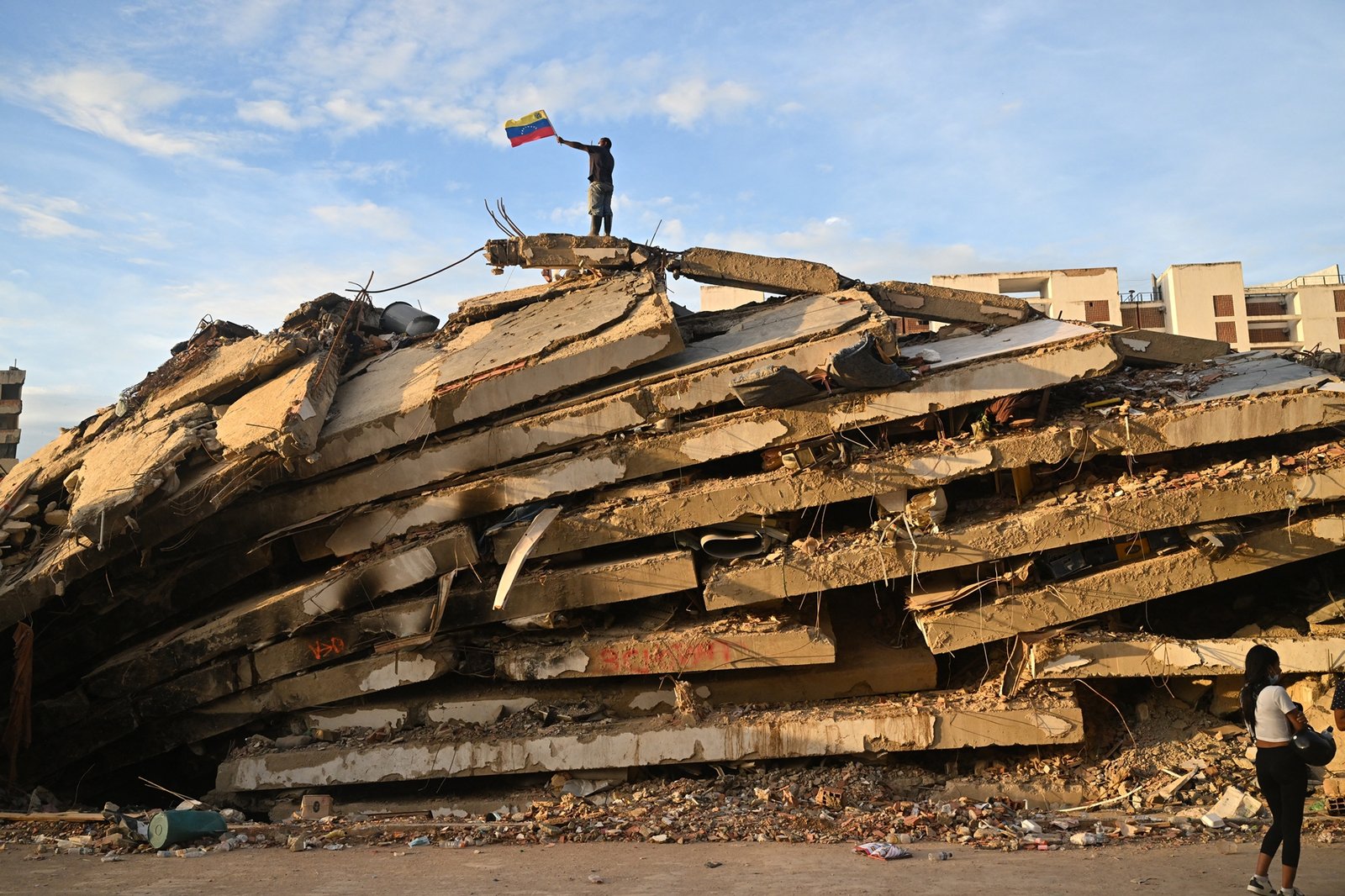
The earthquakes of June 24 in Venezuela caused the ground to move at a maximum speed of 202 centimeters per second in Caraballeda, La Guaira state, one of the three most intense records in history on a global scale, according to a study published by The Seismic Recordjournal of the Seismological Society of America.
Through videos captured by the security cameras of a commercial premises in Caraballeda, an international team of engineers managed to specify the impact of the strong shaking caused by the earthquakes that caused collapses and damage to buildings in La Guaira.
The study was signed by 14 researchers from the University of Chile, the University of Concepción, the British university City St George’s, Stanford University and the Venezuelan engineering company Inelectra.
The research started from the premise that no strong-moving instrument could record the earthquakes within 10 kilometers of the rupturewhich crossed the Boconó and San Sebastián faults almost below the communities of the coastal zone.
To clarify the magnitude of the impact, engineers carefully reviewed the recordings in which it appears a plastic traffic separator that slid on the pavement and an 11-meter street lighting lamp that swayed.
A commission from the team traveled to Caraballeda to measure objects and friction between the base of the pole and the asphalt. Four analysts separately tracked the path of the separator and, from that movement, calculated the shaking, which they then contrasted with the swaying of the streetlight.
The result showed a pulse that lasted less than a second and that It shifted the soil from the north to the south, almost perpendicular to the fault.
Two international database records NGA-West2 exceed that speed, both from the 1999 earthquake in Chi-Chi, Taiwan.
However, the statement released by the British university City St George’s reveals that the figure It was greater than the strongest recorded Kobe earthquake in Japan in 1995. and that any of those analyzed by the Turkey earthquakes in 2023.
According to the study’s authors, it is the first reconstruction of its kind with independent verification.
“Our investigation shows that a major cause was exceptionally intense shaking, which far exceeded what the local building code required the structures to withstand,” he explained. Miguel Bravo-Haroprofessor of structural engineering at City St George’s and co-author of the study.
In his opinion, it is rare for a building to collapse unless “everything goes wrong at the same time,” he said.
Pablo Heresifrom the University of Chile and corresponding author of the work, acknowledged that when observing the images of the earthquakes for the first time he thought they were generated with Artificial Intelligence.
After analysis, the team concluded that the shaking at that point was comparable to the most intense ones never registered.