Macedonia in old books, travelogues, maps, documents and newspapers (18)
The issue of the distinctiveness and historical continuity of the Macedonian people has often been the subject of politically motivated disputes by neighboring Balkan historiographies. The frequent selective approach to the past and the claims that the Macedonian identity is a contemporary political construct imposed after the Second World War face a serious denial when independent sources are seen. Although complex historical circumstances, educational pressures and church propaganda in the past influenced part of the population to temporarily identify themselves under foreign names, a large number of relevant foreign authors, travel writers and diplomats clearly differentiated the Macedonians as a separate ethno-national entity in the Balkans.
The interest of Western European observers in the ethnic image of Macedonia dates back centuries. The official notes of Venetian military officers as early as the 15th century, as well as the writings of later travel writers, clearly draw a line of demarcation between the Macedonian population and its neighbors, locating its presence in the key urban and rural centers of the region. These early observations point to the fact that the Slavs in Macedonia even then functioned as a separate entity within the Ottoman Empire.
In the early 19th century, with the intensification of diplomatic and scientific missions, British and French researchers, including famous military analysts, archaeologists and consuls, documented the linguistic and cultural character of the region in more detail. Their analyzes of cities such as Voden, Kostur and Lerin testify to the dominance of the Slavic language, which was so deeply rooted that even representatives of foreign religious institutions were forced to learn it in order to communicate with the local population.
DE LA TROCQUIERE AND ANGIOLELLO
A certain European traveler De la Troquière already in the 14th century speaks of Macedonians as the main population of Macedonia and sharply distinguishes them from Greeks, Bulgarians and Serbs. Likewise, the Venetian naval officer, Angiolelo, who, due to circumstances, traveled through Macedonia in the direction of Constantinople, distinguishes the Macedonians from the Greeks. Angiolello writes: “Departing from Thessaloniki on August 12, 1470, the Great Lord stopped at a mountain called Bogdana. The next day he stationed himself near a town called Seres. On the 14th of the month he stopped near Mount Athos, a mountain on which there are many monasteries and Christian monks, some of whom are Greeks and some Macedonians, or Vlachs…
On the 16th of August the Grand Master stopped on a plain near the river called Crna Voda, and then on the next day he stationed himself near a fortress near the river called Struma, from a post called Borun, situated near the Sea Bay. Greeks and Macedonians live here. On August 20, he left Gyumuljina and spent the night on the ridge of a mountain called Derio. Here there are two larger towns inhabited by Macedonians…”
WILLIAM MARTIN LICK
The British political and military worker, archaeologist and philologist William Martin Leake, who during the Napoleonic Wars also traveled all over Macedonia, in his paper “Lord Howich”, Thessaloniki, January 1807, among other things, referring to the population of Meglen and Woden, says that “the Slavic Christians in the city of Woden completely ignored the Greek language…” Leake’s descriptions also served as the most reliable information for Byron himself, who in the song “Childe Harold” mentions the Macedonians, and that by their real name: “Macedonian with a belt, bloody, all pale near the delia holding a scimitar…”
VON KNAPICH
When we are talking about the various foreign statistical data for Macedonia, let us also mention the Austrian consul in Thessaloniki, Von Knapich, who in his report from 1874 (in “Macedonian Review”, Sofia 1925, year I, volume 5-6, pp. 108, 109, 110), which refers to the population of the Thessaloniki province, writes:
“In the Thessaloniki Sandjak, there is a Greek population exclusively in the kazas of Kassandra and Ionaros – the old Halkidiki Peninsula, and then at the opposite end of the Peninsula, i.e. on the west coast of the Gulf of Thessaloniki. In contrast, the population of the kazas: Dojranska, Avrethisarska, Strumica, Vodenska, Enidze-Vardarska, is exclusively Slavic. The population in the two kazas – Karaferia and Nausta, where the Greek language, as in general in the capital cities, is more in use.”
CUISINERS
The French consul in Thessaloniki, Cuzineri, who stayed here at the end of the 18th century, says about the ethnic character of Vodensko: “The diocese of Voden to the west of Thessaloniki is entirely inhabited by Slavs. This is why all the metropolitans who come to Voden, even though they are Greeks by nationality, are forced to learn the Slavic language. Their diocese consists of more than a hundred villages, whose inhabitants speak only their mother tongue. That is why the metropolitan, if he did not learn their language, would be received with less honor and his income would be much less significant…”
LEO TOLSTOY
“It’s a little embarrassing, but I have to admit that I have very vague ideas about your homeland. I only know that it is located in the Archipelago, that it is ruled by the Turks and that the life of Christians is deeply unhappy…” (From the conversation of Dimitar Rizov, publicist and diplomat with the great Russian writer Leo Tolstoy, whom he persuaded to stand up to European public opinion about Macedonia).
CASIMET
“I know two historical world tragedies – the Irish and the Macedonian. They are two bloody hearths, two tormented peoples”, emphasized Kazimet, an Irish patriot and revolutionary, hanged by the English colonial authorities because of his activity for the national liberation of the Irish people).
In parallel with ethnographic research, the Macedonian issue over time also acquires a strong political dimension on the international scene. The great minds of European literature and social thought recognize the tragedy of this people, often comparing its fate with that of other enslaved nations that fought for freedom under colonial empires. Progressive thinkers, especially those with Macedonian roots who worked in the western centers, clearly promoted the idea that the only just solution for the region is the recognition of the autonomy and sovereign independence of Macedonia.
The review of the independent foreign documentation clearly shows that the Macedonian national identity is not an artificial decree from recent history, but a historical continuity. Although the path to its official international establishment was filled with pressures, falsifications and neglect, the testimonies of objective observers remain a lasting monument to the uniqueness of the Macedonian people, their language and their country.
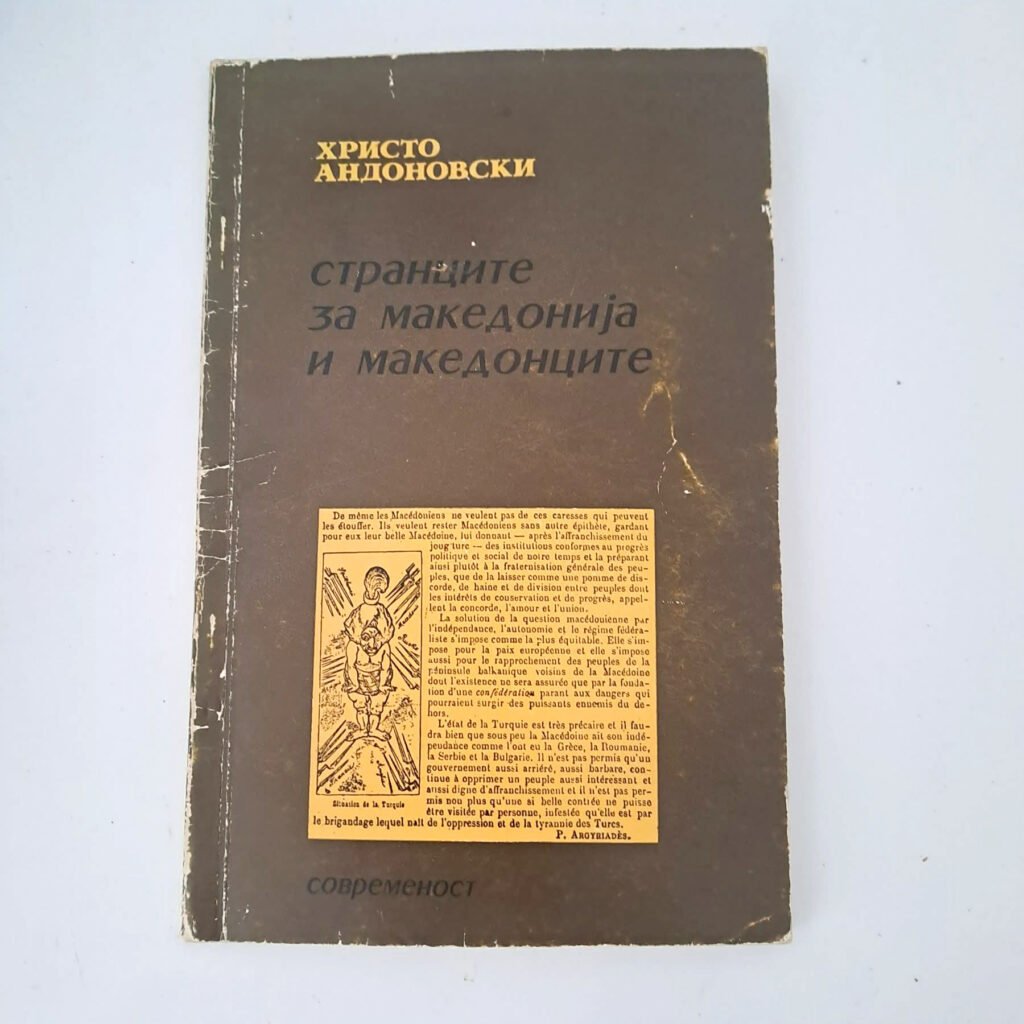
The quotes are taken from the edition “Strangers for Macedonia and Macedonians” by Hristo Andonovski, a book published in 1978. In the same book, the author emphasized: “Many foreign authors even in the last and the beginning of this century, and some even much more recently, clearly separate the Macedonians from their neighbors – the Bulgarians, the Serbs, the Greeks and the Albanians and use the name Macedonian Slavs, Macedonian Slavs, or Macedonians for short, indicating their special national affiliation with that name. The reason for this small paper is the frequent return to this topic of some Greek or Bulgarian historians and publicists, who, in their attempt to refute the existence of the Macedonian nation, use the ‘argument’ that ‘in the past Macedonians were never mentioned as a separate nation, and therefore, the Macedonian nation was a product of a political decree, passed during the Second World War by the leadership of the Communist Party of Ukraine’. We do not in the least try to hide the fact that in the past they were called or called themselves some of our ancestors with the name Bulgarian, Serbian or Greek, which came as a result of ignorance and delusion, or that name was imposed on them through schools and the church, and often through pressure. In the past, not a few more or less famous persons came here to the Balkans at the invitation of one or the other interested party and wrote books with the audacity of ‘eyewitnesses’ and the pretensions of ‘good experts’ on the Macedonian question they succumbed to the temptation of the seductive banquets and royal rewards, to the cunning kindnesses of the intelligence officers, whose interests should have been served by the well-prepared invitation and what should have resulted from it. And few and rare were those authors who found themselves in Macedonia and by the strength of an inner drive and the voice of their own conscience to discover the truth itself, above all, in favor of the tortured Macedonians themselves and the peace of the Balkans. Europe, unselfishly and impartially took on the complicated task – to shed light on the Macedonian issue within the framework of their own strengths and possibilities”.
Nikola Ristevski, MSc