Maybe guava leaves will help. Or ginger, in a mixture with black pepper and hibiscus? You may be able to get rid of it after three weeks of inhaling petrol, according to a circulating WhatsApp message. For the new Ebola variant Bundibugyo, which emerged in Eastern Congo in mid-May, social media is teeming with home remedies that promise protection or cure.
Science does not yet offer a solution. There is no approved vaccine and no specific treatment available for the Bundibugyo variant, a rarer strain of Ebola.
Moïse Esapa, fact checker at NGO Balobaki Check in Kinshasa, sees how that gap is being filled online. “We are at the beginning of the outbreak, so there are always many unanswered questions,” he says by telephone. “About the disease itself, about the symptoms, about how you can protect yourself. When clear information is lacking, misinformation fills that void. As a result, people take matters into their own hands. They then say: look, the people who named this epidemic don’t even have vaccines themselves. So we provide our own remedies.”
The Balobaki fact-check editorial team has built up a file of the misinformation circulating in Congo about the virus. Balobaki comes from Lingala, one of the four national languages in Congo, and means something like: ‘they have said’. Esapa’s organization follows rumors on social media and in WhatsApp groups, checks claims with medical and official sources and tries to feed the corrections back to the communities.
The organization is working on perhaps the toughest layer of the Ebola outbreak. In addition to a medical emergency, the epidemic is also a battle for trust: who is believed, who gets to explain what is true, and who is distrusted? In an area where war, overloaded healthcare and previous Ebola outbreaks have left their mark, these questions directly affect the fight against the virus.
A backlog for the authorities
The World Health Organization (WHO) has now registered 381 cases and 64 deaths spread across provinces in eastern Congo, with Ituri province at the heart of the outbreak. It is unclear how many people are actually infected. MSF warns that the true scale remains “impossible to measure”: testing capacity is limited, large areas are difficult to reach, and hundreds of samples are still awaiting analysis.
For the healthcare authorities, the outbreak already started with a backlog. The uncertainty was partly due to the variant itself: the first tests of suspected cases were negative because they mainly recognized the already known Zaire strain, while later it turned out that it was Bundibugyo.
In these circumstances, rumors about the nature of the disease and the intentions of healthcare providers and authorities gain a lot of oxygen. Congo’s health minister said the disease was initially seen as mystical in some communities. In the busy mining town of Mongbwalu, for example, stories circulated about a coffin knocking on doors. Anyone who heard the knock would develop a fever and die.
In some communities, the outbreak is seen as something ‘created’ or ‘instigated’: by the Americans, by Kinshasa, or by the enemy in the war that has been raging in the east for years. Where the rebel group M23 is strong, there is the idea that the government wants to strike that area, says Esapa. “Or people say: if there is a war, if there is an epidemic, then Tshisekedi (the Congolese president) benefits from it. You hear it in markets, in taxis, in public transport. Because as long as the crises pile up, he does not have to hold elections.”
Also read
New Ebola crisis in Congo shows how vulnerable the WHO itself has become
:format(webp)/s3/static.nrc.nl/wp-content/uploads/2026/05/31121716/310526BUI_2034012403_WHO01.jpg)
Mourning turned to anger
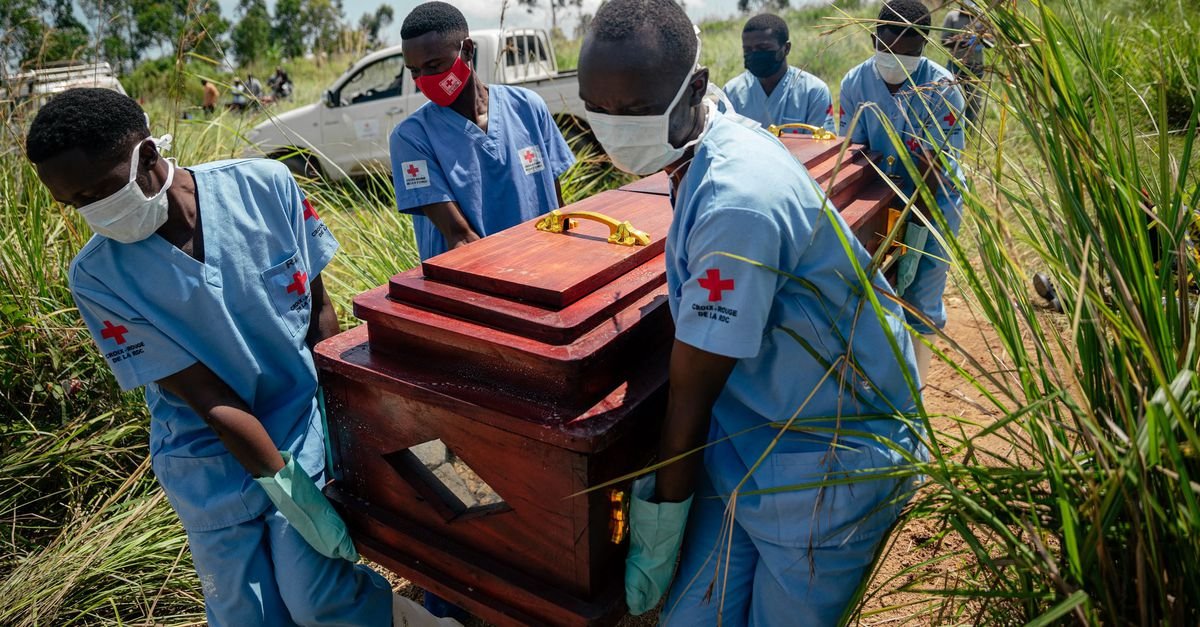
The WHO, which declared an international emergency in May, calls rapid detection, safe burials and community involvement at the core of the fight. In the town of Rwampara, in Ituri, it became clear how that logic can clash with reality. A family claimed the body of a man who died in an Ebola center. His loved ones did not believe that he had died from Ebola and wanted to bury him themselves. The healthcare workers adhered to the rules for a safe burial, intended to prevent contamination through the body. For the family, this felt like dispossession of their dead person. The mourning turned to anger: tents went up in flames and patients had to be removed.
“A funeral like this is locally a family affair, a community affair,” said Elodie Ho, coordinator of the African Infodemic Response Alliance, a WHO-led network that monitors health rumors and lack of information. “When you go against that, you touch something very sensitive locally and culturally. To tackle this, involvement in the community is crucial. Many messages need context and need to be explained more simply.”
The distrust was already there, but in many cases incorrect information adds fuel to the fire
For example, many official messages still appear in French, while other languages are often spoken in the affected areas. In addition, there are practical limitations: too little money for posters, faltering electricity and internet, difficult access and insecurity. That is why people are needed who not only translate the message, but also deliver it well, says Ho. “In the right language, and in a form that the community recognizes and trusts. Only then can we reach communities personally.”
The Ebola crisis takes place in a context where trust in local authorities is already low. Eastern Congo has been experiencing displacement and poverty for years, with foreign aid organizations coming and going, a hollowed-out healthcare system and authorities that stay away or take tough action. That is why Ho warns against too easy a reading: ‘disinformation’ is sometimes an umbrella word under which too much is grouped together. “It is rarely the start of the problem, but rather an amplification of it. That mistrust was already there, but in many cases incorrect information adds fuel to the fire.”
Ituri province, the heart of the outbreak, is seen by many residents as a region that has received too little attention, money and protection for a long time. People therefore first look at who is speaking and on whose behalf before they accept anything. “Communities are not necessarily unruly,” says Ho. “Sometimes there are just real gaps and legitimate concerns. Sometimes they ask for accountability. Sometimes resistance is a way to protect the community. Disinformation arises from uncertainty and fear. The first step must be to address that, even before you try to follow the disinformation.”
:format(webp)/s3/static.nrc.nl/wp-content/uploads/2026/06/08171400/080626BUI_2034196798_ebola2.jpg)
A child looks at illustrations about Ebola on information boards at the Ebola treatment center in Munigi, eastern Congo, on June 2.
Photo Jospin Mwisha / AFP
Profiting from the ‘Ebola business’
Congo has contained several outbreaks of Ebola since 1976. Even without a vaccine, previous epidemics have been stopped with classic public health measures. But the major outbreak from 2018 to 2020 in North Kivu and Ituri also showed how quickly emergency medical care can create distance. Patients were sometimes forcibly removed, local healthcare structures were bypassed, and temporary facilities were dismantled afterwards. The term “Ebola business” emerged among residents. For some, the fight brought work and money. Others wondered why Ebola led to such a mobilization, but not cholera, malaria or years of violence.
Even now, residents hear through the media that millions are being pledged. But they sometimes see little change in their neighborhood, village or health zone, says Esapa. “Some people even see fact checks as part of ‘Ebola business’. We are told: you are paid to spread lies.”
That pattern is not new. During the major outbreak of 2018, a quarter of people in affected areas did not believe the virus really existed, research showed. In addition, there were later revelations about sexual abuse and exploitation of women by employees involved in aid operations.
There are other lessons too. Churches and religious communities provide large parts of education and care in Congo. In the past, dozens of religious leaders have been publicly vaccinated to debunk rumors. But religious communities later said they were often involved late or not at all in decision-making.
:format(webp)/s3/static.nrc.nl/wp-content/uploads/2026/06/03152900/040626BUI_2034196798_ebola2.jpg)
WHO Director-General Tedros Adhanom Ghebreyesus during a visit to the Evangelical Medical Center in Bunia, capital of Congo’s Ituri province, on May 31.
Photo Gradel Muyisa Mumbere / REUTERS
Trust local leaders
During his visit to the provincial capital Bunia, WHO chief Tedros Adhanom Ghebreyesus said at the end of May that communities should not be spoken to, but heard. Last weekend, the African Union-affiliated health organization Africa CDC and the WHO emphasized that an effective approach relies on trusted local leaders. The question is whether this wish will become reality in time. In one interview with actualite.cd Congolese virologist Jean-Jacques Muyembe brought it back to the core. “It’s all about confidence in the science we have in-house.”
That trust does not come naturally in Eastern Congo, Esapa knows. He lacks a clear strategy around disinformation and distrust from Kinshasa. “Access to reliable information, that is the core of the problem. Without it, people will continue to distrust healthcare providers. We, in the capital, can easily participate in a briefing from the health ministry or other healthcare authorities. But deep in the country, this is not self-evident.”
Also read
‘Gaps throughout the health system make an Ebola outbreak like this more difficult to tackle’
:format(webp)/s3/static.nrc.nl/wp-content/uploads/2026/05/21120726/210526VER_2033843719_ebola1-1.jpg)