It happened in the first half of the match between France and Senegal. In an attack by the African team, Ismaila Sarr He went to challenge for the ball in an attacking position and reached the ball before the defender William Saliba. The Frenchman, involuntarily, stomped hard on his opponent, who was left lying on the floor. Clear infringement. The Iranian referee Alireza Faghani did not see it (it could happen) and continued the game.
But the Senegalese couldn’t recover, so a minute later The game was stopped for medical attention.. The new regulations that are being released in this World Cup indicate that this player, in order to receive health care, must remain one minute off the court from the moment the game resumes. Triple injustice perpetrated. The offender came out unscathed, the VAR has no authority to correct the judge’s omission and the team receiving the infraction is left with one less.
But it is not that one or the other is favored. Injustice is global. In the last play of the same match, Kylian Mbappé received a ball in the face from Kalidou Koulibaly. One that left him on the floor and from which it took him a moment to recover. There wasn’t even any infringement here. It was a fortuitous action. The rule does not distinguish. Senegal almost scored in that final play of the game, while the French defenders complained.
FIFA wants end simulation and waste of time. The search is good. It mostly worked in this World Cup. But this rule specifically already caused a couple of injustices in the World Cup and, at any time, will generate a huge scandal.
Up to this point, fortune prevented this iniquity of the new regulations from being transferred to the result. But what would happen if a team that is numerically disadvantaged receives a goal?
The rule targets footballers who suffer minor injuries. Because even if the referee sanctioned the infraction, but did not show a yellow card, the injured player must also leave the field if he is treated.
On the one hand, The fanfare of those who want to waste time faking an illness ends. But… what happens in these cases in which the player is really injured? What if, furthermore, it is for an infraction that the judge did not notice and that is not serious enough to warrant VAR intervention? As stated, the rules as they exist today favor the offending team.
The new standard was included in the “Rule 5.3Powers and duties of the referee”, in the “injuries” section. The technical part may be boring, but it is necessary to explain the point. The IFAB manual says: “The referee must allow play to continue until the ball goes out of bounds if a player is only slightly injured.
“He stops play only if a player is seriously injured; he will ensure that he is removed from the field of play. An injured player cannot be treated on the field of play. And when an injury causes the interruption of play or a delay in its resumption, the injured player must leave the field of play. He may only re-enter one minute after play has restarted.”
Are there exceptions? Yes. But none contemplates the possible omission of a fault (due to it not being seen by the judge). The exception favors the injured player only if he is the goalkeeper, if a goalkeeper collided with a field player and both must be attended to, if two players from the same team collide and require attention (if both were taken out the disadvantage would be greater), if the player who caused the injury is cautioned and, finally, if the infraction led to a penalty and the injured player is the perpetrator.
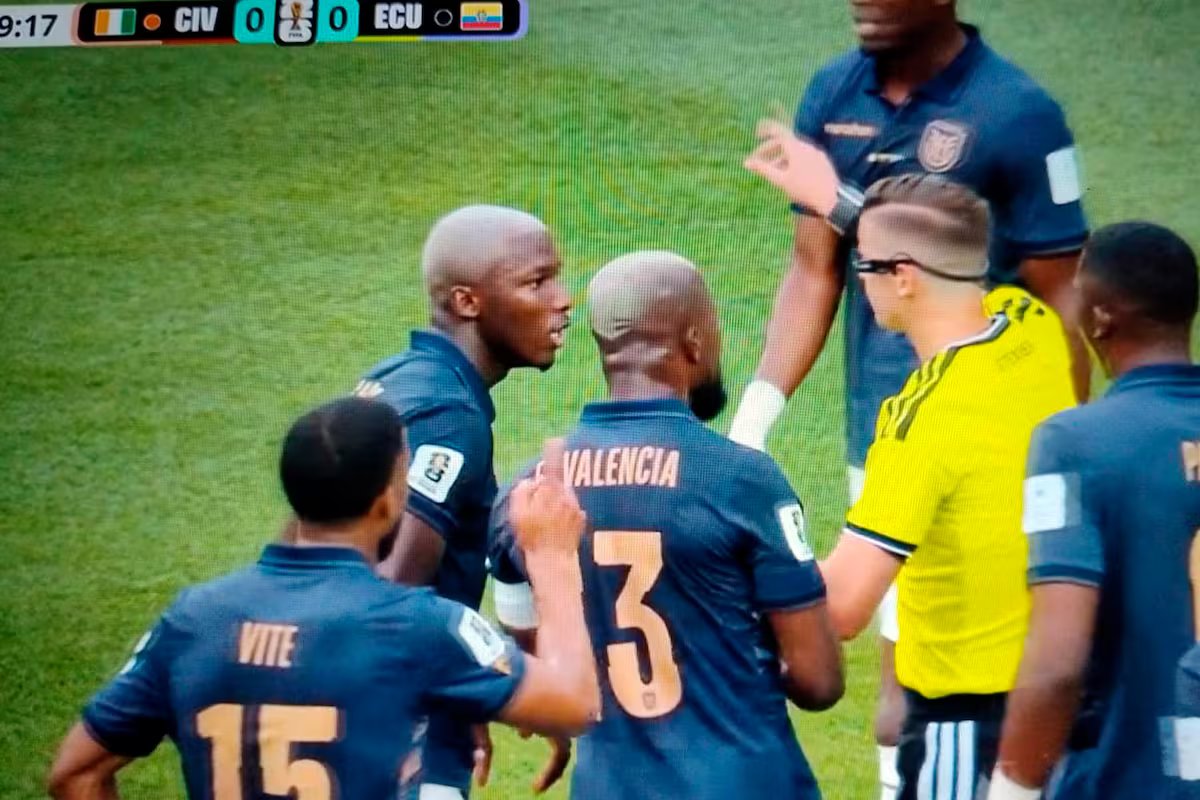
But it was said that there were other cases. Like the one that occurred in Ivory Coast vs. Ecuador. In a set piece play with the Ivorians on the attack, Wilfried Singo tried to shoot at the goal, but hit Moi Caicedo. The French judge François Letexier did not consider that there was an infringement. Caicedo took a while to recover. And here the injustice was greater. Because just as the Ecuadorian rejoined, about 40 seconds after receiving the kick, the referee stopped the game to call for medical attention.
Caicedo showed him the traces of the unnoticed aggression to explain the situation. But there was nothing to do now. Relentless, the referee sent him off the field for just over a minute. And the doctors hadn’t even come in.
The issue will be nothing more than an anecdote until one of the injured teams receives a goal at a numerical disadvantage for an unfair reason. As the old saying goes about the righteous being sinners.
A possible solution is for the VAR to warn the referee that the infraction existed and that there is no simulation. He can keep him on the court, even if he doesn’t turn the action back. In the World Cup it could work.
But if it happened this way, just imagine a similar situation in our Argentine football. What was sought as a solution would be a bigger problem. Because the VAR inspection would begin to be requested in each of the contact plays and the footballers would live lying on the floor.
Here the players are willing to do almost anything they want with the referees. Because they know that it is difficult for judges to reprimand a player (let alone expel him) for simulating infractions or for stalling.
In the World Cup, everything is much healthier. The pilot test is, in general terms, very good. For example, no time is wasted with the wings or goal kicks. It is also true that there are fewer injury simulators (it will be the exclusive function of goalkeepers from now on). But in the case of medical care there is a legal security gap which at any moment is going to generate a big problem.