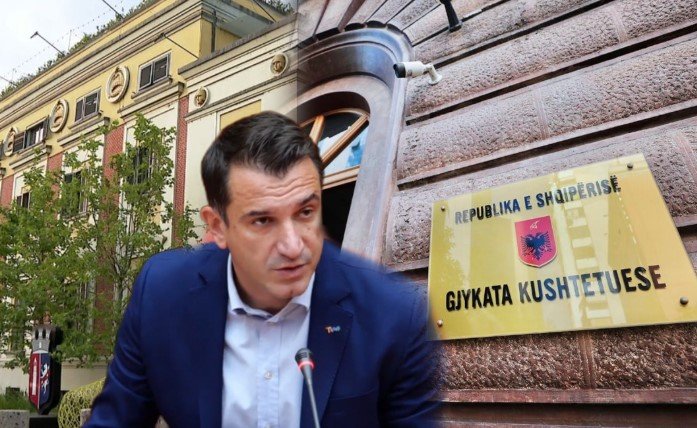
In decision no. 57 of the Constitutional Court, judge Sonila Bejtja has taken a very strong stance on the measure “Arrest in prison” against Erion Veliaj.
In her partially opposed opinion, she assesses that the ordinary courts have not sufficiently and convincingly justified the existence of evidence that justifies the suspicion that Veliaj may have committed the criminal offenses for which he is accused.
According to judge Bejtja, reasonable suspicion cannot be presumed. It must be based on concrete facts, evidence and information capable of convincing an objective observer that the person may have committed a criminal offense.
In this particular case, she estimates that this standard has not been met.
Judge Bejtja emphasizes that the decisions of the courts are based on general and unspecified facts, especially regarding the individual connection of Erion Veliaj with the criminal offenses attributed to him. According to her, the courts have listed evidence and acts, but have not convincingly explained how these evidences are concretely related to Veliaj’s actions.
She notes that it is not enough to say that some companies have received construction permits or public contracts from the Municipality of Tirana. It had to be argued concretely whether these permits or contracts were illegal, whether they were given in violation of the law and whether Veliaj acted because of an irregular benefit.
Judge Bejtja also emphasizes that the courts have connected sponsorships, cultural events and relations of private subjects with Veliaj’s wife, but without being able to prove the concrete connection of these relations with criminal actions committed by him himself.
According to her, the decisions of the courts, although voluminous, lack the reasoning for the connection between the administered evidence and concrete behaviors that constitute elements of criminal offenses.
Even more importantly, Judge Bejtja sees this as part of a wider problem. She notes that, as in many other similar cases, the courts have not been able to get beyond the excessive formalism that pervades the reasoning of the decisions on the assignment of security measures.
In other words, according to her, it is not enough for the decisions to be voluminous. It is not enough to list acts, evidence and suspicions. The court must clearly show what the concrete facts are, what the concrete evidence is and how it relates to the concrete person whose freedom is being restricted.
Sonila Bejtja expresses herself even more strongly when she says that the courts have failed to prove, even at the level of minimal evidence, the criminal facts charged against the petitioner.
According to her, if the evidence on which the arrest measure is based is deficient, incomplete, unclear or incapable of creating reasonable suspicion, then the measure turns into a blatantly arbitrary one.
In conclusion, judge Bejtja comes to the conclusion that the reasoning of the courts does not convince even an objective observer that Erion Veliaj may have committed the criminal offenses for which he is accused.
For this reason, it has voted for the acceptance of the request, the annulment of the decisions of the Supreme Court and the GJKKO of Appeals, and the return of the case for reconsideration to the GJKKO of Appeals, with the aim of repairing the violations and restoring the violated constitutional rights.