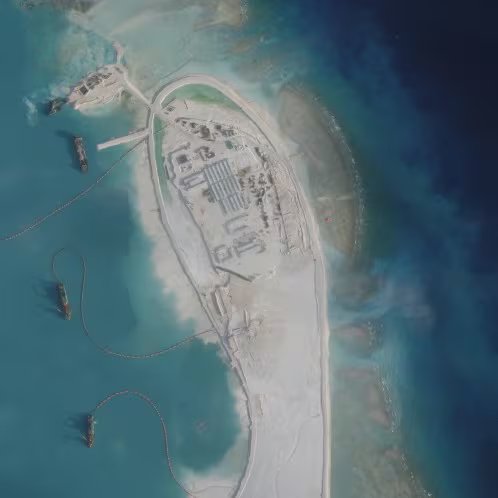
Since last December, 22 Chinese sand dredgers have been working tirelessly in the middle of the South China Sea, in the waters surrounding the area known as Antelope Reef.
That space has been transformed from a sandbank with a few buildings into a large-scale urban complex that is growing day by day, highlights the United Kingdom newspaper The Telegraph.
Experts tell this London media that, if construction continues at the current pace, the island could become China’s largest in the South China Sea.
It is located in the Paracel Islands archipelago, about 270 kilometers from southern China, and is one of many disputed sites that Beijing claims. Vietnam and Taiwan also claim it, the newspaper notes.
The Telegraph explains that the dredgers turned off their transponders before starting work to avoid being tracked. However, satellite images have monitored their progress.
In the three months to February, China is reported to have expanded land reclamation on the reef, built a fortified perimeter around the island and is developing at least two new docks.
The island, which extends for about 3,350 meters, could house a landing strip of 2,743 meters, enough for all of China’s advanced fighters, according to the Asian Maritime Transparency Initiative (AMTI) mentioned by the London media.
Beijing has – he adds – a 2,743-meter runway on Woody Island, its main outpost in the Paracels, which regularly receives bombers, including the nuclear-capable H-6.
Gregory Poling, director of AMTI, told The Telegraph that, at the rate China is expanding Antelope Reef, they will “almost certainly” finish construction of the island by the end of 2026.

“It will be a project in development for the next few years, but it is reasonable to expect that we will see some use of the facilities by the end of the year,” he told the UK newspaper.
Poling argued that given the planned size of Antelope Reef, China is likely to establish an intelligence, surveillance and reconnaissance network on the reef.
This network could include – he detailed – radars, fuel storage infrastructure and possibly shelters to house sophisticated military technology, such as surface-to-air missiles and cruise missiles.
This would add the Antelope Reef to the long list of geographical features in the South China Sea that Beijing has militarized in its attempt to strengthen control over this strategic sea route, the London media points out and recalls that China began to massively expand the size and scale of dozens of formations since 2014, converting small islets and rocks into military outposts.
27 outposts
So far, The Telegraph details, China has built at least 27 outposts in the South China Sea: 20 on the Paracel Islands, near Antelope Reef, and seven on the Spratly Islands, a separate group near the Philippines.
“All of these outposts are military. Any civilian use they have is a facade, a little Potemkin city built on top of them,” Poling told that newspaper.
This media reports that Beijing has three important bases on the Spratly Islands: Fiery Cross Reef, Mischief Reef and Subi Reef, known as the ‘Big Three’. All three have runways and hangars, radars and communication systems, as well as deployments of mobile surface-to-air missile systems and anti-ship cruise missiles.
In the Paracels, it is indicated that Woody Island has become a city with a school, library and bank, serving a population of 2,200 inhabitants. At the end of December 2025, the first shopping center with a supermarket, bookstore, restaurant and hairdresser was inaugurated.
The construction of the three large complexes and Woody Island was completed in 2018 – according to the British media -, three years after Beijing claimed to have completed the militarization of the islands in the South China Sea.
Likewise, in 2024, progress was made on Triton Island, another small enclave in the Paracels, including the installation of a radar. But Beijing – adds the news portal – appears to have stopped the construction of islands in the disputed waters, until the construction of the Antelope Reef.
Experts believe, according to The Telegraph, that the decision to militarize Antelope Reef, which was used for aquaculture, is aimed at monitoring nearby Vietnam.
“Vietnam has also been steadily strengthening and expanding several of its island positions in the region, reflecting the broader pattern of competitive offshore infrastructure development,” Damien Symon, a geointelligence researcher at AI analytics company The Intel Lab, told the London newspaper.
He added that: “in this context, the decision to expand Antelope could represent an effort by China to close the gaps that still exist in its maritime network.”
Since 2021, Vietnam has created 2,200 acres of new land—70% of the amount created by China—by building artificial land across the 21 landforms it occupies in the South China Sea. At least five of these formations would have been militarized.
Poling told The Telegraph that “the best explanation is that (China) decided that Antelope Reef would be most useful as a military outpost from which China can deploy coast guard, navy and military vessels to monitor Vietnamese activity.”
The expert stated that this post “will mainly serve as a listening post and resupply point for ships, in addition to patrolling the waters between the Paracels and Vietnam, which will be very annoying for Hanoi.”
The Telegraph notes, in its article published days ago, that the Chinese coast guard has intensified its activity around formations in the Spratly Islands that are also claimed by the Philippines, such as the Second Thomas Sandbar and the Scarborough Sandbar, which has led to routine, sometimes violent, clashes with Philippine vessels.
However, in the Paracel Islands, there is little land left for China to exploit once it is done with Antelope Reef. “There are only two, maybe three reefs left in the Paracels that China occupies and where it has not built large facilities,” Poling said. (YO)