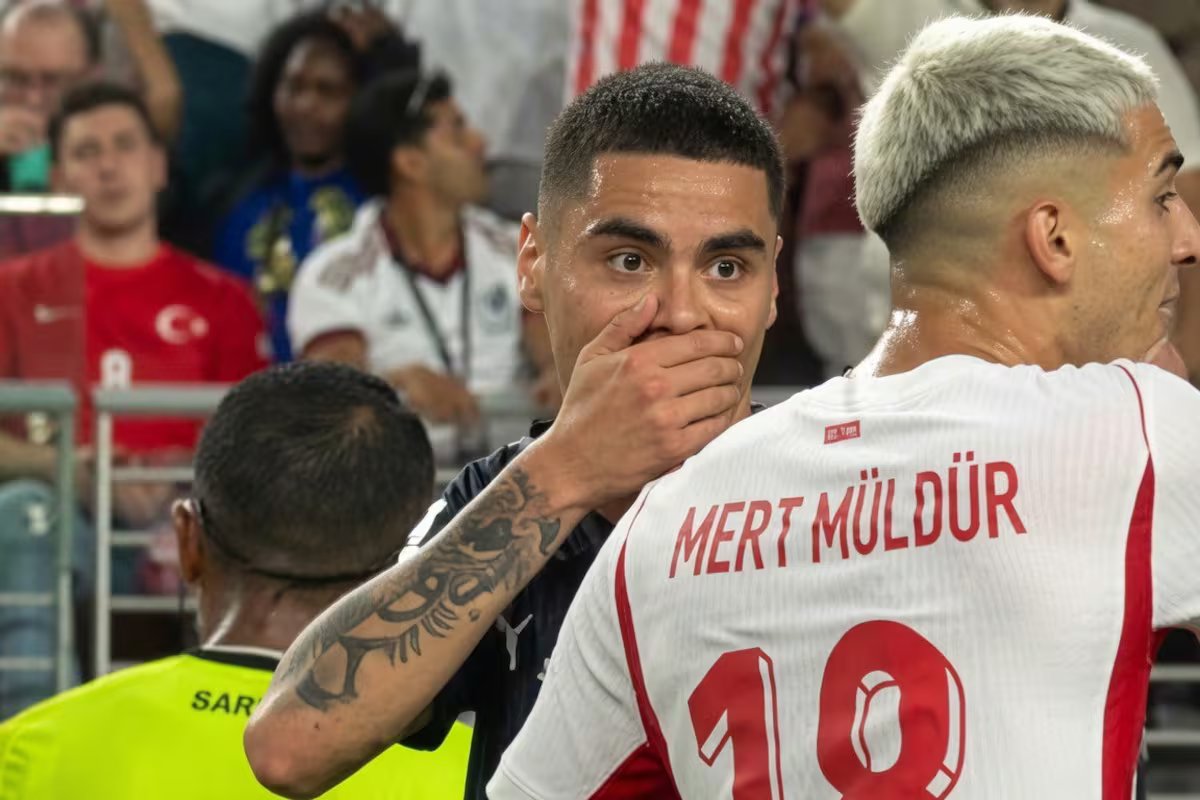
A few meters from Miguel Almironcoach Gustavo Alfaro looked dumbfounded. The first half was over, Paraguay was ahead 1-0 against Turkey, raising its head after 1-4 and the tactical beating it received from Mauricio Pochettino in the defeat with the United States. The meticulous Rafael already had in his head what he was going to say to his players at halftime, in this second timeout in which soccer has been transformed into a kind of NBA or field hockey game.
Alfaro, a man who does not miss a detail, and who surely must have repeated it to his men ad nauseam “Be careful with the new FIFA rules, above all, do not cover your mouth when speaking to a rival,” He didn’t know whether to shout at Almirón when he received the red card, precisely for having made that mistake that a few years ago became a habit in sport and in football itself.
An hour and a half later, at the press conference, Alfaro wanted to be measured when asked about the referee. First he spoke that “It’s hard for me to play this sport, it’s a new sport.” And that was when he said, “Some things are punished with excessive rigor. I’m afraid that football will lose its essence.” Whether he really feels that way is a question that he and no one else knows. There was a condition: Paraguay won the battle, playing the entire second half with one man less. And when you win, the speeches are not the same as when you lose. But ultimately, that is part of the hypothetical: Paraguay triumphed and got back into the qualification zone.
Now, football has been changing its rules. Some have been positive, beneficial for the game. From the fact that the goalkeeper could not take the ball with his hands when faced with a teammate’s pass to the introduction of the VAR and the conditions that are being put in place to try to gain playing time, to reduce the loss of minutes that are taken away from the show due to speculation and tricks.
For this World Cup, FIFA established a package of measures, among which is the time limit to make the changes (10 seconds) and also to perform lateral or goal kicks (5 seconds). More to observe with a magnifying glass is the one that establishes that the player who is medically assisted for a momentary ailment (kicked by the rival, for example) without the referee having called a foul You must exit and wait a minute to re-enter: The rival is benefiting, who is left with one more man. And there is also an expansion of the VAR’s powers, such as modifying a corner penalty if it was actually an action for a goal kick.
But maybe this one not being able to cover your mouth to say something to a rival, based on the scandal that arose between the Argentine Gianluca Prestianni and the Brazilian star Vinicius, in a match between Benfica and Real Madrid, in February of this year for the Champions League, is the most curious and controversial. The greatest anger of FIFA and UEFA, beyond the sanction applied to Prestianni (6 games, three effective and three conditional), is that They never knew what the Argentine told him20 years old, to Vinicius: whether or not there was racism in his expressions. And he sought to cut short that trend.
The direct red sounds like an exaggeration. It is ridiculous when compared to other offenses that are much more dangerous for the physical integrity of the players, of the true artists of this sport-show-business. A devious, malicious kick or a last-man resource to avoid a goal is not technically the same as covering your mouth to say, who knows what, in English in this case. What is certain is that the rule exists, it is there and it was known that it could be applied. The mistake in any case was Almirón’s and the liveliness of the Turkish footballer Mert Muldur, who immediately pointed out the violation of the regulations to the Salvadoran referee Iván Burton. Summoned by the VAR, he saw the action and sent him off.
The expulsion of Almirón
Almirón is not a robot. Perhaps he was distracted when he shouldn’t have been and reacted naively. Why cover your mouth? What was the risk? What was I going to tell him, the CBU or the alias for a transfer? There are things that are incomprehensible. That’s why Alfaro looked at him in disbelief. We are also talking about one of the most unbalanced players that Paraguay has, with vast experience in the Premier League. Alfaro allowed himself to be ironic about the situation by suggesting to 10 “You would have told him everything in Guaraní, no one would understand you.” Surely, especially Muldur. In any case, Alfaro, as a teacher, should make him aware of what is good and what is not, of what should be done and what not, instead of urging him to move on the shoulder.
Let’s go to another point: was it necessary to introduce these modifications for a World Cup? Wasn’t it necessary to give it a reasonable amount of time to adapt, so that the players could get used to it? Usually, the changes are gradual, they are experienced in other tournaments, often youth ones. From Qatar 2022 to this tripartite World Cup 2026, the regulations changed, starting with the law Draw Martínez for the execution of penalties: no more previous talks or throwing the ball away to distract the kicker.
Another image of the expulsion
And in the lack of certainty whether FIFA was wrong or not in introducing the package of measures for the World Cup, there is also praise, for which we can take an Argentine case. 40 years have passed since the feat in Mexico and videos of Diego Maradona’s plays in what was his World Cup are regularly seen. The violence that was used at that time, without the aggressors receiving severe penalties, has nothing to do with what we see today.. It is another football, more protective, more thought about taking care of those who precisely give shine and freshness to the sport. That has been a merit of the entity.
“If a player covers his mouth and says something, and that has a racist consequence, then he has to be sent off, obviously,” he said. Gianni Infantino, president of FIFA, when he first raised the issue after the Prestianni-Vinicius incident. And he justified it: “The rule must exist because a player has said something he shouldn’t. Otherwise, he wouldn’t have had to cover his mouth. If not, he has nothing to hide.” The rule is clear. Whether it is right, whether it is fair or not, is a more debatable question.
The players? They must perfect their learning of the regulations and eventually talk less, or in another way, without chicanery, without racism, without disturbing terms or words, also having coaches who do not encourage that, but rather take care of them. And also, don’t get distracted. They know perfectly well that codes Among professionals they remain unchanged… until the precise moment when someone more alive decides to break them for the benefit of themselves and their team. That’s almost as old as the original regulation.