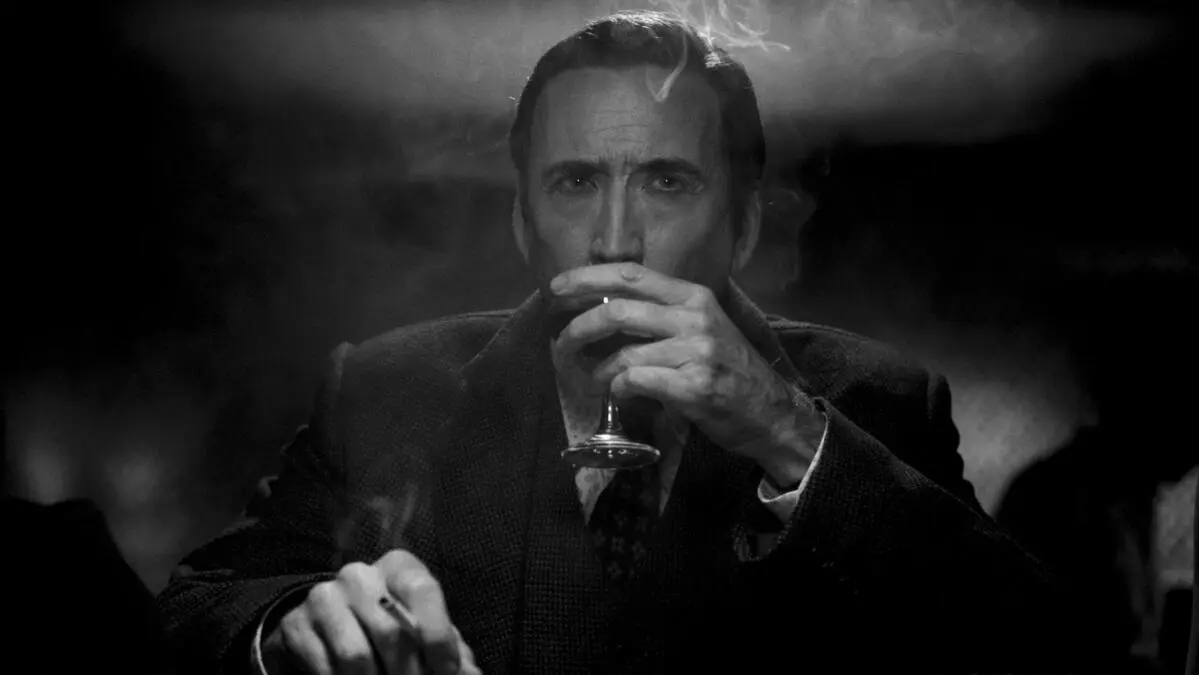
It’s funny: While there are complaints in many places that films and series are too pale, a prominent streaming production advertises that it is completely colorless. We’re talking about “Spider-Noir”, an offshoot of the comic universe surrounding the superhero Spider-Man. The Amazonseries with Nicolas Cage is offered online in two versions: one promises “true full color,” the other “authentic black and white.” A mouse click decides.
Why “authentic”? The series makers proudly point out the production process: Instead of simply decolorizing their recordings digitally afterwards (which has long been technically possible), they adjusted the lighting, costumes and props to the requirements of monochrome optics during filming – as was once common practice. But there is something else that resonates with the authenticity attribute, which is just as beneficial for advertising: black and white, that is genuine, earthy and rustic, that is retro, vintage, vinyl…
The homage to the shades of gray and dark worlds of film noir, whether nostalgic or hipster, is nothing new with God. Every now and then someone in Hollywood or elsewhere comes up with the idea of casting anew the long shadows from “The Trail of the Falcon” (1941), “The Third Man” (1949) or other relevant cult films. A direct precursor to “Spider-Noir” is “Sin City” (2005) by Robert Rodriguez and comic artist Frank Miller, in which Bruce Willis drifts through the pop art version of a noir metropolis (spiced up with occasional splashes of color). Steven Soderbergh tried his hand at “The Good German” in 2006 George Clooney on this postmodern style game, Lars von Trier – already in 1991 – in the arthouse historical drama “Europe”.
More recently, however, the high-contrast salt-and-pepper aesthetic appears to be becoming more popular outside of Humphrey Bogart memorial projects. Black and white productions regularly appear in the main program at major film festivals. They are often historical films and literary adaptations: the Thomas and Erika Mann road movie “Fatherland”, Kirill Serebrennikov’s “The Disappearance of Josef Mengele”, “The Stranger” by François Ozon or “Rose” by Markus Schleinzer, whose sponsor Michael Haneke won the Palme d’Or in Cannes in 2009 with the black and white epic “The White Ribbon”. In the genre and underground context, too, filmmakers are increasingly relying on the charms of the gray look – for example the Steyr-born Norbert Pfaffenbichler in his abysmal “2551” trilogy (which is based on visually colored silent films) or the Briton Ben Wheatley in the experimental science fiction piece “Bulk”.
Where does the ongoing fascination with black and white come from? Why can’t a look that most people have associated with “old films” since the 1960s at least be killed? The short answer is very simple: black and white images look damn good. (“Why not?” was Markus Schleinzer’s response to the journalist’s question as to why he decided to go colorless in “Rose.”)
The longer answer has to do with the associations that black and white photographs trigger in us. First of all, their aesthetics are always somewhat historicizing: they inevitably refer to that clearly defined historical period in which black and white was the norm for camera technology. Paradoxically, this also results in an aura of timelessness: black and white views seem to speak to us from a past that has survived into the present and continues to have an unbroken effect – especially when it confronts us in the form of current, “living” moving images.
This gives many black and white films from the polychrome era something serious and dignified. Especially when they deal with important historical issues: it’s no coincidence Steven Spielberg He largely avoided color in his epoch-making Holocaust drama “Schindler’s List” (1993). In this way he also wanted to build on the raw immediacy of the black and white documentary film material that survives from the Second World War.
Black and white often serves a dramatic effect: Renaissance painters already knew that harsh light-dark contrasts can create visual tension. They had a term for it: “chiaroscuro.” The cinema repeatedly resorted to this technique, from German Expressionism to the aforementioned film noir – to Orson Welles’ Kafka film adaptation “The Trial” (1962).
Their drama comes not least from the feeling of abstraction that black and white can evoke when it removes what is depicted from reality and reduces it to what appears to be the “essentials”. Robert Surtees, cameraman on the black-and-white coming-of-age classic “The Last Picture Show” – which was already retro when it was released in 1971 – compared the qualities of this conscious reduction with those of artistic etchings. Can you imagine the symbolically heavy chess duel between Knight and Death from Ingmar Bergman’s “The Seventh Seal” (1957) in bright Technicolor? At best as a parody.
Since the heyday of urban portrait and street photography (and the wave of films inspired by it), coolness has also been an essential aspect of black and white stylistics. Pioneering artists such as Robert Frank, Robert Mapplethorpe and Herman Leonard shaped a look in the post-war USA that radiated directness, authenticity and confident nonchalance – especially in comparison to the sugar-colored world of goods during the economic boom.
Later, the power of these counter-images was hijacked by the world of goods in question – a circumstance that has long since been reflected in our perception. Today, black and white in advertising is an almost hackneyed means of emphasizing – depending on the degree of visual smoothness – the robust “authenticity” and individuality of what is shown or of associating products or personalities with a kind of nobility that implies sublime stylistic confidence. Even Hawaiian shirts look classy in black and white.
Film and series makers also relied on this effect. It arises primarily from the contrast that the monochrome creates with the usual. Digitalization has made it easier to contrast color and non-color within a film – whether as a cinematic gimmick (as in Wes Anderson’s “The French Dispatch”) or as part of an aesthetic concept (as in Serebrennikov’s Mengele film). That’s the irony of (film) history: color was once what made films stand out from the gray monotony. Now it’s the other way around.