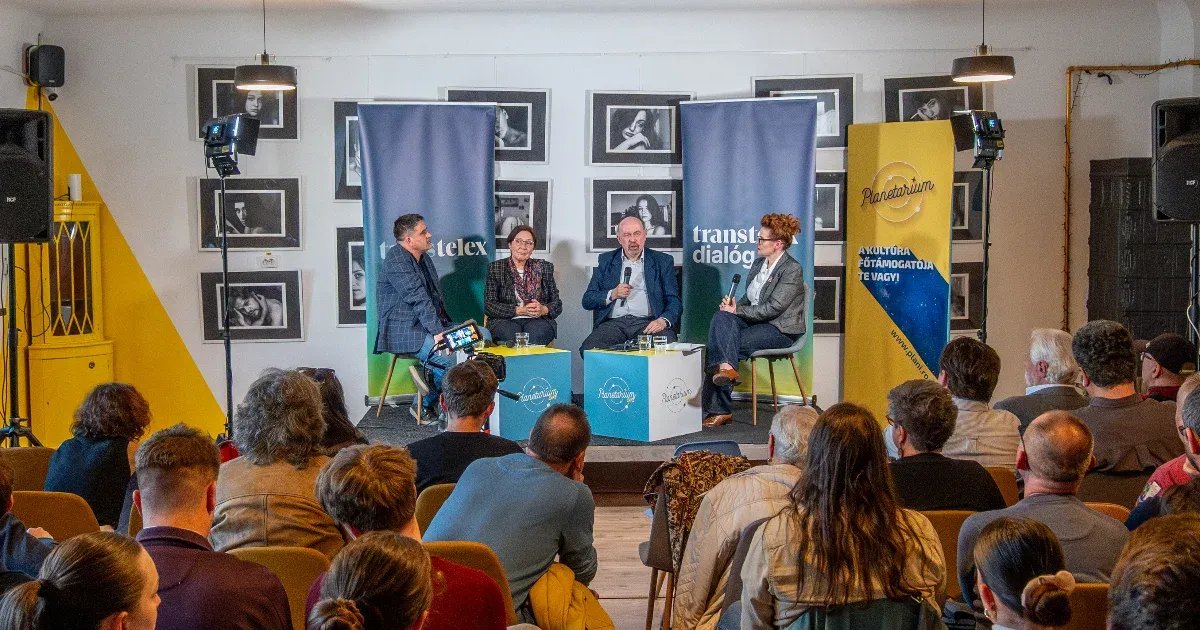
The Hungarian election results rewrite the political balance not only in Budapest, but also in Transylvania, as it is clear that the eradication of Fidesz dependence must be solved and a change of direction is needed both within the RMDSZ and at the level of the entire Hungarian society in Transylvania – it was said at the Transtelex Dialog, where the past, present and future of Hungarian interest representation in Transylvania were discussed in the context of the Fidesz defeat.
The discussion was attended by three guests who follow the Hungarian political processes in Transylvania from different points of view but with deep insight: Tamás Kiss, who in his research he also analyzed the political attitudes of Transylvanian Hungarian society and the operation of support systems; Béla Markó, the founder and former president of the RMDSZ, who represents the earlier, more balanced era of the party, and has been since then is critical of its change of direction; and Smaranda Enache, who has been following the development of Romanian-Hungarian relations for decades, as well as from outside he is well aware of the consequences of RMDSZ’s close ties to Fidesz.
Béla Markó, who led the Association between 1993 and 2011, formulated the principle of “equal proximity, equal distance” as the basis of the relationship with the governments of Bucharest and Budapest. This meant that the RMDSZ does not bind itself to any political side, but cooperates pragmatically with the current governments along its own community interests. This principle has come up again and again in the recent period, as the shift of the RMDSZ and its one-sided attachment to Fidesz became more and more obvious.
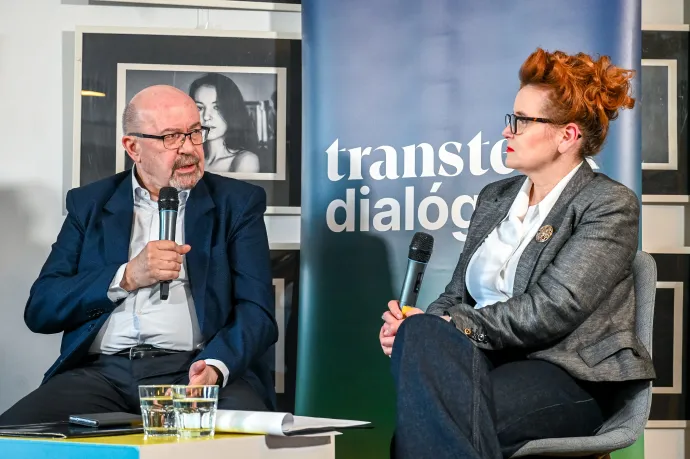
Béla Markó, former president of RMDSZ and Emese Vig, editor-in-chief of Transtelex – Photo: Tamás Zsófia / Transtelex
Markó said: when the Association was founded, it was an express goal to represent the entire Transylvanian Hungarian community, not to create an ideologically unified organization. They wanted to create a political framework in which multiple worldviews and approaches could be accommodated. This balance was maintained for decades, and even relations with Hungary did not overwrite this principle.
“For us politicians, this was always a puzzle: another government came, we had to cooperate with it, we had to clarify the principles. Not everyone thought the same way. But basically, until 2010, our interests coincided: Hungarian interests in Hungary and Transylvania also pointed in the direction of European and Euro-Atlantic integration. There was no dispute about that,” he said.
After 2010, however, a conflict of interest gradually appeared between the government policy in Hungary and the Hungarian political representation in Transylvania, which the RMDSZ did not address openly for a long time, but rather avoided or relegated to the background.
Now, when the outgoing prime minister of Hungary, Viktor Orbán, says goodbye with the slogan that he will invest his energy in building the national side, it has a negative effect on the Transylvanian Hungarians, because according to Markó, this is rhetorical appropriation, we all belong to the national side:
“There is no such thing as a national side. There is a nation. And this nation is made up of Hungarian people of different political colors, thoughts and worldviews.”
This kind of political expropriation not only simplifies but also narrows the self-interpretation of the community, the former RMDSZ president drew attention, according to whom this kind of exclusionary politicization was not acceptable until now.
One of the central elements of the RMDSZ’s campaign communication was that Hungarian interests in Hungary and Transylvania coincided. According to Markó, this was partly true: “we obviously agreed with the generous subsidy policy, part of which served a really useful purpose”. At the same time, according to him, this relationship has gone into such extremes that an image of dependency has developed: the impression is that the Hungarian political representation in Transylvania, and even the community itself, is unilaterally dependent on the Hungarian government. This image was fixed primarily in the public opinion and political space of the motherland, but it also affected the self-image of Transylvanian Hungarians. Even if the reality was more nuanced than this, the narrative of the dependency relationship was permanently embedded in the public consciousness.
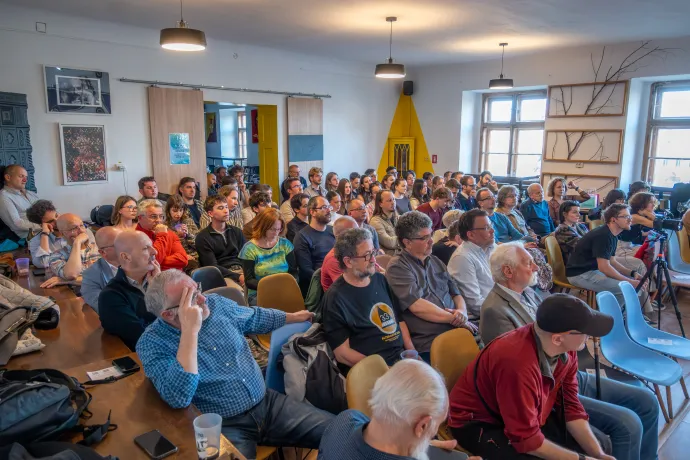
Photo: Zsófia Tamás / Transtelex
Tamás Kiss is a sociologist who already mapped the support policy mechanisms he approached the question from the point of view of how we came to the conclusion that it was Viktor Orbán refer to Kelemen Hunor as the chief of Transylvanian Hungarians. According to him, there is (also) a type of illiberalism in Transylvania, by which politics dominates the sub-systems that are not political in principle, be it the fields of culture, science or even the press. And this has been built up to its present state in the last 16 years, as a result of a gradual change in direction.
“Direct party politics – which currently means the RMDSZ, because there are no alternative organizations that can be taken seriously – undermines institutions, and one of the sources of this is clearly Hungarian,” he said.
In educational matters, the organization of cultural events, and the awarding of scholarships, political decisions prevailed more and more, while these previously belonged to professional organizations and autonomous institutions. This type of intervention not only leads to the relegation of professional aspects to the background, but also undermines the credibility and functionality of the institutions in the longer term, he explained.
One of the most visible examples of this illiberal structure is the postal voting system. According to Kiss, the RMDSZ played a dual role here: on the one hand, it campaigned for Fidesz as a political actor, and on the other hand, it functioned as an extension of the Hungarian state in a technical-administrative role. Thus, he imported a party-state operating logic that is fundamentally foreign to the democratic institutional environment in Romania.
At the same time, it is not only Hungarian influences that matter. The Romanian minority policy framework also contributed to the operational model in which RMDSZ operates today. Although there is no formal autonomy, a de facto autonomous situation has developed, where Hungarian decision-makers have control over Hungarian institutions, Romanian state actors and authorities intervene relatively little, and local governments, educational institutions, and historical churches led by the RMDSZ have considerable room for maneuver. According to him, the problem is that this system operates largely without internal control, so accountability is incomplete, and decisions are often made according to a closed, politically driven logic.
Therefore, according to him, the key issue is the internal democratization of the Hungarian institutional system in Transylvania, which could create a more transparent and balanced operation.
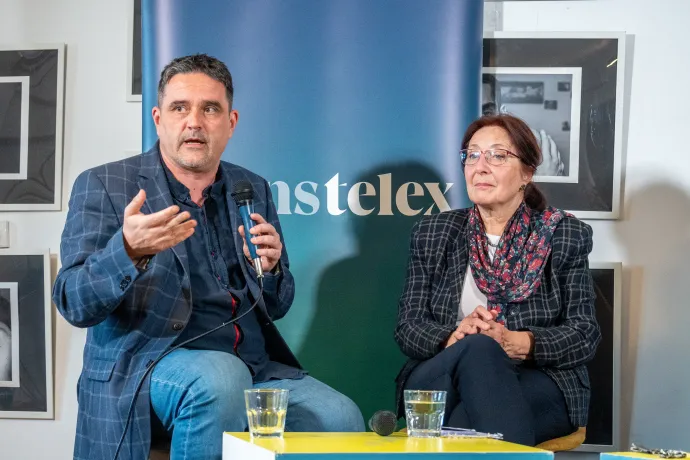
Tamás Kiss, sociologist and Smaranda Enache, human rights activist – Photo: Zsófia Tamás / Transtelex
According to Smaranda Enache, the Fidesz-RMDSZ relationship can also be characterized as ideological colonization. Fidesz found an ally in the RMDSZ in which it recognized the orientation necessary to export its values. He found people who, by being key players in the Transylvanian Hungarian community, were able to achieve material and symbolic success, but in return they paid the price by perpetuating the ideology.
According to the human rights activist, the restoration of the RMDSZ’s image cannot be done by a simple change of direction, and even self-critical rhetoric of the “mea culpa” type is not enough, but rather it is necessary to amplify the internal critical voices, as well as to publicly acknowledge that the organization contributed to the one-sided information of the Hungarian community in Transylvania and to the creation of the distorted reality bubble from which it is now very difficult to mentally exit. Without it, he added, the position of the RMDSZ in both Bucharest and Budapest could further weaken.
At the end of the evening, Béla Markó summarized the most important lessons. He said that although he is still a member of various governing bodies, he often feels alone with his opinion. At the same time, according to him, every responsible leader must bear criticism and has a duty to speak up.
“This is the future. I see no other solution. The RMDSZ must be opened, it must be made into an alliance again. A new alliance must be created,” he said.
According to Markó, opening up to intellectuals, rebuilding relationships of trust, and bringing professionalism back into decision-making are essential for this. He sees that in recent years the RMDSZ has become strongly partisan – he considers the influence of Fidesz to be a determining factor in this – and has moved away from the broad, multi-faceted community operation that once characterized it.
According to him, the “old covenant” in its current form is practically dominated by a single, conservative direction. If the need for modernization does not appear alongside it, the entire community may be in danger. “You have to stand up, you have to speak up, you have to do self-examination,” he said, adding that there is nothing tragic about this, it is a necessary process. A new alliance is needed – built on new foundations and in a much more socially inclusive way.

Béla Markó – Photo: Zsófia Tamás / Transtelex
During the conversation, the change of direction in foreign policy and past omissions were also discussed, and the audience’s questions made it clear that the relationship between the RMDSZ and the Transylvanian Hungarian community it represents has now “eroded to the point of fringes” and, according to many, has already become “dysfunctional”. Several people also asked about a possible leadership crisis within the Association.
Béla Markó admitted that although he has not led the Association since 2011, he still feels responsible for the political principles of the RMDSZ and how it affects the fate of Transylvanian Hungarians. According to him, the key issue in this situation is the rebuilding of trust, especially in the direction of critical intellectuals, who have been gradually pushed out of the organization’s environment in recent years.
He also emphasized that instead of an opaque support system, decision-making would be needed that is based on clear, professional aspects and restores accountability. In his opinion, only such a change of direction can create a chance for the Association to once again become an authentic political representation.
The entire conversation will soon be available on the Transtelex website.