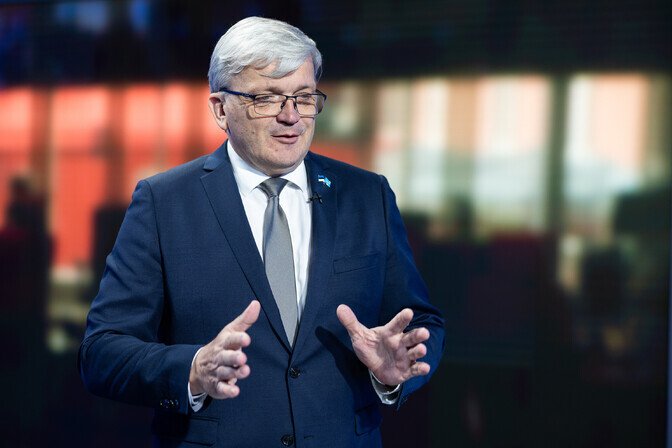
Raudsepp said architects and the excessive pursuit of custom solutions for projects are driving up costs for the city.
“An architectural competition is organized for virtually everything and whenever even remotely possible. That certainly provides architects with a large and steady source of work and income and subsequently work for interior designers and interior architects as well, but what does it mean for the city? It means these projects become expensive from the outset. A great deal of custom design is used. We do not want to see any kind of standard solution anywhere. We want everything to be exclusive; we want to be impressive. Emotionally, that is all understandable, but in reality our projects are too expensive,” Raudsepp said.
According to the mayor, Tallinn has had projects whose costs have increased by 30 percent, 50 percent and even more than 70 percent over the years.
“That shows cost management has really gotten completely out of hand,” he said.
“The result is that we either end up with very expensive projects, where all the money is spent on them and there is no funding left for other similar projects. Instead of creating isolated beautiful things in the city, we should be improving the quality of the entire urban environment. Or, unfortunately, another outcome that has occurred very often is that a competition is completed, everything is planned out and then the project has to be abandoned because the price tag is simply too high,” Raudsepp said.
“In this regard, my city government has given different instructions. First, budget discipline must be maintained. If costs and investment volumes have already been set, there is no point in coming back asking for more money. That will not happen. It must be justified and we have become very strict about this,” he said.
Raudsepp said projects whose costs have risen include the entrepreneurship incubator building, the Tallinn City Theater, the circular economy center in Lasnamäe, Tallinn Secondary School of Science and Kullo.
Raudsepp said he has directed the city government to make greater use of standard solutions. He noted that eliminating architectural competitions could make a playground project almost half as expensive.
“If we proceed from the principle that the interiors of buildings, for example schools, should use standard furniture or standard solutions, that makes them significantly cheaper,” Raudsepp said.
As a negative example, Raudsepp cited a planned flower wall in a procurement for Tallinn Secondary School of Science that would cost €60,000, as well as a cabinet for the teachers’ lounge priced at €26,000.
“This is what happens when officials accept everything without question, when there are no filters in place. If an architect and interior architect have been appointed, then everything they propose is accepted as it comes,” Raudsepp said.
“We do not behave this way at home. At home, we are not so dependent on architects and interior architects or so influenced by their ideas. So standard solutions are the next direction, allowing us to save money and build more projects with the same amount of money, rather than just one very expensive one,” the mayor said.
According to Raudsepp, standard solutions can help save money, for example in the interior design of buildings.
“I graduated from a high school that was built using a standard design. I attended university lectures in a building that was also built using a standard design. Those certainly were not things that negatively affected my education in any way,” Raudsepp said.
“It is very strange to think that in Tallinn we have one very luxurious school in the city center and then a kilometer or a kilometer and a half away there is suddenly a school where, unfortunately, students do not even have hot water when washing their hands in the restroom,” Raudsepp said, speaking about the Old Town Educational College.
ERR’s Indrek Kiisler asked Raudsepp whether Tallinn could make greater use of private capital.
“If we are talking about large concert and conference halls, for example in the context of Linnahall, then that is exactly the right place for it,” Raudsepp said.
Speaking about the renovation of schools and kindergartens, he said it is beneficial when there are multiple sources of financing for an investment and private capital could be one of them in the future.
However, Raudsepp stressed that public-private partnership (PPP) projects for the renovation of Tallinn schools are not currently under consideration.
“Today, we are not considering anything of that kind. But if you ask whether such an idea could be discussed, then it could, for two reasons: first, as a source of financing, and second, because of the approach and expertise involved. Inevitably, the private sector handles these things more rationally,” Raudsepp said.
Mayor: Cars will not be going anywhere
Speaking about traffic in Tallinn, the mayor said the goal is to increase the capacity of intersections.
“The previous city government’s approach was more about pushing cars out, reducing the number of lanes and replacing them with pocket parks. That is certainly not sustainable if we apply it to all intersections. The capacity did not even decrease that much — only by about 10 percent. But what happens if all of those intersections, one after another, lose around 10 percent of their capacity? That is undoubtedly a major problem,” Raudsepp said.
“Cars will remain everywhere. That is inevitable,” Raudsepp said.
According to Raudsepp, the city must also take into account families who have moved outside Tallinn or to its outskirts but continue to work in the city and are among the most active car users.
“As a result, Tallinn has begun to age and population growth has come to a halt. That means constant commuting between neighboring municipalities and central Tallinn for jobs, schools, kindergartens, extracurricular activities, service providers and shops. Mobility is an issue that must be addressed seriously — not from the perspective of pushing cars out, but of increasing capacity,” Raudsepp said.
—