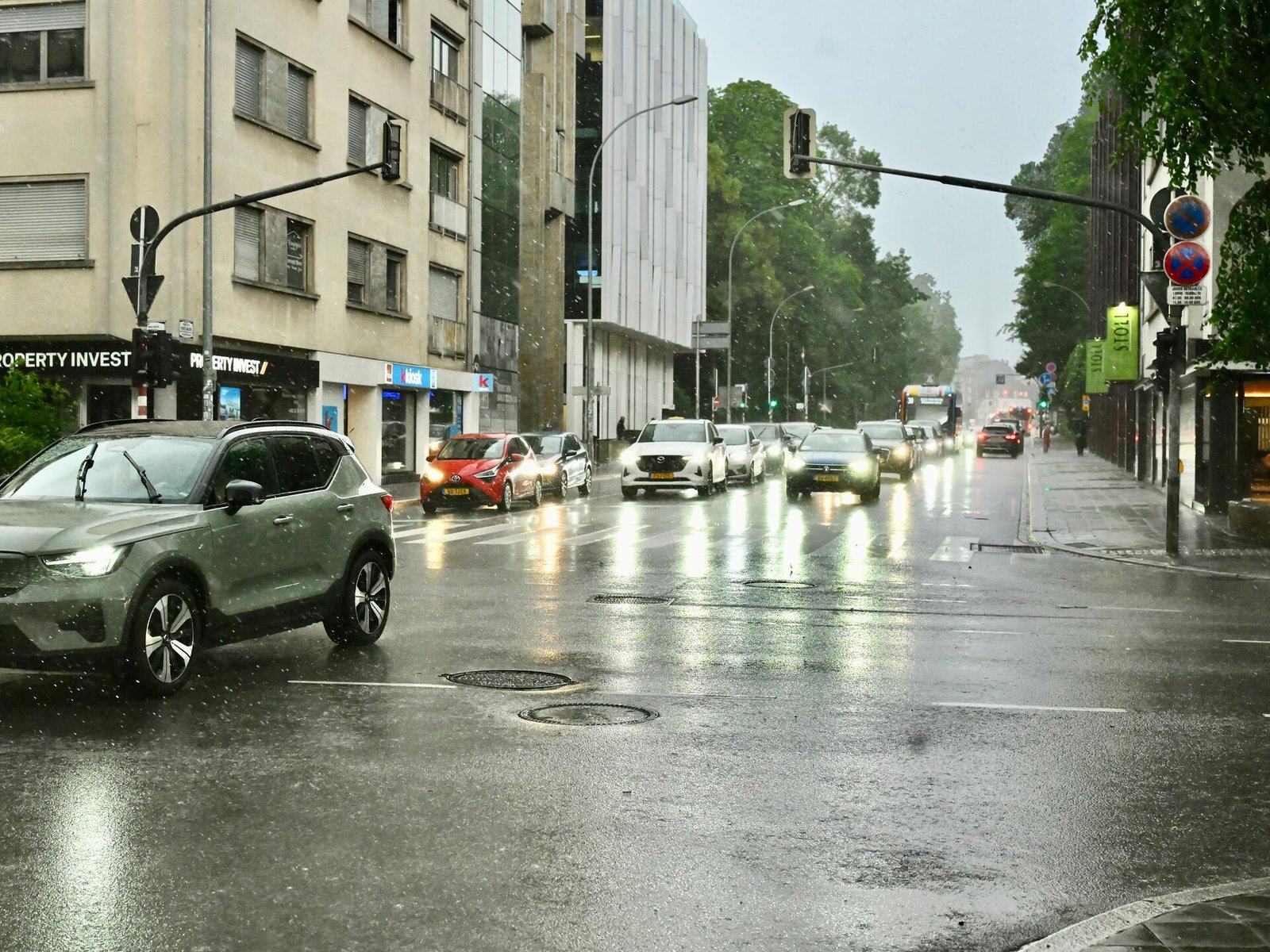
Committing to a safe bicycle infrastructure and corresponding political measures: That is the goal of a “Vëlo Manif” that ProVelo is calling for in the capital on Saturday. Such actions are important – and also affect those who rarely cycle. Because they are a reminder of how great the need for action continues to be in Luxembourg City, among others. Despite all political affiliations, cars still have the right of way there.
The parking vignette system shows how car-oriented the capital’s transport policy is: residents can park outside their residential area for two hours free of charge throughout the city; the first vignette is free. The second one costs 60 euros and the third costs 120 euros. This makes Luxembourg City one of the most generous municipalities in the country. Others charge a fee for the first vignette or limit the number per household.
In March 2024, mobility alderman Patrick Goldschmidt (DP) announced at the presentation of the capital’s mobility plan that public transport was a priority – and just a few moments later, together with Mayor Lydie Polfer, he declared that the second tram line through the upper city was “not a priority until 2035” and was “simply not feasible”. This meant that an important public transport project was postponed indefinitely. There had been repeated discussions about the second route, especially the part through Avenue de la Porte-Neuve.
Speaking of Avenue de la Porte-Neuve: As ProVelo in September 2025 wanted to organize a car-free day in the capitalthe association met with rejection from the city. In particular, closing the busy road along “Stater Park” was out of the question, explained ProVelo President Monique Goldschmit. And pointed out that in Paris the entire Champs-Elysées will be closed to traffic for this occasion. What is feasible elsewhere is apparently still too big a step in Luxembourg City.
When something is done for gentle mobility, it is always prestige projects, such as the seven million euro “Passerelle des arts” on the Kirchberg near Mudam or the planned bridge over Neudorf. 40.1 million euros are budgeted for their construction. However, far less spectacular measures are often crucial for quality of life: safe zebra crossings, continuous cycle paths and public space that is not primarily tailored to car traffic.
While ProVelo takes to the streets with the “Vëlo-Manif” on Saturday, the city of Luxembourg is celebrating 100 years of urban bus operations and 150 years of public transport in Hollerich. This is pleasing because, despite all the commitments, cars still predominantly shape the capital’s transport policy. Anyone who seriously wants to promote public transport and soft mobility should not only celebrate them on anniversary days. These should get the green light from politicians every day.