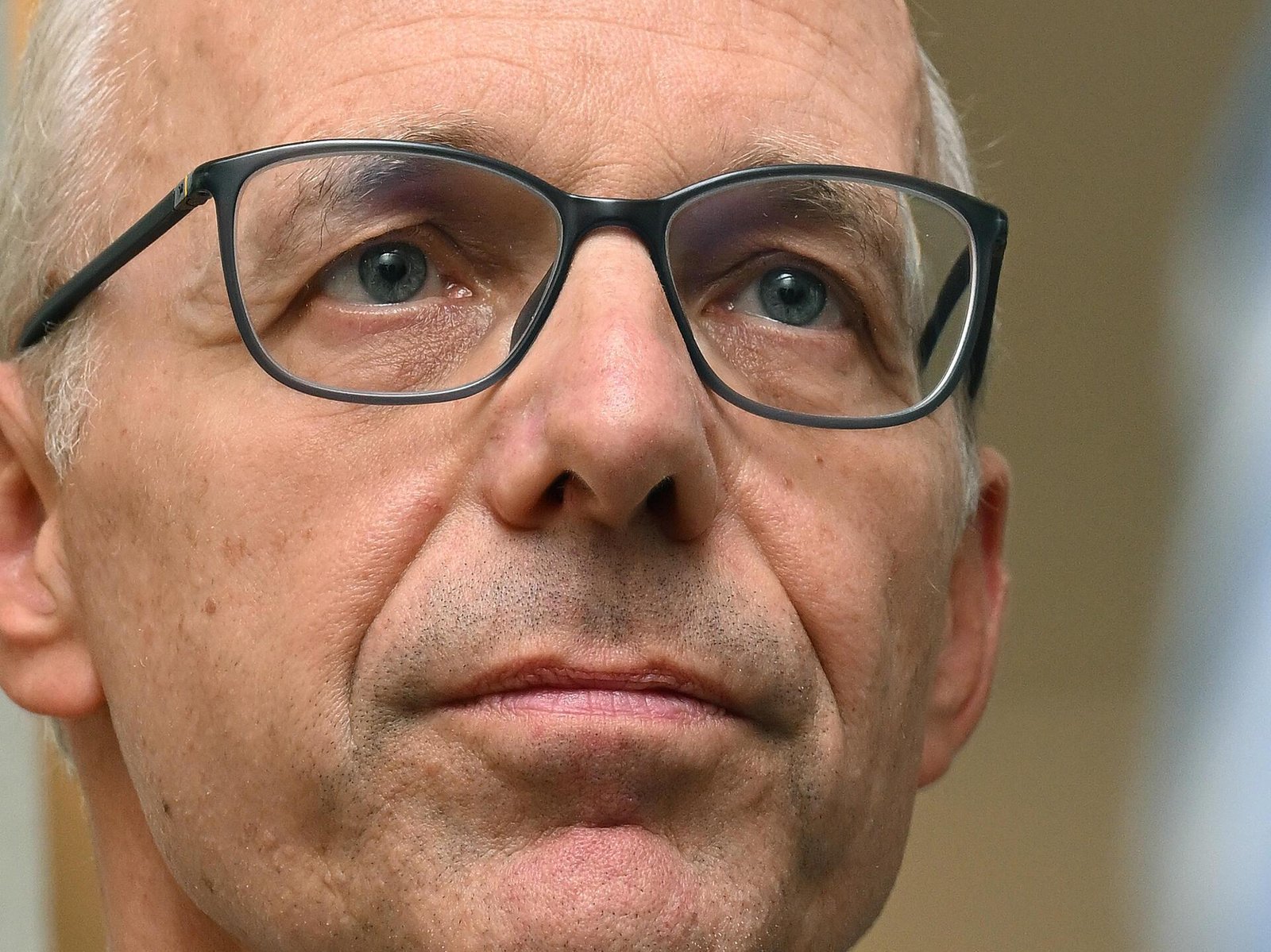
The sparrows whistled from the rooftops after the opposition, trade unions, some patron representatives and even the junior partner DP called for the government and social partners to come together: Prime Minister Luc Frieden (CSV) announced on Wednesday that “a Tripartite format” would meet at the end of May or beginning of June to discuss the simmering crisis in the Middle East and its impact on energy prices and purchasing power in Luxembourg. Until then, the Prime Minister and the responsible ministers want to meet with the social partners in preparatory discussions. The “Comité de coordination tripartite” will then meet at the “highest national level”.
The timing of the announcement is no coincidence. Prime Minister Frieden justified this by saying that they were not reacting to the crisis in the Gulf region and the blockade of the Strait of Hormuz with a certain amount of “hustle and bustle” like “the markets”, but rather wanted to “govern with a steady hand”. However, May 1st is almost a week away. A day on which the government has to expect sharp criticism from the unions over its past decisions regarding the minimum wage and the fallow social dialogue. The demand for a Tripartite would have been loudly voiced there again. The announcement of a tripartite is intended to take the wind out of the sails of the unions OGBL and LCGB, which are allied in the trade union union, and is perhaps hoping for a somewhat more conciliatory reception.
Trade union union reaction
OGBL President Nora Back is pleased about this Daily newspaper representative of the trade union union OGBL-LCGB about the government’s announcement. What is important now is that, unlike the previous meetings of the social partners, there is discussion in the tripartite and that this is properly prepared. “It has to be properly structured with an agenda that is acceptable to all negotiating partners. It’s good that the tripartite was only scheduled for June,” says Back. The trade union union does not necessarily want to commit itself to certain topics, but minimum wages or the strengthening of collective agreements would also be part of the increase in purchasing power called for by Prime Minister Frieden.
The Prime Minister denies that Frieden felt compelled to take a tripartite because of the DP’s recent statements. “I listen to what everyone tells me. There were also many voices in the CSV who thought a tripartite was good,” said Frieden at the press conference on Wednesday after the government council. After all, the situation today is different than it was a few weeks ago. It is not possible to predict how long the blockade of the Strait of Hormuz and its consequences for the prices of oil products, fertilizer and food will be maintained. In an interview on RTL on Monday morning, DP Minister Yuriko Backes was the first member of the government to openly call for a Tripartite. DP President Carole Hartmann confirmed these considerations within the party on Radio 100.7 on Wednesday morning.
Crisis or no crisis?
However, Frieden did not want to give up the decision-making authority over the timing of a tripartite on Wednesday. “I think now the moment has come,” explained the Prime Minister at the PK. The moment when he uses what he calls a “crisis tool” and thereby recognizes the implicit existence of a crisis? Not quite. “It is an atypical crisis that was brought on from outside, is international in scope and whose effects cannot be fully predicted,” explains Frieden. To what extent this attribution differs from the previous energy crisis as a result of the Ukrainian war, the financial crisis or the steel crisis in the 1970s as a result of the international oil crisis, only the CSV Prime Minister himself knows. However, one thing is certain for peace: “We see the consequences primarily at the gas station and with heating oil, but not yet in a structural way.” Industry is also affected by energy prices, although small and medium-sized companies are not directly affected by longer-term energy contracts. Frieden did not want to reveal directly which topics would be discussed in addition to rising energy prices. “We will conduct preparatory discussions to find out where the impact is greatest and try to find a consensus that will help both people and companies.” Just this much: Purchasing power and energy prices are “two adjustment screws” that the government wants to adjust.
Limited financial flexibility
Frieden also states that the government has already taken some measures leading up to the Tripartite. “We have the index that other countries don’t have,” says the Prime Minister. In addition, the government has covered the network costs for 2026 with a budget of around 150 million euros in order to curb energy prices and has tripled the energy bonus for needy households. Selling the index as a political measure by the CSV-DP government is reminiscent of the faux pas made by Labor Minister Marc Spautz (CSV) and Economics Minister Lex Delles (DP) a few weeks ago, when they touted the increase in the minimum wage based on wage indexation and adjustment to real wage developments as a government decision. The tripling of the energy premium was already decided and budgeted for in July 2024, and the assumption of the network costs for 2026 was already decided and budgeted for last year – neither of which were concrete reactions to the war that broke out in the Middle East at the end of February 2026 and the resulting increase in energy prices.
A crucial question that Prime Minister Frieden and his Finance Minister Gilles Roth (CSV) will have to answer by then is that of the financial scope for possible measures. Frieden had already indicated in the past that Luxembourg would no longer necessarily stick to a national debt below the 30 percent mark. However, when asked by a journalist on Wednesday, Frieden made it clear: “I don’t know where you got the 30 percent figure from. In the coalition agreement, we set the goal of securing the ‘Triple A’.” This means: In the future, the government will not only have to raise money for the announced tax reform, which it wants to stick to according to peace, and increasing defense spending, but also finance a possible package of measures from the Tripartite – if necessary with further debt. “This government stands for fewer taxes and healthy state finances. Strengthening cohesion in society has its costs,” said Frieden.
“Success an Echec zesum”
Costs that could cost the Prime Minister dearly, both financially and politically, given the recent “death blow” to social dialogue, as the unions have dubbed the government’s announcements on the minimum wage. Trade union representatives have already demanded concrete results several times in the past and will not want to be fobbed off easily in the coming tripartite. The patronage will hardly want to make any concessions with reference to the economic situation. The previous winner is the coalition partner CSV. Despite statements to the contrary, Luc Frieden is being driven through the political arena by the DP. This does not reduce the pressure to bring together the demands of salary and patronage representatives to reach a consensus.
Meanwhile, Prime Minister Frieden is trying his hand at slogans for perseverance, saying that we should go into the Tripartite with a “constructive attitude”. And on Wednesday he spread the blame for a potential failure on several shoulders and said that it was not a “one-man show”. “Et gëtt e Succès zezumen an et gëtt en Echec zessumen. I started with the strong hope that I would find a compromise solution based on the traditional Lëtzebuerger model with consensus.”
Child benefit will be increased
The government council also decided on Wednesday to increase child benefit per child by 45 euros. For children over the age of twelve, a surcharge of 60 euros was imposed.