Washington, June 12 (SANA) Syria’s proposed “Four Seas Initiative,” an ambitious plan to transform the country into a regional hub for energy, transport and trade connectivity, received renewed attention this week during a policy discussion in Washington that brought together Syrian officials, energy experts and regional analysts.
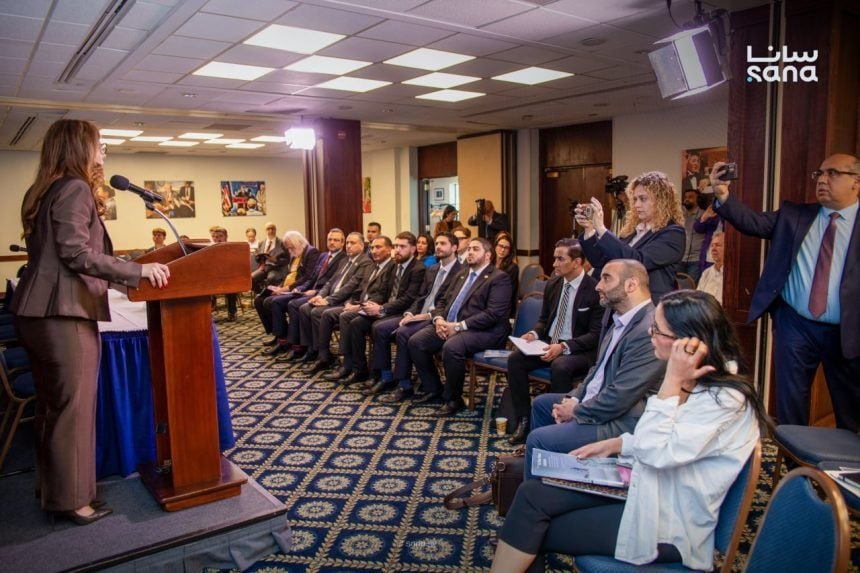
Speaking at an event hosted by the New Lines Institute, Syria’s chargé d’affaires in Washington, Mohammad Kanatri, presented the initiative as a blueprint for reconnecting Syria to regional and global markets after years of war, isolation and sanctions.
“We want Syria to connect countries again, not divide them,” Kanatri said.

Syria’s vision for regional connectivity
The initiative envisions expanding regional infrastructure networks through pipelines, electricity interconnections, railways and communications links connecting the Mediterranean, the Gulf, the Black Sea and the Caspian region.
Kanatri said that Syria’s strategic geography, once overshadowed by conflict and political isolation, could become one of the country’s greatest economic assets.
“In the past, this location was seen as a burden,” he said. “But today, that regime is gone, and its policies are gone. This same geography and location can now become a real opportunity and asset for Syria, for the region and, if I may say, for the world.”
The proposal comes as Syria seeks to attract foreign investment and rebuild an economy devastated by more than a decade of war. Syrian officials have increasingly promoted infrastructure development and regional integration as pillars of the country’s economic recovery strategy.
Energy corridors and post-sanctions opportunities
Kanatri pointed to recent progress, including oil shipments by truck from Iraq to Syria, the operation of a gas pipeline linking Kilis in Türkiye with Aleppo, and ongoing discussions over reviving the historic Kirkuk-Baniyas oil pipeline.
He added that recent geopolitical tensions affecting maritime energy routes have increased the importance of alternative land corridors across the Middle East.
“When there are risks around the Strait of Hormuz, energy supplies become uncertain,” Kanatri said. “This makes alternative routes more important.”
Experts see economic potential
The initiative received support from several participants at the event, who described Syria’s geographic position as a potentially valuable link between major regional markets.
Azeem Ibrahim, Director of Special Initiatives at the New Lines Institute, said Syria’s geographic position enables it to become a regional energy hub.
He said the Four Seas Initiative offers a framework for regional energy cooperation involving Syria, Iraq, Türkiye and other neighboring countries.
“With the geopolitical landscape shifting, it is now time to take this more seriously and secure support from countries like the United States and Europe behind such initiatives to help rebuild Syria,” Ibrahim added.
Aaron Y. Zelin, a senior fellow at the Washington Institute for Near East Policy, said Syria’s location could give it a significant economic advantage if infrastructure projects move forward.
“I think it’s an important place for Syria to go now that it’s integrating back into the world economy because it’s a key midpoint between a lot of different regions,” Zelin said. “If this does work out and the infrastructure is built, it could be a huge boon for the state treasury, but also hopefully economically, locally as well.”
Regional energy projects take shape
Energy cooperation featured prominently in the discussion, with Syrian Assistant Minister of Energy Ibrahim al-Addahan outlining ongoing regional projects and negotiations.
Al-Addahan said Damascus is currently coordinating with Iraq on plans to rehabilitate the Kirkuk-Baniyas pipeline and studying the feasibility of additional oil export routes extending through Syria to the Mediterranean.
He noted that Syria has already begun importing oil from Iraq by truck while expanding energy cooperation with neighboring countries.
“We take gas from Jordan and also from Türkiye,” he said. “We have an electricity linkage between Syria and Türkiye, and we have negotiations with our colleagues in Lebanon regarding gas and electricity.”
The official said such projects reflect the Syrian government’s belief that regional connectivity will be central to future economic growth.
Growing investor interest in Syria
Meanwhile, Myles B. Caggins III, a non-resident senior fellow at the New Lines Institute who recently visited Syria’s energy-producing regions, said international interest in the country’s energy sector is growing.
“American companies and international companies are interested in investing in Syria,” Caggins said.
He credited recent outreach efforts by President Ahmad al-Sharaa’s administration and energy officials with attracting attention from major investors.
“This will benefit all Syrian people,” he said. “In a few years, we will begin to see more jobs, more infrastructure projects.”
Beyond economics: A strategy for reintegration
For Syrian officials, however, the initiative is about more than economics.
Kanatri described the project as part of a broader effort to reintegrate Syria into regional and international affairs after years of conflict.
“Projects like this are part of healing,” he said. “Not only in an economic sense, but also in a social and global sense.”
“For many years, Syria was seen as part of a problem,” he added. “Now it can finally be seen as part of the solution.”


KA.ABD