
Updated ,first published
New defence force chief Mark Hammond says the navy is ready to deploy a ship to the Strait of Hormuz after being promoted in a significant military reshuffle that includes the appointment of the nation’s first female army chief.
Hammond, a former submariner who has led the navy since 2022, will take up the role in July following the resignation of current defence force chief David Johnston after two years in the role.
Hammond told reporters the navy was “absolutely” capable of assisting operations to reopen the Strait of Hormuz, despite widespread claims Australian warships were not equipped for the age of drone warfare.
“We’ve got 10 surface combatants right now, eight of them are at sea today. The navy is as ready as it ever has been,” he said.
“They are fitted with one of the most advanced radars in the world … and some of the most advanced missile and point defence systems in the world. Are they capable of performing the mission as Admiral Johnston said last week? Absolutely.”
Hammond continued: “The question of a contribution is one for consideration by the Australian government, should they receive a request, and there’s been no such request as yet.”
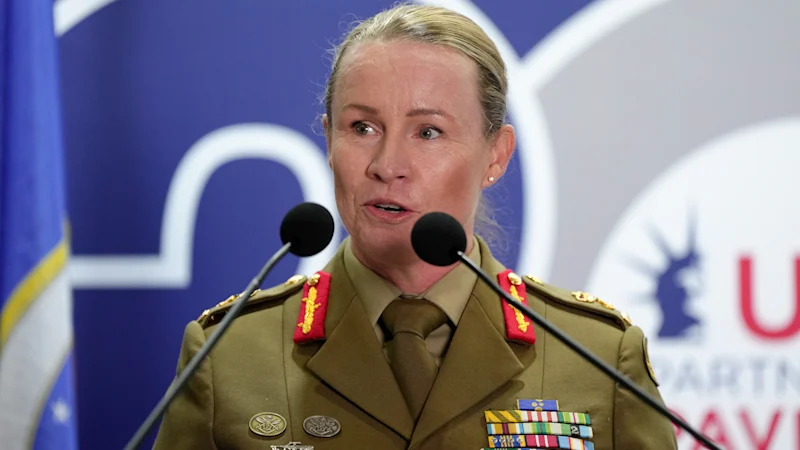
Susan Coyle, the current head of joint capabilities, will become army chief, replacing Simon Stuart following his retirement.
Defence Minister Richard Marles said Coyle’s appointment was “a deeply historic moment, one that should be noted”.
“As Susan said to me, ‘You cannot be what you cannot see’,” Marles said.
“And Susan’s achievement will be deeply significant to women who are serving in the Australian Defence Force today and women who are thinking about serving in the Australian Defence Force in the future.”
Coyle, who joined the Army Reserves as a soldier in 1987 before holding a series of senior roles, is the first woman to lead a branch of the defence force – army, navy or air force.
Prime Minister Anthony Albanese said Hammond had enjoyed a distinguished career, including 40 years in the navy, including as a submarine commander.
Marles said Hammond had “been right at the heart” of the plan to acquire a fleet of nuclear-powered submarines under the AUKUS pact, and had done an “incredible job” as navy chief since 2022.
Hammond and Albanese formed a strong working relationship, including on trips together to the US.
Johnston is retiring as expected after being appointed to a two-year term as defence force chief in 2024.
“The question of contribution is one for consideration by the Australian government should they receive a request and there’s been no such request as yet.”
Former submarine commander Matthew Buckley will replace Hammond as the chief of navy.
The government has yet to appoint a new secretary for the Department of Defence to replace Greg Moriarty, who is heading to Washington to become ambassador to the United States.
The government is also searching for a new head of the Australian Submarine Agency, which is tasked with delivering the plan to develop a fleet of nuclear-powered submarines.
Jennifer Parker, an expert associate at the Australian National University, said Hammond’s appointment reflects the growing importance of the maritime domain in military planning, and the importance of delivering on the AUKUS pact.
Parker, a former naval officer, noted that Hammond had strong connections within the US military system and was well known in Washington, putting him in a strong position to drive AUKUS forward.
As for the appointment of Coyle as the nation’s first female service chief, she said the move “had been a long time coming and is well overdue”.
She noted that Coyle had experience in space and cyber capabilities, as well as traditional army platforms, making her well-placed to learn lessons from modern conflict, including in Ukraine.
Former defence official Michael Shoebridge said Hammond’s appointment was unfortunate, describing him as “Mister Continuity at a time when the defence force needs change and urgency”.
Noting Hammond’s long career as a submariner and his advocacy for nuclear-powered submarines, he said he was concerned he would be too focused on naval capabilities.
 Matthew Knott is the foreign affairs and national security correspondent for The Sydney Morning Herald and The Age.Connect via X, Facebook or email.