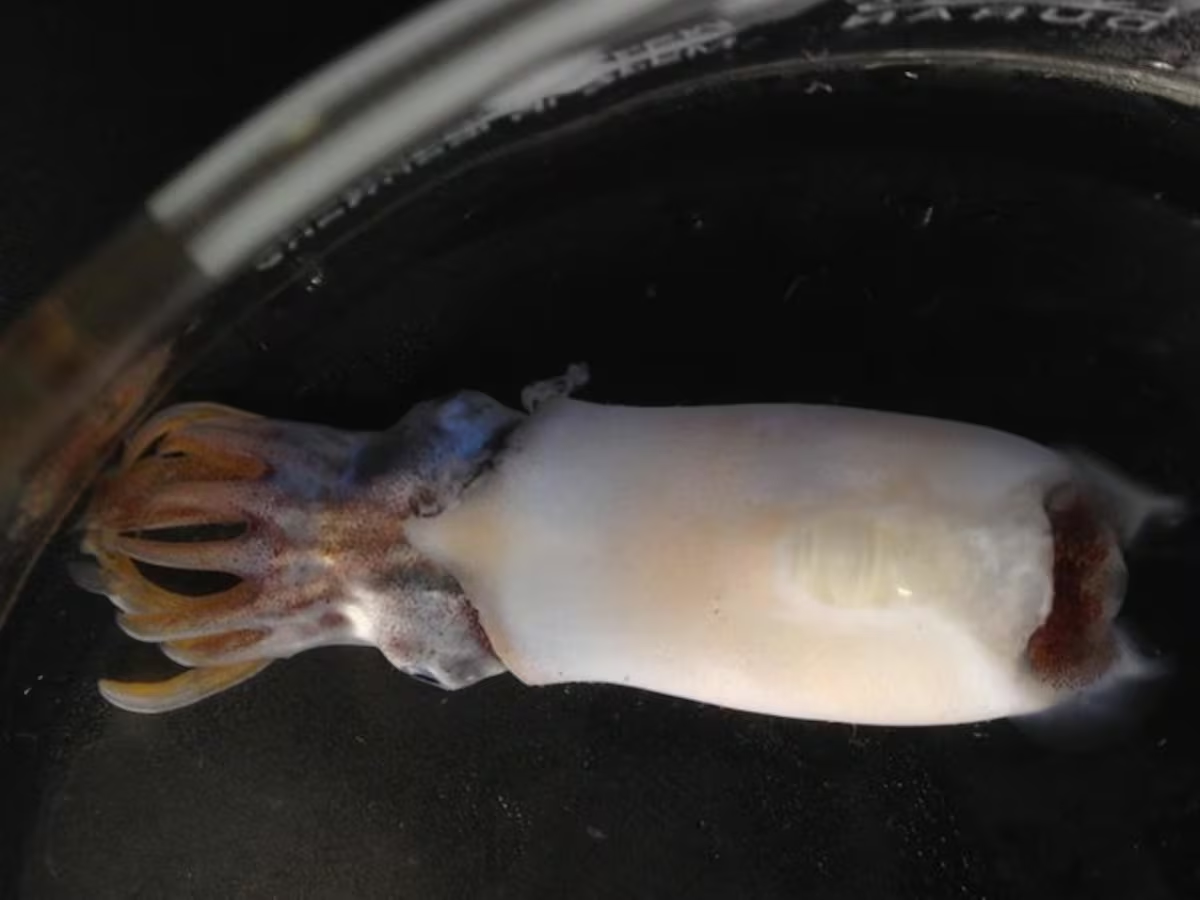
International research led by the Japanese Okinawa Institute of Science and Technology (OIST), in collaboration with the Spanish Institute of Oceanography (IEO, CSIC) among others, has shed light on the evolutionary success of squid and cuttlefish.
The work, recently published in the prestigious magazine Nature ecology & evolutionexplains how a group that was on the verge of disappearance or stagnation managed, after millions of years of “waiting” in the depths, to become one of the most diverse and successful groups of marine predators on the planet, according to a press release from the Oceanographic Institute.
To reach these conclusions, the international team sequenced three new squid genomes and used advanced transcriptomics techniques to understand how their organs and internal shell evolved.
The analysis combined existing databases with three squid genomes sequenced for the first time to identify the “tipping point” that gave rise to the current diversity of squid and cuttlefish, which together make up the Decapodiformes (ten-limbed) cephalopods.
The researchers propose that the mass diversification of modern squid did not occur immediately, but rather followed a “long fuse” model.
This means that, after an initial split of lineages about 100 million years ago (in the Cretaceous), there was a long period of little evolutionary change before the diversity of species existing today exploded.
“Unlike other groups that diversify quickly after an environmental change, squid followed a pattern of slow evolution,” highlighted Gustavo Sánchez, leader of the study, who pointed out that “the fuse was lit in the explosion of biodiversity, it did not happen immediately.”
According to him, after millions of years of stability in deep waters, the group recorded a rapid expansion into new ecological niches once conditions on the surface stabilized, giving rise to the enormous variety of shapes and sizes that can be seen today.
“Cephalopods managed to survive catastrophic events, such as the Cretaceous-Paleogene mass extinction that wiped out non-avian dinosaurs and ammonites, thanks to these refuges in the deep ocean,” explained Fernando Á. Fernández-Álvarez, co-author of the study.
“After the great extinction, during the recovery period, squid and cuttlefish experienced rapid diversification to adapt to new ecosystems and niches that were left empty in the ocean,” he indicated.