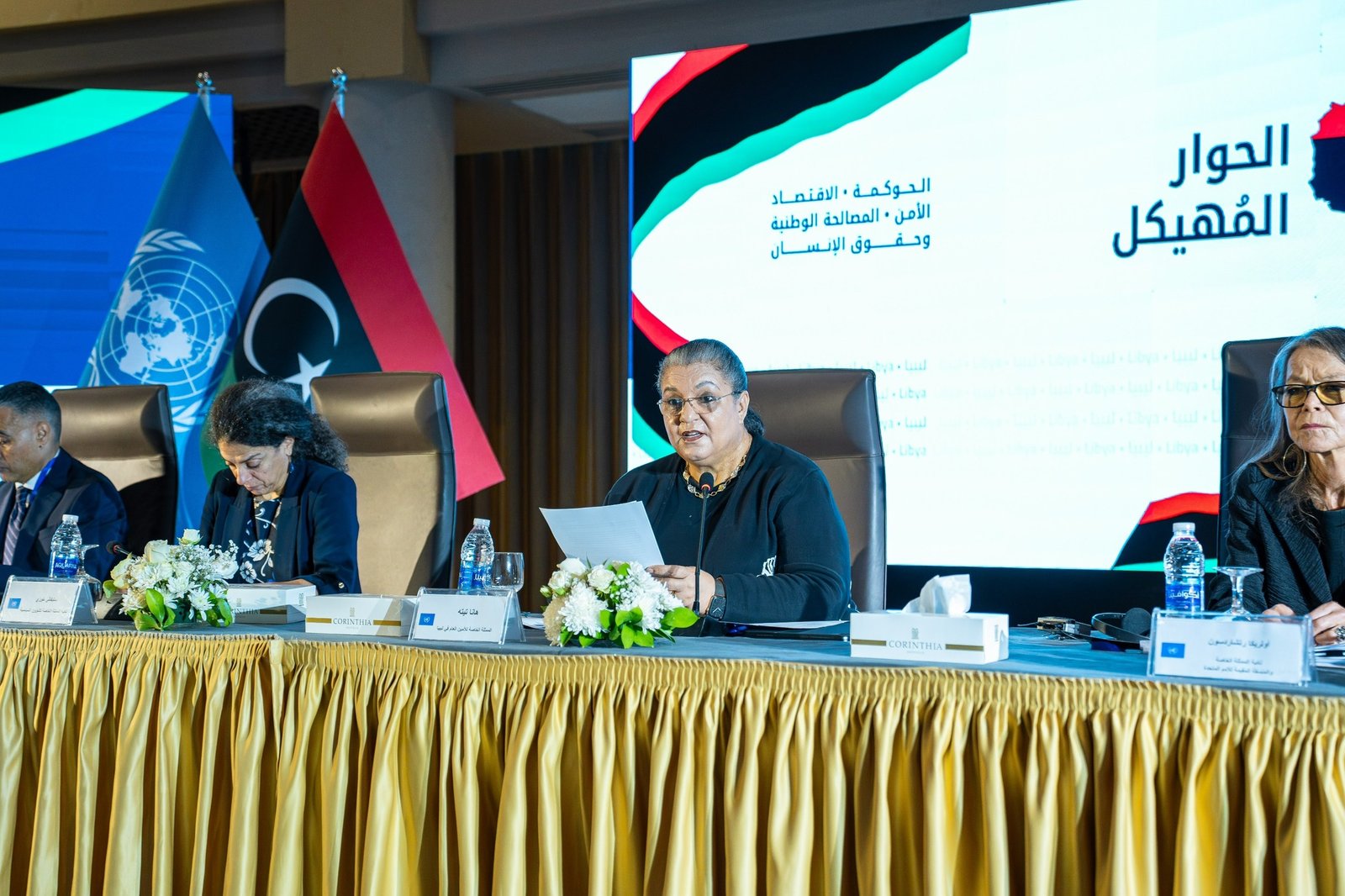
The United Nations Support Mission in Libya (UNSMIL) has concluded the Governance Track of its Structured Dialogue, issuing recommendations aimed at ending the country’s political deadlock and institutional division through a new roadmap leading to elections.
The proposals call for the immediate formation of a unified executive authority and the unification of military and security institutions to create the conditions necessary for holding elections. The roadmap envisages a transitional period lasting between eighteen and twenty-four months, with no possibility of extension.
Under the recommendations, a new Presidential Council would consist of a president and two deputies, with the council president holding defined executive powers, including approving the state budget proposed by the government. Both the Presidential Council and the Prime Minister would be selected by the Dialogue Committee established under (Article 64) of the Libyan Political Agreement.
The recommendations also propose a Government of National Entitlement headed by a prime minister and three deputies representing Libya’s three historical regions. The prime minister-designate would be required to present a cabinet to the House of Representatives for a confidence vote within thirty days.
To safeguard the political process, executive office holders during the transitional period would be barred from running in the subsequent elections, while attempts to obstruct elections or reforms would be subject to legal accountability.
On governance and economic reforms, participants called for greater decentralization through expanded municipal powers and the transfer of resources and administrative responsibilities to local authorities. They also recommended establishing a National Financial Balance Fund to ensure a fair distribution of resources among regions and strengthening transparency, oversight and accountability measures to combat corruption.
The Structured Dialogue was launched by UNSMIL as part of efforts to overcome the stalemate that followed the failure to hold the December 2021 elections and the continued rivalry between Libya’s competing administrations.