Friday, June 19, 2026
    The GeoStrategic Consensus
    No Result
    View All Result
    • Login
    • HOME
    • AMERICAS
      • Argentina
      • Brazil
      • Canada
      • Chile
      • Colombia
      • Costa Rica
      • Cuba
      • Dominican Republic
      • Ecuador
      • El Salvador
      • Greenland
      • Guatemala
      • Honduras
      • Mexico
      • Nicaragua
      • Panama
      • Paraguay
      • Peru
      • United States
      • Uruguay
      • Venezuela
    • ASIA-PACIFIC
      • Australia
      • Brunei Darussalam
      • Cambodia
      • China
      • Federated States of Micronesia
      • Fiji
      • Indonesia
      • Japan
      • Kiribati
      • Laos
      • Malaysia
      • Marshall Islands
      • Mongolia
      • Myanmar
      • Nauru
      • New Zealand
      • North Korea
      • Palau
      • Papua New Guinea
      • Philippines
      • Samoa
      • Singapore
      • Solomon Islands
      • South Korea
      • Taiwan
      • Thailand
      • Timor-Leste
      • Tonga
      • Tuvalu
      • Vanuatu
      • Vietnam
    • CARICOM
      • CARICOM – Non-English
        • Haiti
        • Suriname
      • CARICOM Associates
        • Anguilla
        • Bermuda
        • British-Virgin-Islands
        • Cayman-Islands
        • Curacao
        • Turks-and-Caicos
      • CARICOM English
        • Antigua and Barbuda
        • Barbados
        • Belize
        • Dominica
        • Grenada
        • Guyana
        • Jamaica
        • Montserrat
        • Saint Kitts and Nevis
        • Saint Lucia
        • Saint Vincent and the Grenadines
        • The Bahamas
        • Trinidad and Tobago
    • EURASIA
      • Armenia
      • Azerbaijan
      • Balarus
      • Georgia
      • Kazakhstan
      • Kyrgyzstan
      • Moldova
      • Russia
      • Tajikistan
      • Turkmenistan
      • Ukraine
      • Uzbekistan
    • EUROPE
      • Albania
      • Andorra
      • Austria
      • Bosnia and Herzegovina
      • Bulgaria
      • Croatia
      • Cyprus
      • Czech Republic
      • Denmark
      • Estonia
      • Finland
      • France
      • Germany
      • Greece
      • Holy See
      • Hungary
      • Iceland
      • Ireland
      • Italy
      • Kosovo
      • Latvia
      • Liechtenstein
      • Lithuania
      • Luxembourg
      • Malta
      • Monaco
      • Montenegro
      • Netherlands
      • North Macedonia
      • Norway
      • Poland
      • Portugal
      • Romania
      • San Marino
      • Serbia
      • Slovakia
      • Slovenia
      • Spain
      • Sweden
      • Switzerland
      • United Kingdom
    • MIDDLE EAST AND NORTH AFRICA
      • Algeria
      • Bahrain
      • Egypt
      • Iran
      • Iraq
      • Israel
      • Jordan
      • Kuwait
      • Lebanon
      • Lybia
      • Morocco
      • Oman
      • Palestinian Territories
      • Qatar
      • Saudi Arabia
      • Syria
      • Tunisia
      • Turkey
      • United Arab Emirates
      • Western Sahara
      • Yemen
    • SOUTH ASIA
      • Afghanistan
      • Bangladesh
      • Bhutan
      • India
      • Maldives
      • Nepal
      • Pakistan
      • Sri Lanka
    • SUB-SAHARAN AFRICA
      • Angola
      • Benin
      • Botswana
      • Burkina Faso
      • Burundi
      • Cabo Verde
      • Cameroon
      • Central African Republic
      • Chad
      • Comoros
      • Cote d’Ivoire
      • Democratic Republic of the Congo
      • Djibouti
      • Equatorial Guinea
      • Eritrea
      • Eswatini
      • Ethiopia
      • Gabon
      • Gambia
      • Ghana
      • Guinea
      • Guinea Bissau
      • Kenya
      • Lesotho
      • Liberia
      • Madagascar
      • Malawi
      • Mali
      • Mauritania
      • Mauritius
      • Mozambique
      • Namibia
      • Niger
      • Nigeria
      • Republic of the Congo
      • Rwanda
      • Sao Tome and Principe
      • Senegal
      • Seychelles
      • Sierra Leone
      • Somalia
      • South Africa
      • South Sudan
      • Sudan
      • Tanzania
      • Togo
      • Uganda
      • Zambia
      • Zimbabwe
    • HOME
    • AMERICAS
      • Argentina
      • Brazil
      • Canada
      • Chile
      • Colombia
      • Costa Rica
      • Cuba
      • Dominican Republic
      • Ecuador
      • El Salvador
      • Greenland
      • Guatemala
      • Honduras
      • Mexico
      • Nicaragua
      • Panama
      • Paraguay
      • Peru
      • United States
      • Uruguay
      • Venezuela
    • ASIA-PACIFIC
      • Australia
      • Brunei Darussalam
      • Cambodia
      • China
      • Federated States of Micronesia
      • Fiji
      • Indonesia
      • Japan
      • Kiribati
      • Laos
      • Malaysia
      • Marshall Islands
      • Mongolia
      • Myanmar
      • Nauru
      • New Zealand
      • North Korea
      • Palau
      • Papua New Guinea
      • Philippines
      • Samoa
      • Singapore
      • Solomon Islands
      • South Korea
      • Taiwan
      • Thailand
      • Timor-Leste
      • Tonga
      • Tuvalu
      • Vanuatu
      • Vietnam
    • CARICOM
      • CARICOM – Non-English
        • Haiti
        • Suriname
      • CARICOM Associates
        • Anguilla
        • Bermuda
        • British-Virgin-Islands
        • Cayman-Islands
        • Curacao
        • Turks-and-Caicos
      • CARICOM English
        • Antigua and Barbuda
        • Barbados
        • Belize
        • Dominica
        • Grenada
        • Guyana
        • Jamaica
        • Montserrat
        • Saint Kitts and Nevis
        • Saint Lucia
        • Saint Vincent and the Grenadines
        • The Bahamas
        • Trinidad and Tobago
    • EURASIA
      • Armenia
      • Azerbaijan
      • Balarus
      • Georgia
      • Kazakhstan
      • Kyrgyzstan
      • Moldova
      • Russia
      • Tajikistan
      • Turkmenistan
      • Ukraine
      • Uzbekistan
    • EUROPE
      • Albania
      • Andorra
      • Austria
      • Bosnia and Herzegovina
      • Bulgaria
      • Croatia
      • Cyprus
      • Czech Republic
      • Denmark
      • Estonia
      • Finland
      • France
      • Germany
      • Greece
      • Holy See
      • Hungary
      • Iceland
      • Ireland
      • Italy
      • Kosovo
      • Latvia
      • Liechtenstein
      • Lithuania
      • Luxembourg
      • Malta
      • Monaco
      • Montenegro
      • Netherlands
      • North Macedonia
      • Norway
      • Poland
      • Portugal
      • Romania
      • San Marino
      • Serbia
      • Slovakia
      • Slovenia
      • Spain
      • Sweden
      • Switzerland
      • United Kingdom
    • MIDDLE EAST AND NORTH AFRICA
      • Algeria
      • Bahrain
      • Egypt
      • Iran
      • Iraq
      • Israel
      • Jordan
      • Kuwait
      • Lebanon
      • Lybia
      • Morocco
      • Oman
      • Palestinian Territories
      • Qatar
      • Saudi Arabia
      • Syria
      • Tunisia
      • Turkey
      • United Arab Emirates
      • Western Sahara
      • Yemen
    • SOUTH ASIA
      • Afghanistan
      • Bangladesh
      • Bhutan
      • India
      • Maldives
      • Nepal
      • Pakistan
      • Sri Lanka
    • SUB-SAHARAN AFRICA
      • Angola
      • Benin
      • Botswana
      • Burkina Faso
      • Burundi
      • Cabo Verde
      • Cameroon
      • Central African Republic
      • Chad
      • Comoros
      • Cote d’Ivoire
      • Democratic Republic of the Congo
      • Djibouti
      • Equatorial Guinea
      • Eritrea
      • Eswatini
      • Ethiopia
      • Gabon
      • Gambia
      • Ghana
      • Guinea
      • Guinea Bissau
      • Kenya
      • Lesotho
      • Liberia
      • Madagascar
      • Malawi
      • Mali
      • Mauritania
      • Mauritius
      • Mozambique
      • Namibia
      • Niger
      • Nigeria
      • Republic of the Congo
      • Rwanda
      • Sao Tome and Principe
      • Senegal
      • Seychelles
      • Sierra Leone
      • Somalia
      • South Africa
      • South Sudan
      • Sudan
      • Tanzania
      • Togo
      • Uganda
      • Zambia
      • Zimbabwe
    No Result
    View All Result
    Agentially
    No Result
    View All Result
    Home ASIA-PACIFIC Cambodia

    Structural reform is Cambodia’s next test

    The Analyst by The Analyst
    June 19, 2026
    in Cambodia
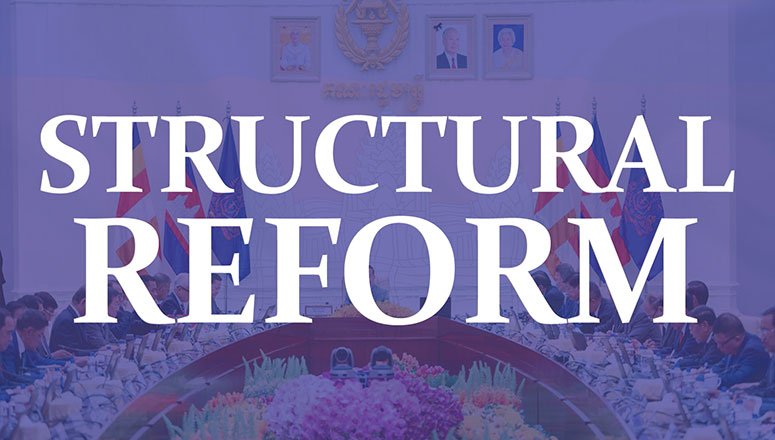
    Structural reform is Cambodia’s next test


    Cambodia has entered a more difficult phase of nation-building. Peace and stability, once the country’s overriding priorities, are no longer enough. The question now is whether the state can transform itself quickly enough to compete in a harsher and more uncertain world.

    READ ALSO

    ASEAN, China Strengthen Media Cooperation Amid Digital Transformation

    Cambodia showcases culture and charity at Asia Festival in Bulgaria

    For decades, Cambodia benefited from political stability, demographic momentum and integration into regional markets. That model delivered impressive growth. But the conditions that sustained it are changing.

    Geopolitical rivalry is intensifying. Supply chains are shifting. Artificial intelligence and automation are reshaping economies faster than governments can adapt. Smaller states that fail to modernise risk being trapped between stronger competitors and weaker institutions.

    Cambodia can no longer afford incrementalism.

    The country’s next stage of development will depend less on low-cost labour and more on institutional strength — quality of governance, efficiency of the bureaucracy, credibility of public institutions, and capacity of leaders to make difficult decisions.

    Structural reform is a condition for national survival and resilience.

    That begins with leadership.

    No institution becomes clean if its leadership is not clean. No ministry becomes accountable if accountability does not begin at the top.

    Citizens already know where public services fail because they experience those failures every day. They know where inefficiency, nepotism and corruption persist.

    Governments often spend too much time explaining reforms and too little time listening to the people most affected by institutional weakness.

    Policy communication and implementation need to be seriously and systematically addressed. Systems thinking and holistic solutions must be promoted.

    It is necessary to solve the root causes of all governance issues, not just the symptoms.

    Political will, knowledge, and courage are essential elements for decision makers and implementers.

    Public trust is not built through slogans. It is built through competence, fairness and visible accountability.

    Cambodia has already begun important reforms in public administration and digital governance. Training and innovation initiatives within the Office of the Council of Ministers reflect growing recognition that the state must become more adaptive and professional. But isolated programmes are not enough. Reform must become systemic.

    Some government agencies carry overlapping mandates and fragmented responsibilities that slow decision-making and dilute accountability. Streamlining institutions will inevitably face resistance from entrenched interests, but avoiding difficult restructuring only increases long-term inefficiency. A modern state cannot function effectively when coordination is weak and bureaucracy becomes an obstacle rather than an instrument of governance.

    Digital transformation offers Cambodia an opportunity to leap forward rather than merely catch up.

    Integrated digital systems can reduce opportunities for corruption, improve service delivery and strengthen policy coordination across ministries. Artificial intelligence and data-driven governance tools can help governments respond faster to economic shocks, monitor implementation gaps and allocate resources more efficiently. Countries that modernise early will gain strategic advantages.

    Those that delay will struggle to compete.

    But technology alone cannot repair weak governance.

    Technical reform without ethical reform eventually collapses under the weight of political culture. Institutions are shaped not only by systems, but by the values of the people operating them.

    If impunity becomes normalised, even sophisticated systems fail. If professionalism and integrity become institutional norms, even imperfect systems improve over time.

    Cambodia’s deeper challenge may therefore be cultural rather than administrative.

    A culture of accountability must replace a culture of impunity. Public office should be understood not as a source of privilege, but as a responsibility to serve.

    Accountability should not be treated as a political weapon deployed selectively against rivals. It must become a national principle applied consistently and fairly.

    That transformation cannot come only from above.

    Citizens themselves must become active participants in reform. Anti-corruption efforts succeed only when society develops zero tolerance for everyday abuses of power, not just high-profile scandals.

    National transformation becomes sustainable when people believe they have ownership in the country’s future rather than simply receiving directives from the state.

    Cambodia also faces strategic pressures that make reform more urgent. Regional competition is intensifying. Economic security, energy security, food security, water security, climate security, and cyber security are increasingly intertwined.

    Defence and security institutions will need modernisation to adapt to emerging threats and a less predictable geopolitical environment. Administrative systems must become more agile, data-driven and future-orientated.

    The danger for countries in transition is not sudden collapse. It is gradual stagnation — institutional decay hidden beneath the appearance of stability. States that postpone reform often discover too late that economic momentum alone cannot compensate for weak institutions.

    Cambodia still has important advantages: a young population, strategic geographic position, political stability and growing regional connectivity. But advantages do not guarantee success. They create opportunity. Whether that opportunity is realised depends on political will, courage, and institutional capacity.

    History rarely waits for countries to reform at their own convenience. The global economy is moving too quickly, technological disruption is accelerating and competition among states is becoming more severe.

    Cambodia’s next chapter will not be determined by whether reform is discussed. It will be determined by whether reform is implemented with seriousness, consistency and urgency.

    Time is no longer on Cambodia’s side. Structural weaknesses, if left untreated, do not heal on their own; they deepen and spread. Like a serious illness, the cost of delay eventually becomes far greater than the pain of decisive action.

    The government must recognise the fact that citizens can no longer tolerate corruption, nepotism and chronic inefficiency. Public frustration is no longer confined to private conversations. It is becoming a defining political and social challenge.

    Cambodia has reached a critical moment where structural reform is about safeguarding national resilience, preserving political legitimacy, maintaining peace and stability, and securing the country’s long-term growth and future prosperity.




    Source link

    Related Posts

    ASEAN, China Strengthen Media Cooperation Amid Digital Transformation
    Cambodia

    ASEAN, China Strengthen Media Cooperation Amid Digital Transformation

    June 18, 2026
    Cambodia

    Cambodia showcases culture and charity at Asia Festival in Bulgaria

    June 18, 2026
    Cambodia

    Cambodia, Russia celebrate 70th diplomatic anniversary

    June 18, 2026
    Cambodia

    Cambodia and Laos deepen media cooperation

    June 18, 2026
    Cambodia

    ASEAN, China boost media partnership

    June 18, 2026
    Cambodia and Azerbaijan vow closer parliamentary ties
    Cambodia

    Cambodia and Azerbaijan vow closer parliamentary ties

    June 18, 2026
    Next Post
    Fish giveaway sees 2,000 packs of black tilapia distributed to Sibu folks

    Fish giveaway sees 2,000 packs of black tilapia distributed to Sibu folks

    POPULAR NEWS

    Second round results Peru 2026 Elections LIVE: ONPE count, electoral flash and who wins between Keiko Fujimori and Roberto Sánchez today, June 7

    Second round results Peru 2026 Elections LIVE: ONPE count, electoral flash and who wins between Keiko Fujimori and Roberto Sánchez today, June 7

    June 19, 2026
    Over 6m Afghans returned from Pakistan, Iran since 2023: UNHCR – Pajhwok Afghan News

    Over 6m Afghans returned from Pakistan, Iran since 2023: UNHCR – Pajhwok Afghan News

    June 18, 2026
    Trump and doctors signed the memorandum of understanding between Iran and America virtually

    Trump and doctors signed the memorandum of understanding between Iran and America virtually

    June 18, 2026
    What to Know About Canada’s New Citizenship Eligibility Requirements and How to Apply

    What to Know About Canada’s New Citizenship Eligibility Requirements and How to Apply

    June 18, 2026
    Tourism growth continues with strong arrivals, industry transition

    Tourism growth continues with strong arrivals, industry transition

    June 18, 2026

    EDITOR'S PICK

    Thursday’s papers: ‘Serious problem’ with combat uniforms, Helsinki seaside pool demolition, and are you walking enough? | Yle News

    Thursday’s papers: ‘Serious problem’ with combat uniforms, Helsinki seaside pool demolition, and are you walking enough? | Yle News

    June 18, 2026
    Japan is developing a hypersonic passenger jet that could exceed the speed of Concorde more than twice. Flight Tokyo-USA, in just two hours

    Japan is developing a hypersonic passenger jet that could exceed the speed of Concorde more than twice. Flight Tokyo-USA, in just two hours

    June 18, 2026
    Pantless, please? Skirt suits are enjoying a revival within the fashion world

    Pantless, please? Skirt suits are enjoying a revival within the fashion world

    June 19, 2026
    2026 World Cup: Ronaldo enters the track after the record debuts of Messi and Mbappé

    2026 World Cup: Ronaldo enters the track after the record debuts of Messi and Mbappé

    June 18, 2026

    Recent Posts

    • Tracking the reopening of the Strait of Hormuz, in live maps and charts
    • Niú Magazine
    • The revolution eats its own – iWitness News
    • Stakeholders praise PPGPL selection for Guyana project

      © 2026 Agentially - Navigating shifting sovereignties and global risk .

      Welcome Back!

      Login to your account below

      Forgotten Password?

      Retrieve your password

      Please enter your username or email address to reset your password.

      Log In
      No Result
      View All Result

        © 2026 Agentially - Navigating shifting sovereignties and global risk .

        This website uses cookies. By continuing to use this website you are giving consent to cookies being used. Visit our Privacy and Cookie Policy.