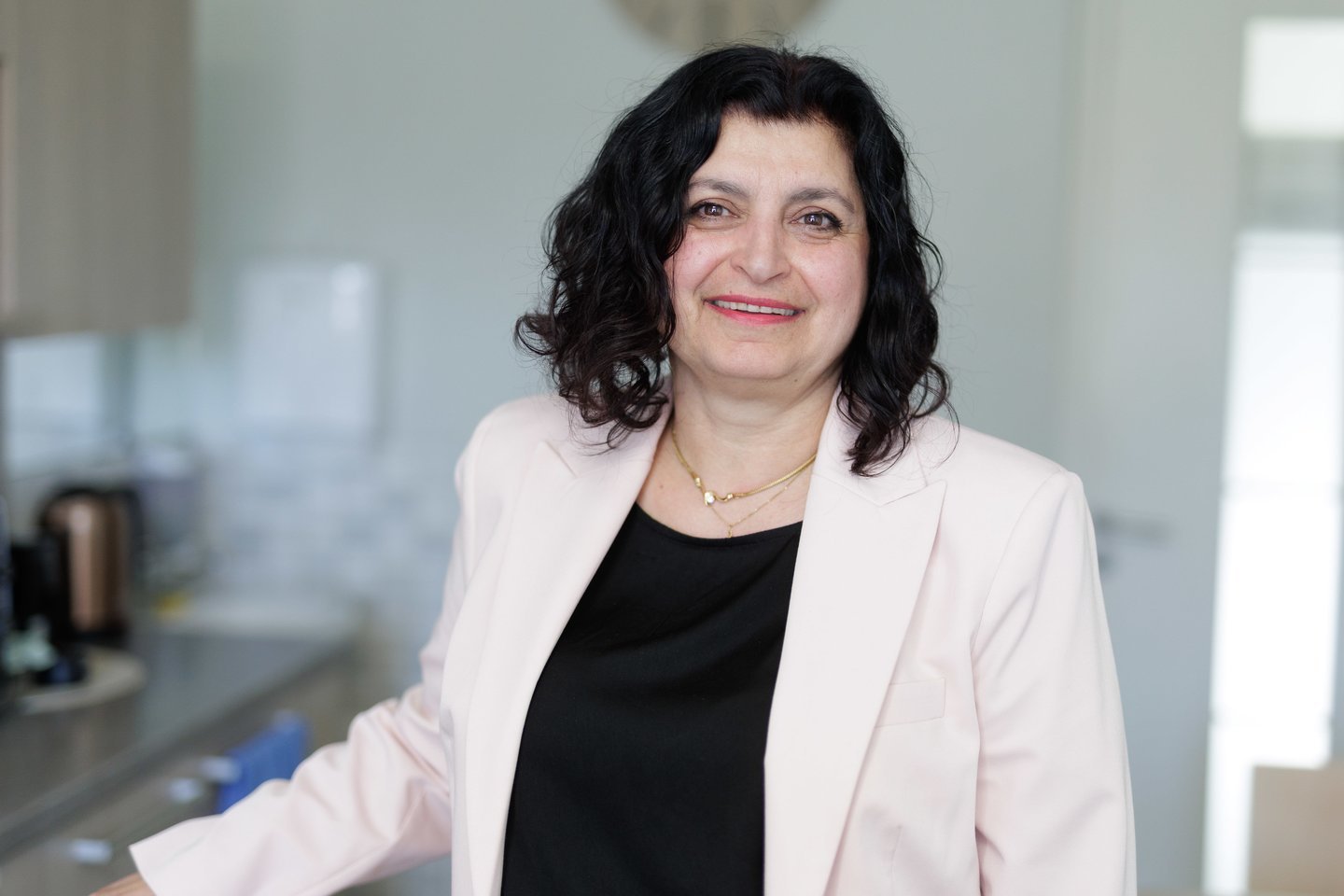
There were no doctors in the interviewee’s family, but she decided as a child that she would wear a white coat when she grew up.
“I knew from the age of five that I would be a doctor,” in an interview Morning says E. Teiberienė.
According to an experienced doctor, it happens that a family has problems with infertility, turns to doctors for help and then does not protect itself from storks. “The first birth is followed by the second, sometimes the third, and then the woman laughs that she didn’t plan so much,” smiles E. Teiberienė.
She adds that this is typical of cases of idiopathic infertility, where medical tests show no change, but the family begins to grow, although previous attempts have failed.
Over several decades, a variety of stories have occurred in the work of a gynecologist – both happy and heart-wrenching.
“Hands drop when a pregnant woman says ‘I don’t want’ to give birth.” My goal is that if a person doesn’t want to, that pregnancy wouldn’t happen at all. I talk a lot with patients about contraceptives”, sighs E. Teiberienė.
“A woman must understand that this can affect her health, increases the risk of complications in the future. Termination of pregnancy also negatively affects the emotional state,” she adds.
The doctor remembers a case when a 16-year-old girl, an exemplary schoolgirl, became pregnant. But she and her boyfriend had already gone their separate ways, and she didn’t feel ready for motherhood either.
“She gave birth and her aunt adopted the baby, I don’t know how it was arranged legally. But it was decided in the family that the child will never find out who his real mother is,” E. Teiberienė remembers the story that happened a dozen years ago.
The doctor’s experience shows that unplanned pregnancy happens to women of all ages. However, more and more are deliberately avoiding pregnancy.
“I had a patient who, at 44, said, ‘I’m not ready for motherhood yet.’ Let’s be cowardly, but be fair, maybe say frankly that you don’t want children and cut them off with an axe”, thinks E. Teiberienė.
She is happy with the progress of Lithuanian medicine. The doctor notices that Lithuanians working and living abroad, after returning to their homeland during the holidays, not only rest, but also visit doctors and praise the excellent quality of health services.
“They don’t necessarily receive compensation. Women trust us, respect the professionalism of the doctors, and appreciate the available opportunities,” observes E. Teiberienė.
– From the patient’s feedback about you: “I would recommend it very highly, especially for younger girls who are afraid and nervous.” How many patients are excited in the gynecologist’s office? – I asked E. Teiberienė.
– Of course, there is excitement about a gynecological examination. Especially sensitive communication is necessary with women for whom this is the first such experience.
Even before that, there is a conversation where the entire procedure is explained so that the patient relaxes and does not worry. But it happens that a woman walks for many years and reacts sensitively – the doctor needs to adapt, to do everything gently.
The consultation lasts only 15 minutes, so I try to determine the patient’s psychological type as soon as possible. One needs to be explained in detail, the other needs to be reassured, and the third needs to be “scared” a little so that he will follow the doctor’s instructions.
– You also find malignant tumors of the cervix. How do you tell someone they have cancer?
– Thank God, we use the word “cancer” very rarely, because such cases occur only a few times a year. With the cervix, pre-cancerous conditions are much more common. Then we have to do everything we can to prevent real cancer.
Patients often report terrible things on the Internet. If you adapt everything to yourself, you can cause yourself unnecessary anxiety. When we have a precancerous condition, the first question is always whether a woman is planning a family. Taking into account the results of the tests and the woman’s wishes, we draw up a care and treatment plan. But sometimes you need to act fast, before the real cancer, the one with “horns”, appears.
If the result of the test comes with the result that cancerous cells have been found, then we talk and schedule the patient’s visit for more detailed tests at another institution. The “green corridor” helps – the patient gets to where she needs to be within a week.
– There is a cervical cancer screening program in Lithuania. However, it is often complained that residents do not participate enough in preventive programs. How are you inviting women?
– From 2024 the polyclinic participates in the pilot project and the invitations are centrally handled by the Coordination Center. His activities increased the number of women participating in the preventive program in Lithuania. The results in the center polyclinic were good: from 60 to 90 percent. But we were very active in inviting women – a call, SMS, e-mail and a call from the family doctor. Since we are not actively doing it ourselves at the moment, the results have worsened.
– Family planning is a team effort. Do you still have to deal with the attitude that when you can’t get pregnant, there is “something wrong” with the woman, but not with the man?
– We never assess only the condition of the woman, we always ask about the man. Unfortunately, sperm quality continues to deteriorate. One ejaculation contains millions of sperm, and only one is enough for fertilization. But if a decrease in the number of spermatozoa is detected, we state infertility.
The examination of a man is much simpler – the quality of sperm is examined. Examination of a woman begins with non-invasive tests, it is much longer, sometimes more painful, everything is very individual, there are many nuances. At the same time, the man is sent for a sperm test.
– Modern women give birth later. Do you see any increased risks as a result?
– I had a patient whose husband died of cancer. Previously, they had frozen sperm, the woman did not want children, but 5-6 years after her husband’s death, when she was already in her 50s, she changed her mind. A very nice boy was born, and the mother was 51 years old.
If the non-pregnant woman is older than 35 and the man is 42. and older, the woman is sent for genetic counseling.
This is done to assess additional risks to fetal development. But there is a “clock” that is ticking. A woman’s health and physical condition change, with age more frequent problems due to blood pressure, diabetes, increased weight, various chronic conditions.
But doctors take care, look after women, monitor their condition during pregnancy. The risk does not mean that there will be problems, there is really no need to scare women.
– You communicate a lot with patients who are about to give birth or are trying to conceive, so you hear what they are worried about, what concerns them. Recently, there has been particular concern about the declining birth rate: both in 2027 and 2028. published in the Year of the Family. Maybe you have some insight into what measures would help increase the birth rate?
– Actually, not really my “garden”, let’s leave it to the politicians. I hear from women that they do not plan to have children because of the unstable geopolitical situation, fear of war, housing, finances, career and other nuances. There is also a movement of conscious childlessness. Often these are people with high education and good earnings.
But housing and career issues often come first for young couples before planning children. Sometimes one partner wants it and the other doesn’t. After all, it is a decision of two people.
– Doctor, what does your free time look like – isn’t everything about medicine?
– I really like to cook. The heart sings when the guests gather at the table, the discussions boil – a kind of emotional therapy is obtained.
I go for a walk with the dog, it used to be 5 kilometers, but my German Shepherd is getting old and doesn’t want long walks anymore.
I like books – especially psychological and detective books. I try to maintain a balance between work and rest.