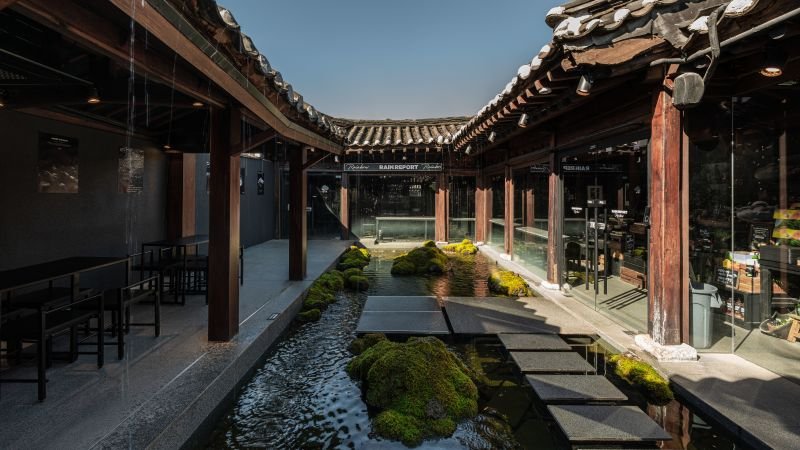
Walk into almost any cafe in South Korea and you’ll find a familiar sight: business partners planning their next pitch, friends reconnecting, dates — and cagongjok, a Korean term that literally translates to “the tribe of people who study in cafes.” But in Korea, many cafes go beyond the functional, using creative design to enhance these “third spaces,” offering an escape from the long working hours and the competitive education system that underpins Korea’s high-pressure grind culture.
What started as convenience, a place to grab a latte or an Americano —Koreans’ preferred coffee beverage — has evolved into something closer to a cultural outing. For Koreans, cafes are “multifunctional hubs,” says Jihyu Kim, 34, co-CEO of Seven Island Coffee, a cafe and cultural space in Busan. Modern cafe culture is now “considered the same as going to a museum or the movie theater,” she says.
South Korea has a term — “gamseong” — defining the emotions evoked by aesthetically pleasing places. That sensibility has helped fuel a uniquely Korean phenomenon: the gamseong cafe. Here, the priority isn’t only the perfect cup of coffee, but the space itself. From exterior architecture to interior design, lighting, and the mood a customer feels, everything is planned — creating an atmosphere that’s not only visually appealing and “Instagrammable,” but emotionally stimulating, too.
In a hyper-competitive industry, cafes must differentiate, and that pressure shapes everything from menus to architecture.
One word used in Korea these days, especially among MZ (a Korean term combining Millennials and Gen Z), is “chugumi,” to convey “the image, lifestyle and fashion that one pursues and desires,” says Heesu Jeon, 41, CEO of architecture firm A.Live and lead architect behind the 2025 iF Design Award-winning OUTPOST — a minimalist, stone-walled cafe building that’s part of the larger Stonery vacation complex on Ganghwa Island.

K-cafes increasingly sell customers a chance to step into a lifestyle — even if only for an hour. Jeon says, “If the lifestyle someone wants is the Danish ‘hygge’ (coziness) style, then they go to a cafe with that kind of interior because they want to experience the lifestyle there vicariously. That is chugumi.”
The logic is similar to how K-pop became a global export by building an experience bigger than the music alone. “K-pop has gone beyond just the music — it combines performance and fashion to enhance the experience,” says Kim. “Similarly in Korea, cafes are more than just coffee. They combine architecture and (the owners’) brand storytelling.”
The need to stand out has produced two broad tracks: city cafes that compete through concept and staging, and suburban cafes that compete through space, scenery and a sense of escape.
City cafes often work within small footprints. When space must be sacrificed, owners make up for it with intentional design and quick-hit novelty, like Rain Report in Seoul’s Yongsan District, a rain-themed cafe that caters to customers who like the feeling of sipping coffee on a rainy day — every day. “They can’t really do nature and healing (in the limited space), so the focus is more on being fun and providing immediate new stimulation …triggering dopamine,” says Jeon.
Suburban cafes weave natural elements into their design, creating spaces “focused heavily on healing and recharging in a space with nature,” says Jeon. “The best interior is nature … Because the view you see is different in each of the four seasons, the reason people come is actually created by (nature).”
OUTPOST is a good example. Jeon said it was the first cafe where her firm conceptualized both the exterior and interior, allowing them to “orchestrate the visitor’s journey and the scenarios they experience” — from what people see as they walk through the space to where the “wow” points appear. OUTPOST draws inspiration from “dondae,” ancient, military fortresses or watchtowers from the Joseon dynasty.

“While the dondae was once a place of “great tension,” says Jeon, it was reimagined as a place of peacefulness: “It’s so beautiful. The emotions have changed with the passage of time. Now you look down at nature over the low wall of the cafe, and there’s a peacefulness the boundary provides.”
Suburban cafes also fit Korea’s car-centric culture, where many customers treat a cafe visit as a mini road trip, and often make a point of stopping off at cafes on longer journeys. A trip to an outskirt cafe can feel like “a little journey and day trip,” says Kim of Seven Island Coffee.
Kim sees a broader move in cafe culture toward what she calls emotional value. “In modern society we have emotional capital (gamseong ja-bon) and the experience economy (gyeong-heom gyeong-je),” she says. “In the past, money and technology was capital. However, as time goes by, things that move us or touch our minds are much more valued.”
That helps explain why, even if coffee prices in Korea can be higher than in other countries, customers keep coming. Koreans, Kim says, “are willing to pay for it if they are satisfied with the experience and emotional satisfaction.”
At Seven Island Coffee — which was named one of the World’s Most Beautiful Restaurants by the 2025 Prix Versailles — she says customers are paying for the full arc of the visit, “from when they come to when they leave.”
Perched on the cliffs of Gadeokdo Island off the southern coast of Busan, Seven Island Coffee draws inspiration from the surrounding islands. Its exterior buildings face different islands so patrons experience shifting views as they move through the space. Inside, the first floor is set in dark tones to mimic the ocean floor, transitioning upward into a lighter floor designed to represent the island itself. Seats are kept lower than average to avoid blocking the scenery, and artificial light is minimized to preserve as much “pure nature” as possible.

The design choices, explains Kim, are meant to respect the landscape — and deliver the relaxing, “healing” experience many customers seek.
South Korea is sometimes described locally as a “kafe-republic,” Kim says — it’s a nod to both the scale of the industry and the intensity of competition.
A new cafe can open to high acclaim and be forgotten within two or three months when another “Instagrammable” space appears. “This culture helps keep quality high, but it’s also hard to sustain,” Kim adds.
Jeon sees the same dynamic. “The design of Korean cafes is directly linked to survival,” she says. “Everyone feels it’s a part that cannot be overlooked. The quality comes out because the café owners are making the investment.”
For architects and cafe owners alike, the future of Korean cafe culture may be defined by the same forces that shaped its rise: competition, re-invention, and the search for new forms of experience.
Jeon expects city cafes to sharpen their “owned differentiation points,” leaning into what they do best. “If an owner makes coffee beans with real confidence, they create a café interior that makes their coffee beans stand out the most,” she says.
Kim believes suburban cafes will likely keep pushing into experiences that city cafes can’t replicate — including cultural programming. “In the future, customers want cultural spaces, for example art exhibitions within the coffee shop,” says Kim. “In fact, that’s something we’ve already started to do (at Seven Island Coffee) — cultural collaborations with other businesses.”
Jeon shares this sentiment and expects the out-of-town cafe trip to become even more theatrical. “(Suburban cafes) will move toward delivering more dramatic experiences in a stronger, more stimulating and impactful way.”
In South Korea’s “kafe-republic,” the next hit cafe may still serve an excellent Americano. But what customers are increasingly buying is gamseong: an artfully crafted, designed feeling alongside every cup.