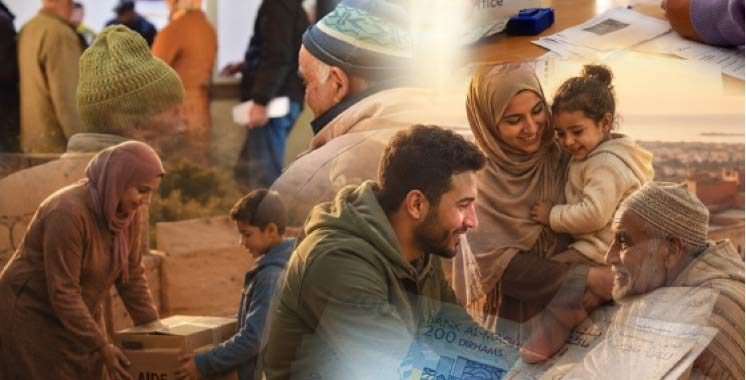
Good news for households receiving direct social assistance. A new bill has just received the green light from members of the second parliamentary chamber. Indeed, the Committee on Education, Cultural and Social Affairs in the House of Advisors unanimously adopted, on Thursday, Bill No. 41.26 amending and supplementing Law No. 58.23 relating to the direct social assistance system.
Presenting this bill, the Minister Delegate in charge of the budget, Fouzi Lekjaa, stressed that this text is part of the continuation of the social state project launched by His Majesty King Mohammed VI, to make social justice and economic inclusion fundamental pillars of the Morocco of tomorrow and essential components of a modern social state.
The minister indicated that the Direct Social Assistance Program has made it possible, since its launch in 2023, to cover nearly 4 million households and more than 5 million children, for a monthly cost of around 2.2 billion dirhams (billion dirhams), specifying that the credits mobilized for this project have reached 62 billion dirhams since its implementation.
The practical experience of deploying this system revealed certain difficulties, mainly linked to the connection between the benefit of direct social assistance and access to the labor market, he added, noting that many beneficiaries feared losing their aid if they obtained a job or declared to the National Social Security Fund (CNSS).
In this context, the bill introduces a new provision providing for the granting of an exceptional bonus paid once to households having lost their right to aid from the direct social assistance system due to the declaration of one of the spouses or the head of household with the social security system applicable to the private sector. The duration of benefit from this bonus will be fixed by regulation.
According to Mr. Lekjaa, the proposed amendments also aim to encourage the integration of beneficiaries into the labor market by allowing the households concerned to accumulate, for a period which will be fixed by decree within the limit of one year, direct social assistance and income from professional activity.
This measure aims to promote the professional stability of beneficiaries and their access to social rights linked to employment, in particular family allowances.
Mr. Lekjaa indicated that the text also provides for the automatic restoration of direct social assistance benefits when a beneficiary loses his or her job, whatever the reason, including after the expiration of the one-year period.
These modifications, he continued, aim to support vulnerable households, improve their economic and social conditions and promote their sustainable integration into society and the labor market.
For their part, the parliamentary advisors welcomed the direct social assistance system, considered one of the main pillars of the social reform project initiated under the leadership of HM King Mohammed VI to consolidate the foundations of the social State and strengthen social justice and economic inclusion for the benefit of vulnerable categories, within the framework of the implementation of the framework law relating to social protection.
They highlighted the importance of the adoption of this new text, which aims to improve the mechanisms for implementing this national project by providing responses to the difficulties revealed by the practical application of the system, in particular those linked to the integration of beneficiaries into the formal sector and the fear of losing social assistance in the event of declaration of employment.
According to them, the new provisions will make it possible to gradually support beneficiary households towards integration into the formal labor market, thanks to transitional aid guaranteeing their social stability and encouraging the declaration of activity without immediate risk of loss of aid, thus promoting a gradual and secure transition towards economic autonomy.
For their part, union components, in particular the group of the Moroccan Labor Union (UMT) and the group of the Democratic Confederation of Labor (CDT), welcomed the introduction of the possibility of recovering the right to direct social assistance in the event of loss of employment, without being subject to certain temporal conditions currently in force, considering that this is a positive step forward in terms of social protection.
The two groups noted, however, that this amendment, despite its importance, remains a partial measure which should be accompanied by more global actions in order to guarantee lasting social stability for working households.
They stressed that the success of the direct social assistance system should not be evaluated solely on the basis of the number of beneficiaries, but also on its capacity to reduce poverty and vulnerability, improve the purchasing power of households and ensure better articulation between the different social protection programs.
The new bill will soon have to be scheduled for adoption in plenary session. As a reminder, the Governing Council adopted the bill in question on May 22. At that time, the Minister Delegate in charge of relations with Parliament, government spokesperson, Mustapha Baitas, during a press briefing held at the end of the weekly meeting of the Council, specified that the said project aims to consolidate the process of supporting the ASD regime through the broadening of the base of beneficiaries of social protection and the strengthening of economic inclusion, within the framework of a functional complementarity between the social support mechanisms and those of employment, in order to ensure a balance between the imperatives of social justice and the requirements of economic development. It also falls within the framework of the provisions of article 18 of framework law n°09.21 relating to social protection which provides for the revision and updating of the relevant legal and regulatory system, so as to guarantee its effectiveness and its adequacy with economic and social changes, the minister specified.
Social support Proximity
The National Social Support Agency (ANSS) adopts a proximity policy in order to strengthen the effectiveness of the direct social assistance system. In response to a written question on “the evaluation of the effectiveness of the direct social assistance program”, the Minister Delegate to the Minister of Economy and Finance, responsible for the budget, Fouzi Lekjaa, indicated that the ANSS is keen to adopt a policy of proximity in its human and territorial dimensions with the aim of evolving the social assistance system from a financial support mechanism to a lever for integrated territorial development. The Minister Delegate detailed this system, specifying that it is based on the creation of territorial representations where social supports work. Their mission is to inquire into the situation of beneficiary households and assist them to escape poverty and integrate sustainably into socio-economic life. Mr. Lekjaa explained that these territorial representations will be responsible, in partnership with the various local actors in the areas of economic and social integration, of supporting beneficiaries of the direct social assistance program and ensuring compliance with the social commitments of families, particularly with regard to the schooling of their children and regular monitoring of the health of the mother and child, in addition to other commitments which will be adapted to the specificities of the territories and families.