NOT JUST NUMBERS:
What matters to intelligence work is crucial, reliable information, so even a few credible leads can be highly valuable to national security, a legislator said
-
By Huang Chin-hsuan and Fion Khan / Staff reporter, with staff writer
The National Security Bureau (NSB) yesterday said it has finished the establishment of an information-reporting channel for Chinese nationals, the aim of which is to broaden intelligence gathering on China’s political, military, economic and social developments.
Chinese nationals can submit information on the Web page, https://report.nsb.gov.tw, the NSB said in a statement.
The move aims to expand the bureau’s diverse intelligence sources and is pursuant to the National Intelligence Services Act (國家情報工作法), it said, adding that it referenced practices adopted by intelligence agencies in the US, the UK and Israel.
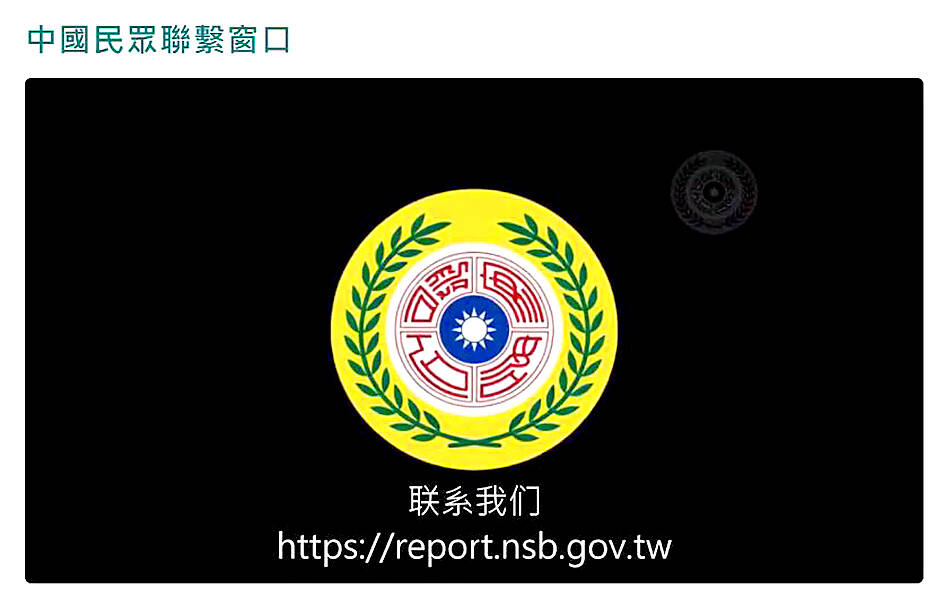
Photo: Screen grab from a video on the bureau’s Web site
An increasing number of people are approaching Taiwanese agencies to provide information, as growing social and livelihood problems in China have fueled public discontent amid a worsening economy and tight political control, the NSB said.
In light of the Chinese government’s stringent Internet surveillance and the cybersecurity risks associated with China-made mobile phones, the NSB said it focused on information and communication security, and identity confidentiality in designing the Web site.
Upon accessing the page, the person would be directed to different procedures, depending on whether they are in China or overseas, and they would need to follow six security guidelines to complete the reporting process, the bureau said.
The guidelines include: using mobile phones or tablets that are not Chinese brands, restoring their device to its factory settings, connecting to Wi-Fi networks that do not require real-name authentication, using virtual private networks and Web browsers developed by Western companies, and browsing the Web site in incognito or private mode, it said.
The NSB said it would use technology to filter the data provided by Chinese nationals, adding that the information would be evaluated and validated by its team for follow-up contact.
The bureau called on Chinese nationals wherever they are to provide information and help make a change with courage.
In view of the evolving situation in China and the international landscape, the NSB pledged to continue reviewing and refining its intelligence-related tactics, so that Chinese nationals who share the same values of democracy can collaborate with the bureau.
The aim is to bolster intelligence collection and analysis on China to safeguard Taiwan’s national security and interests, it added.
Democratic Progressive Party Legislator Chen Kuan-ting (陳冠廷) said the initiative is one of the bureau’s concrete measures to broaden its sources of information.
The value of intelligence work does not lie in the number of contacts established, but in whether crucial information can be obtained, he said, adding that a small number of credible leads can prove to be highly valuable to national security assessments.
As China continues to expand its military, cyber and information operations, Taiwan must keep enhancing its intelligence-gathering and analytical capabilities, Chen said.
The core of national security work is not only preventing threats, but also improving the government’s ability to understand and assess risks, he said.
In an environment marked by increasingly frequent information warfare, cognitive warfare and “gray zone” tactics, establishing more legal, secure and diverse sources of information is a fundamental part of modern intelligence work, Chen said.
Any legitimate channel that helps bolster national security — that is conducted in accordance with the law, and which safeguards the security and human rights of information providers — deserves continuous improvement, he added.
Similar practices are common internationally, Chen said, citing the CIA’s efforts to reach sources that work in Chinese agencies.
The CIA last year released two Chinese-language recruitment videos encouraging Chinese government insiders to contact US authorities through secure channels, and a video aimed at members of the Chinese People’s Liberation Army was released in February, he said.
The information-reporting Web site, which includes secure communication methods and protective measures for sources, is one practical step toward expanding Taiwan’s intelligence network, he added.