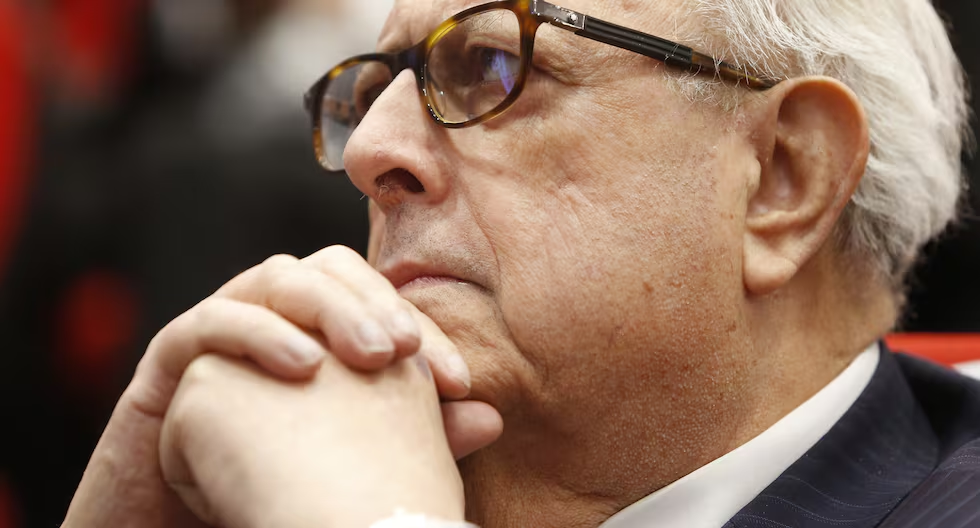
The Senate Plenary ratified the appointment of Julio Velarde as president of the Board of Directors of the Central Reserve Bank (BCR) for a new period of five years. The decision obtained 40 votes in favor and 12 against, with no abstentions.
Ratification required at least 31 votes, equivalent to more than half the legal number of members of the Senate. The session was attended by 53 legislators. After approval, the Upper House announced that it would publish the corresponding legislative resolution.
The favorable report was supported by Hugo Ccahuana, president of the Special Procedures Commission and senator of Together for Peru. He explained that the working group reviewed the documentation sent by the Presidency of the Republic, the Presidency of the Council of Ministers (PCM), the Ministry of Economy and Finance (MEF), the National Civil Service Authority (Servir) and the National Superintendency of Higher University Education (Sunedu).
The commission concluded that Velarde met the constitutional and legal requirements to hold the position, did not present impediments or incompatibilities, and had training and experience linked to the functions of the BCR. The report had previously been approved with nine votes in favor, two against and one abstention.
Ccahuana clarified that he had voted against in the commission, but that, as president of the working group, it was his responsibility to support the decision adopted by the majority. At the conclusion of the debate, he pointed out that the rule that establishes the requirements and impediments to join the BCR board, in force since 1992, was anachronistic, although he stressed that it should be applied as long as it remained in force.
During the debate, senators from Together for Peru questioned Velarde’s prolonged stay at the head of the BCRits declared links with private companies and the idea that its continuity was essential to preserve monetary stability.
Edyson Morales, from Together for Peru, maintained that Velarde’s academic credentials had not been adequately accredited and warned of possible conflicts of interest arising from his participation in private companies.
“In that sworn statement, he speaks directly about his ties to private companies. And these private companies are, as an example, Volcan, a mining company in whose shares he participates,” he stated. Morales also questioned the performance of the BCR in the face of the exchange rate fluctuations registered between 2021 and 2022.
Bernardo Quito, from the same bench, rejected that economic stability depended on a single person and raised the need to renew the management of the issuing entity. “Is it a totem of the economy that we have to respect this character? Does our economy or monetary stability depend solely on him?” he expressed.
Quito also attributed responsibilities to the BCR in the design and execution of Reactiva Perú and questioned whether large companies had accessed the program. His statements were raised during the parliamentary debate and were not part of the conclusions of the Special Procedures Commission report.
Wilfredo Verano, also from Together for Peru, pointed out that the autonomy of the issuing entity should not be associated with the permanence of a single official. “The autonomy of the Central Reserve Bank of Peru is an attribute of the institutional framework, not of the person who occupies it,” he stated.
Verano considered that there were other economists with the capacity to direct the institution and questioned what he called Velarde’s “myth of indispensability.” In his opinion, its continuity restricted the debate on possible changes in monetary policy and microenterprises’ access to credit.
In contrast, Fuerza Popular, Ahora Nación and the Partido Cívico Obras expressed their support for ratification during the debate. José Arista, from Fuerza Popular, highlighted the results obtained by the country in controlling inflation and compared its evolution between 2021 and 2025 with that registered in Chile and Colombia.
“What we have to do is ratify those officials who do an excellent job in Peru and we should not be thinking about changing them,” said Arista.
Patricia Juárez, also from Fuerza Popular, maintained that Prolonged tenure in office should not be considered a privilege, because it was subject to evaluation at the beginning of each period. “Continuity is not a privilege that is given, it is a trust that is renewed,” he said.
Juárez also rejected questions about Velarde’s academic degrees. He indicated that the Organic Law of the BCR did not require having a master’s degree or a doctorate registered at Sunedu, but rather being Peruvian by birth, having recognized moral solvency and having extensive competence and experience in economics and finance.
From Ahora Nación, Jaime Delgado supported the ratification and highlighted the role played by the BCR in the monetary and financial stability of the country. However, it proposed that all members of its board of directors, and not just its president, hold the position full-time and with exclusive dedication to reduce possible conflicts of interest.
Delgado also asked for greater transparency in the decisions of the issuing entity. “All banks have transparency in the decisions that are made, including the minutes that are adopted from the meetings, except Peru,” he said.
Walter Gago announced that the Civic Obras Party would vote in favor of ratification and argued that The stability of the currency, the level of international reserves and the confidence of investors supported Velarde’s continuity at the head of the institution..
The ratification came after the Executive will formalize the appointment of the economist through Supreme Resolution 258-2026-PCM, published on August 21. The norm was signed by the President of the Republic, Keiko Fujimori; the president of the Council of Ministers, Luis Fernando Galarreta; and the Minister of Economy and Finance, Elmer Cuba.
Last July, when she was still president-elect, Fujimori met with Velarde at the BCR headquarters to publicly ask him to remain at the head of the institution for five more years. The economist accepted the proposal during the press conference held after the meeting.
“I feel honored by the request that has been made to me and yes, in other circumstances I might not have accepted. But I do accept with my best pleasure and I plan to dedicate myself as much as possible to fulfill the task that they are entrusting me with,” he said then.
Velarde has presided over the BCR since October 2006, when he was appointed during the second government of Alan García. Subsequently, He was ratified to continue in office during the governments of Ollanta Humala, Pedro Pablo Kuczynski and Pedro Castillo. With the decision approved by the Senate, he will serve a fifth consecutive term and will remain at the head of the monetary authority until 2031.