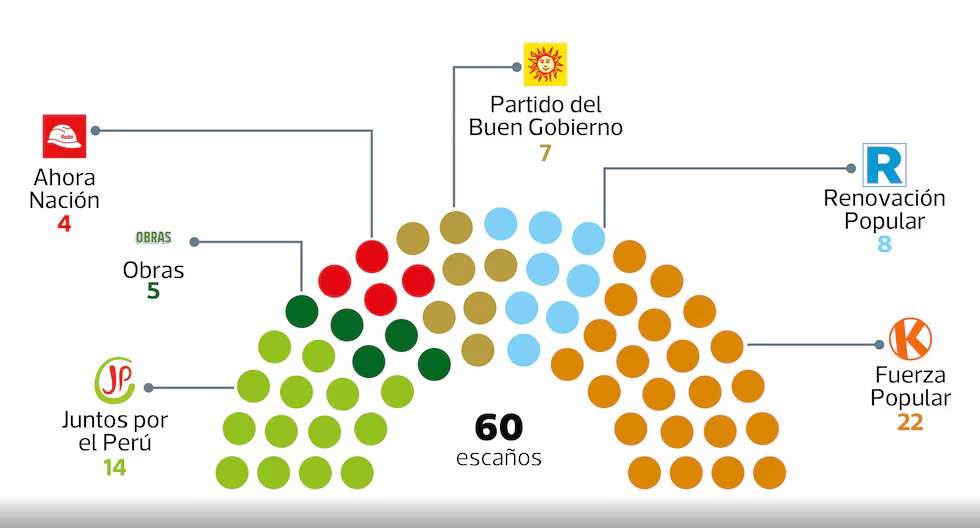
The regulations establish that the quorum for holding plenary sessions of the Senate is half plus one of the working number of senators. This means 31 congressmen. With that minimum quorum, a law of the Chamber of Deputies could be ratified with 16 votes.
The problem arises if we take into account fragmented voting scenarios. For example, there could be the case of a law that is ratified with a simple majority of 11 votes in favor, 10 against and 10 abstentions.
The number of eligible congressmen is defined when the 60 senators are subtracted from those who are on leave, those who are suspended and those who are not incorporated. An additional point to take into account is that the same regulation allows 20% licenses, so, in an extreme case, the number of eligible senators could remain at 48 and the quorum could drop to 25 senators for the development of the plenary session.
This newspaper reviewed all attendance records in the current unicameral period 2021-2026, which included 130 congressmen. The analysis shows a clear low reduction in the presence of congressmen in the chamber as their management progresses, going from an average of 87.4% in the 2021-2022 period to 72.1% present in 2024-2025.
Unjustified absences doubled: from 8% in 2021-2022 to 16.6% in the 2024-2025 period. Meanwhile, licenses are the ones that register the highest alert indicator: they went from 4.6% in 2021-2022 to 10.9% in 2024-2025. For this comparative analysis, the period 2024-2025 was taken into account, because since the second part of 2025, leaves and absences have registered a greater increase, but due to the start of the electoral campaign.
—Some padlocks—
Despite the possibility of a scenario of laws ratified with a low number of votes, PUCP professor Milagros Campos explained that the regulations include reservations for when the Senate wants to introduce modifications to the laws sent by the Chamber of Deputies.

Voting scenarios in the Senate.
“This avoids fast-track legislation or surprise regulations. If they want to modify or archive the texts sent by the deputies, they must have 31 votes. It does not matter whether or not the 60 senators go to the plenary session,” explained one of the academics who most dominates the parliamentary issue in Peru.
As an example, Campos indicated that if the Chamber of Deputies sends a rule to declare gas an emergency, and the Senate decides to modify the text to create a national company, it could only be achieved with 31 votes. “If you don’t have that majority, you don’t get it,” he noted.
—Necessary modifications—
For his part, the expert in parliamentary affairs, Martín Cabrera, warned of other types of regulatory contradictions. “There are asymmetries that draw a lot of attention: 11 votes may be enough to approve a law, but to reopen that same vote, through a reconsideration, 31 are needed,” he calculated.
As indicated, in the region there are diverse cases such as Chile, which has the lowest session quorum in the region: the Senate can meet with only 17 of its 50 members. Argentina, at the other extreme, requires an absolute majority of its total members to meet: 37 out of 72. “The solution is a regulatory adjustment, not a constitutional reform. This means that the new senators could do it from the first day of the first legislature,” said the director of IPOC Consultores.