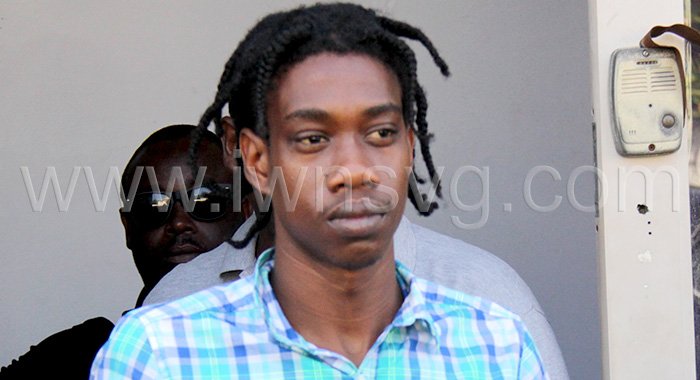
Jeremiah Samuel aka Mozique, 25, who kidnapped and then killed 14-month-old baby Janae Samuel-Wright in Rose Hall on Feb. 10, 2024, had said in the days leading up to the act that the child was demon-possessed and had to die.
And, as he was waiting to be served food at the house where the child’s mother, Jonessa Samuel, lived, he snatched the baby from where she was laughing and playing in a chair and fled into some bushes, where he stabbed her to death.
Samuel, who had been abusing marijuana before he was 16 years old, was later diagnosed with psychosis.
On May 22, Justice Rickie Burnett ordered him to spend a further 19 years, nine months and six days in prison for his crime, saying that the sentence was intended to achieve all the aims of sentencing: prevention, retribution, rehabilitation, and deterrence.
Samuel was initially charged with murder and kidnapping in connection with the baby’s death.

However, his psychiatric evaluation meant that he could not legally be tried for murder. Instead, he pleaded guilty to the lesser charge of manslaughter by reason of diminished responsibility.
Baby snatched while playing and laughing
Presenting the facts of the case, Justice Burnett said it was sometime after 6 p.m. on Feb. 10, 2024, a Saturday, when the defendant left the home of his grandmother, Anesta Alexander, where he lived in Park, Rose Hall and went to his mother’s home in New Village, another section of the North Leeward community.
The defendant’s mother, Myrtle Samuel, was washing at a sink in the yard when she saw the prisoner appear.
When she saw her son, Myrtle left the wash and went to the door of her sister, Joan Samuel’s, home, about 10 seconds from the sink, and told her daughter, Mazonya Samuel, who was inside, to give some food to the defendant.
The defendant’s mother then went back to the sink and continued washing.
Mazonya went into the bedroom where Jonessa — Baby Janea’s mother — was to retrieve a bowl from Jonessa to serve the defendant the food.
Baby Janea’s was sitting in a long chair in the living room, playing and laughing.
Mazonya’s 2-year-old son, her 4-year-old niece and Jonessa’s 9-year-old brother were also at the house.
The defendant was outside sitting on the porch.
Having obtained the bowl from Jonessa, Mazonya went into the kitchen, which is adjacent to the living room, to serve Jeremiah.
Whilst Mazonya was doing so, Jeremiah snatched the baby from the chair and began to run with her.
Jeremiah’s mother, who, on turning from her wash, saw him running with the baby to his chest, ran to the house and screamed, “Jonessa, Mozique gone with the child!”
Mazonya ran out of the kitchen and noticed that Baby Janea was not in the chair.
She informed Jonessa that the baby was missing and Jonessa began to cry and went outside, where she met Jeremiah’s mother, who said, “Look, Mozique gone with one ah you pickney!”
Jonessa, cursing and crying at the same time, left the house, headed up the road to look for Jeremiah and the baby.
In the meantime, Jeremiah, who was running with the baby, jumped over a wall into some bushes with her.
Jeremiah used a black-handled knife he had taken from his grandmother’s kitchen earlier and cut the baby’s neck, and left the body and the knife under a lemon tree.
Jeremiah then escaped into some bushes and hid from the people in the community, including Jonessa and Lenroy Robertson, Jonessa’s ex-boyfriend, who were looking for him and the baby.
Baby stabbed multiple times
Sometime later, Robertson found the dead baby in Stephannie’s yard, lying in some bushes under a lemon tree.
He noticed the baby and noticed that her neck was cut and bleeding.
He lamented, “Look, Janae! The boy killed her!”
At about 8:50 p.m., PC 460 Martin, stationed at the Rose Hall Police Station, heard noise and crying in the village and went to investigate.
He saw Robertson with the dead baby on his shoulder, running around and repeatedly saying that she was dead.
The baby was taken to the police station and was pronounced dead by the district medical officer later that night.
Jeremiah was later escorted to the Rose Hall Police Station and was arrested on suspicion of murder.
The following day, Sunday, Feb. 11, 2024, about 9 a.m., police and a villager retrieved the black-handled knife at the crime scene, in a bushy area.
That same day, Dr. Karen Providence conducted a psychiatric evaluation of Jeremiah and referred him for psychiatric care at the Milton Cato Medical Hospital, where he was admitted until Feb., 23, 2024.
Pathologist Dr. Ronald Child conducted an autopsy on the deceased and found that she had died of multiple sharp force injuries.
The body had four incised wounds to the neck, including to the external jugular vein.
On Feb. 25, 2024, Jeremiah was electronically interviewed in the presence of Justice of the Peace Dwayne Knights.
He admitted that he killed the baby, saying he did so because other males were claiming his baby.
That same day, he accompanied the police to the scene and pointed out what he had done.
Jeremiah was later charged with murder and kidnapping.
On Jan. 29, 2026, he pleaded guilty to manslaughter by reason of diminished responsibility.

Marijuana use from early in life
The judge read from a social inquiry report, which said that Jeremiah lived with his paternal grandmother from birth to about eight months and remained in her care until he committed the offences.
She reported that she had observed Jeremiah was using marijuana in primary school and that it continued well into his adult life.
The report indicated that Jeremiah did not comply with rules or instructions, left school without permission, and dropped out at Form 1, saying he was wasting time in school.
Thereafter, he was involved in farming even as his grandmother declined opportunities to migrate, opting to remain in St. Vincent and the Grenadines to take care of Jeremiah.
Rose Hall residents described Jeremiah as “easy-going”, “helpful”, “calm”, “quiet”, but said he at times appeared disobedient to his grandmother.
Fellow villagers were saddened and shocked by the incident.
Baby’s mom feels heartbroken and betrayed by her own family
In the victim impact statement, Jonessa said that Baby Janea was the first of her children to bring joy to everyone around her.
She said Janea was a calm and loving baby and a quick learner even at that age.
The mother said the baby’s death has filled her life with pain; she feels heartbroken and betrayed by her own family.
She feels empty without the child and still cries whenever the child’s birthday comes around.
Justice Burnett said that in formulating his sentence, he considered the victim impact statement, Jeremiah’s criminal history, the mitigating factors and aggravating factors.
He said Jeremiah has a particular profile, and, as expected from the victim impact statement, the mother naturally had a particular view.
However, the judge said that in arriving at a sentence, the court had to balance the positions of the defendant and the victim.
He said that sentencing is individualised, meaning that two people who commit the same act can receive different sentences if the circumstances differ.
The judge further stated that the court must also bear in mind that crime is not only against the state but also against a specific person.
The judge indicated early that his sentence would separate Jeremiah from society by incarcerating him.
“It is hoped that during the period of incarceration, the defendant, Jeremiah Samuel, will engage in programmes to aid in his rehabilitation,” Justice Burnett said.
“The court is quite familiar with programmes at His Majesty’s Prison, and I say to you now, Jeremiah, that during your time in prison, make good use of the time, so that when you are released, I trust that you will reintegrate into society better than you went in.”
The law and the crime
The judge noted the absence of Eastern Caribbean Supreme Court sentencing guidelines for manslaughter by reason of diminished responsibility.
The court, therefore, considered the UK sentencing guidelines, case law, and the lawyers’ submissions.
He noted that Baby Janea’s mother is still traumatised by her death and struggles with guilt and self-blame but quickly reminded herself that the baby was in the safety and comfort of her home, and there was no reason to believe someone would intrude and harm her.
The judge also explained the offence of manslaughter by reason of diminished responsibility, saying it is a partial defence that reduces the murder charge to manslaughter.
“It applies to the defendant as the condition that seriously impairs his mental faculty, which prevented him from exercising self-control, rational judgement, and to be able to understand the nature of his actions,” Justice Burnett said.
He noted that the law says that someone shall not be convicted of murder “if he was suffering from such abnormality of mind (whether arising from a condition of arrested or retarded development of mind or any inherent causes or induced by disease or injury) as substantially impaired his mental responsibility for his acts and omissions in doing or being a party to the killing”.
The judge noted that the baby’s mother said that while Jeremiah is her cousin, he was never close to Baby Janae, and his actions were completely unexpected and shocking.
She felt betrayed as the child was innocent, harmed no one, and could not defend herself.
“As would be expected, the mother has strong views on sentences,” the judge said, adding that the mother wanted the court to remember, when sentencing, the pain and lasting impact the crime had had on her family.
The judge noted that Jeremiah’s mental illness was caused by the marijuana that he had been abusing since he was a child.
He cited a mental health evaluation dated Feb. 23, 2024 and approved by clinical psychologist Alisa Alvis.
The report was based on an assessment of Jeremiah between Feb. 12 and 22, 2024 and revealed that he began smoking before he was 16 years old and smoked two spliffs (marijuana cigarettes) per day.
He was tested for tetrahydrocannabinol (THC), the principal psychoactive component of cannabis and was given a working diagnosis with psychosis.
‘demons deh in the baby, and the baby have to get rid ah’
Psychiatrist Dr. Enyinne Williams conducted a follow-up psychiatric evaluation dated June 1, 2025, on Jeremiah, which showed that at the time of the offence, he had suffered from a brief psychotic disorder.
He experienced delusional ideation, auditory hallucinations, and poor insight and judgment, lasting at least one day but less than one month.
Jeremiah told the mental health professionals that he had a history of marijuana use.
Before the incident, people in Rose Hall had noticed that Jeremiah was acting strangely.
One of Baby Janea’s mother’s neighbours had seen Jeremiah walking back and forth on the road, talking to himself, when she (the neighbour) was in conversation with him.
She had also heard him cursing, saying that he had told them already “demons deh in the baby, and the baby have to get rid ah”.
Jeremiah ‘acting mad, … cursing like a crazy man’
Further, Mazonya observed that on Feb. 9, 2024, Jeremiah was “acting mad, walking up and down, cursing like a crazy man”.
He was saying that the baby had a demon, and he had heard voices in his head telling him that he had to kill the baby and that he had to die.
Jonessa noted that after the death of one of Jeremiah’s friends, he had started to smell bad, which was unusual.
Miss Alexander also noticed that after the death of Jeremiah’s friend, he had begun to behave differently.
He started reading the Bible and at one time said he could bring people back from the dead.
30 years as a starting point
Justice Burnett established a starting point of 30 years in prison.
He said the death was caused in the course of an unlawful act, which carried a high risk of death or really serious harm, which was or ought to have been obvious to Jeremiah.
He noted that the baby’s body was concealed and was later found in some bushes.
The judge said the court must also consider the horrifying manner in which this innocent child met her death.
Aggravating of the offence was that the victim was particularly vulnerable, aged 14 months.
The court said there was abuse of trust in that Jeremiah knew the child. The attack was unprovoked.
The offence involved the use of a weapon and there was an element of premeditation, even though it may have arisen from delusional thoughts.
The court found no mitigating factors and held that the aggravating factors outweighed them.
The judge increased the sentence by six years, taking it to 36 years.
The court found no aggravating factors of the offender.
Mitigating factors were his good character and his mental illness, which was undiagnosed and untreated at the time.
The court also considered Jeremiah’s youth, noting he was 22 years old at the time of the incident.
He also cooperated with the authorities.
The court concluded that the mitigating factors outweighed the aggravating and reduced the sentence by three years, taking it to 33 years.
Jeremiah was granted the full one-third discount for his guilty plea, which reduced the sentence to 22 years.
The two years, two months and 24 days that Jeremiah spent on remand were deducted from his sentence.
On the kidnapping charge, the court established a starting sentence of 10 years and six months — 75% of the maximum of 14 years.
After considering the aggravating and mitigating features of the case, applying the one-third discount and deducting the time spent on remand, Jeremiah was left with a sentence of a further four years, one month and seven days in prison to run concurrently with the sentence for manslaughter.
The court also ordered that Jeremiah receive adequate psychiatric treatment while in prison.