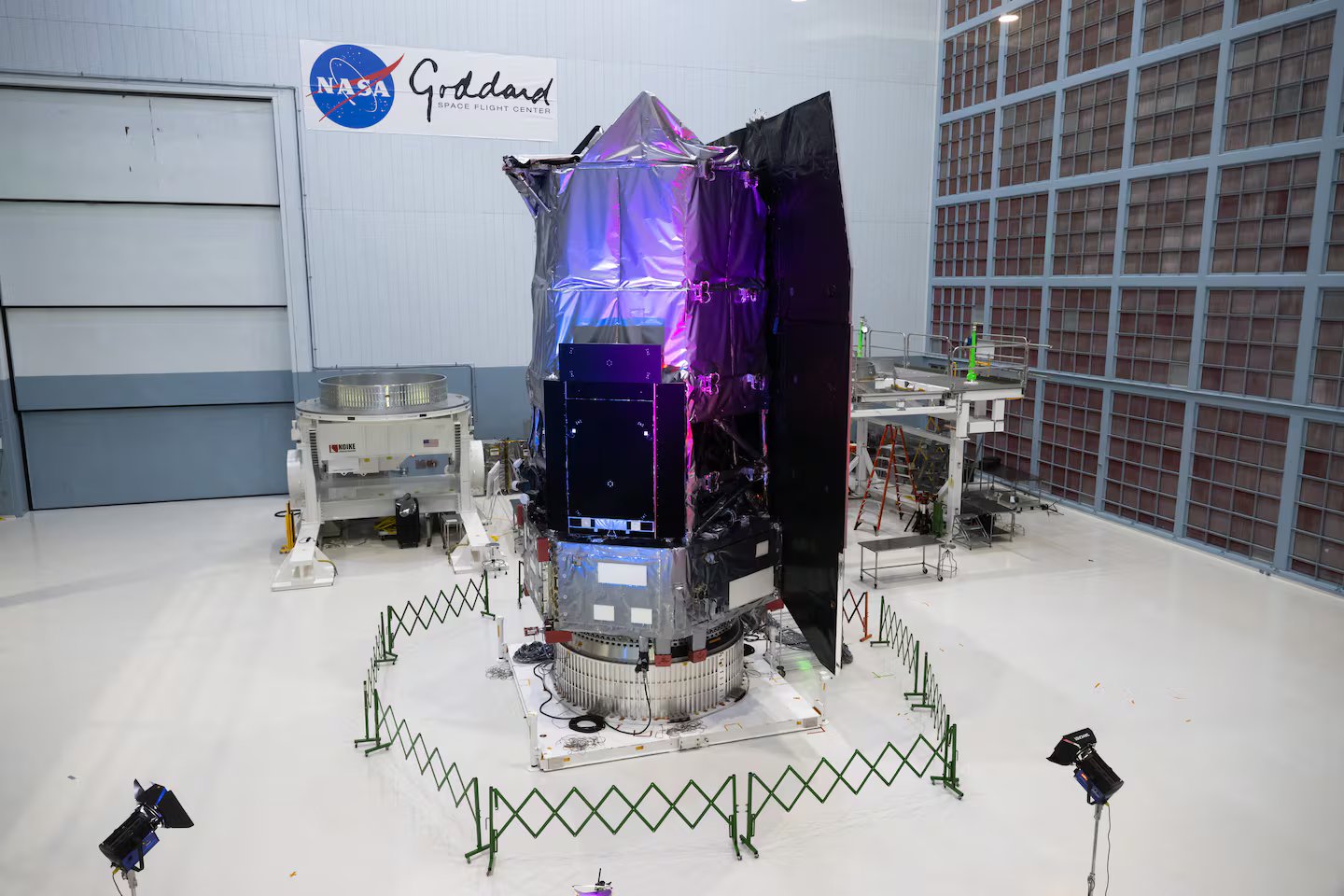
The POT introduced the space telescope Roman. This tool will explore large areas of the universe. The device seeks to find new exoplanets and solve mysteries about dark matter and energy.
Jared Isaacman, director of NASA, stated that this telescope will offer a new atlas of the universe. The announcement occurred at the Goddard center in Maryland in the United States. At that site the space agency completed the mounting of the device.
The telescope measures more than 12 meters high. Its structure is silver in color. Those in charge will move the equipment to Florida. The launch into space will be at the beginning of September on a SpaceX rocket.
The development of the project lasted more than a decade. The investment exceeded $4,000 millions. The name honors Nancy Grace Roman. She is known as the mother of Hubble for her contributions to astronomy.
This new instrument will be responsible for answering pending questions. Hubble showed that the universe is expanding rapidly. Now the Roman He will continue with that scientific mission 35 years later.
The field of view of this telescope is wide. It exceeds the capacity of Hubble by 100 times. The device will sweep areas of the sky from a distance of 1.5 million kilometers of the Earth.
Mark Melton, systems engineer on the project, explained to AFP that the telescope will send 11 terabytes of data daily. Only the first year will provide more information than that collected by the Hubble throughout its history.
NASA hopes to discover tens of thousands of new planets. Nicky Fox, scientific manager of the agency, pointed out that they also plan to locate thousands of supernovas. The goal is to expand current knowledge.
The study of the invisible is another priority of the mission. Scientists will analyze dark matter and energy. These elements represent the 95% of the universe, but its origin is still unknown.
Melton indicated that if the instrument wins a Nobel Prize it will be for a hitherto unthinkable discovery.