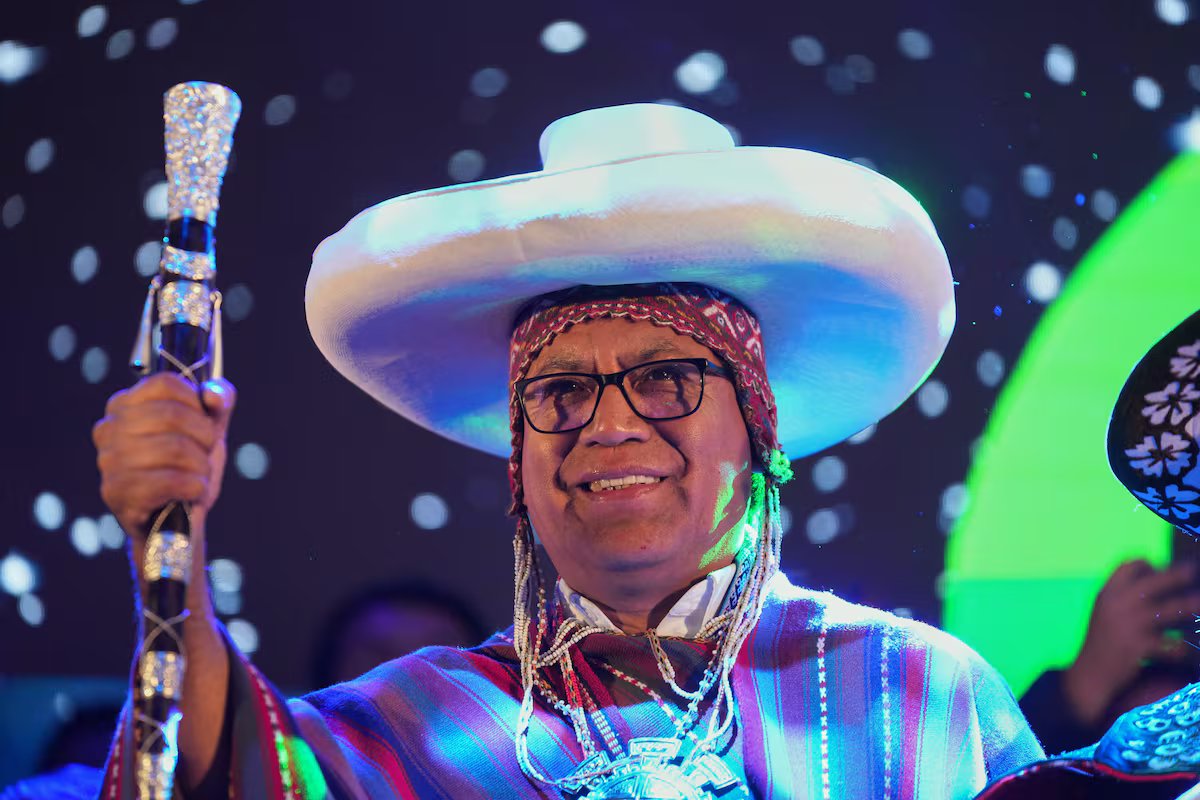
Roberto Sánchez almost died four months ago. He was campaigning in the south of the country, in a rural area far from Lima.when he was attacked by intense and persistent pain in his abdomen in the middle of the road. They transferred him to the nearest health center, but his team became desperate when they were told that he had acute appendicitis and they did not have specialists to operate on him. He visited up to three health posts and when he arrived at a clinic, Sánchez had lost consciousness. He had peritonitis, one of the daily tragedies outside the capital, which concentrates a third of the country’s population and services.
The leftist, a 57-year-old congressman and a trained psychologist, returned to the electoral race weeks later and managed to gain a place among the 35 candidates who aspired to the presidency in the first round when he was not yet on the radar of the pollsters nor did he represent, as Fujimorism now accuses him, a danger to democracy. In an agonizing recount that took a month, punctuated by accusations of fraud by the far-right candidate and former mayor of Lima – he had the most votes in the capital and was the favorite in the polls – whom he displaced from the runoff, Today he is the candidate who can break Fujimori’s chances of becoming president.who has already tried it four times. The last known poll, from Ipsos, gives him a slight advantage (43.8% of voting intention) over the autocrat’s daughter (43.2%), whom Sánchez calls “chaos lady with K” by Keiko.
Sánchez founded Together for Peru in 2008, a political group that defines itself as democratic left, critical of capitalism and in favor of calling a referendum to draft a new Constitution. When it went to the second round, many viewed its program with suspicion and the business world was on guard. In an unexpected turn, since last Monday he has been trying to refine his proposal and make it more centrist and palatable to capital and investors.
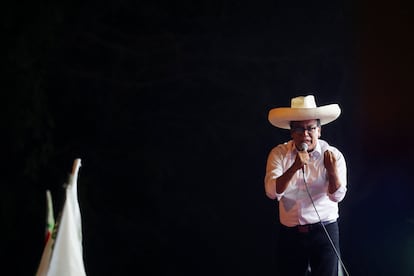
He presented a new government program six days before the elections, the result of an alliance with other parties. Now he promises to preserve macroeconomic stability, respect the autonomy of the Central Reserve Bank, as well as international free trade agreements. While his critics interpret it as a maneuver to hide more radical positions, others highlight the effort of a candidate who understood that to win the elections it is not enough to inherit the vote of Pedro Castillo, the imprisoned former leftist president. for trying to hit yourself in 2022, to whose figure Sánchez has decided to link his candidacy. With this strategy he tries to capitalize on the discontent of those who believe that Castillo is a victim of the maneuvers of Fujimorism to make it impossible for him, with his opposition from Congress, to govern.
At the end of March, from the Barbadillo prison, Pedro Castillo made his sponsorship official through a post in In those days it was said that Sánchez had turned his back on him after the attempted self-coup. A few characters closed the discussion. And, suddenly, the candidate stopped being just Roberto Sánchez to become the heir to his hat, with which he is presented everywhere as a symbol of the rural world, and his political legacy.
When he had peritonitis, he was campaigning on the so-called “Castillista route”, a journey that replicates the path that took Pedro Castillo from rural areas to Palacio in 2021. The electoral poster of Together for Peru includes Pedro Castillo’s older brothers, José Mercedes, senator-elect, and Castillo’s political daughter, Yenifer Paredes, elected deputy. In squares and markets, Sánchez has asked for the freedom of his mentor and has promised that he will pardon him if he becomes president. Without sweeping the southern Andean region like Castillo in 2021, Sánchez has managed to attract a good part of the protest vote towards the political elites in the first round.
Meanwhile, Keiko Fujimori does not stop stoking the fear expressed by voters that Sánchez is a left-wing radical who will destroy the economy. On Friday, in X, the candidate He assured that he had had an “emotional call” with María Corina Machado, the leader of the Venezuelan opposition, to point out below: “History gives us powerful lessons of the paths to follow and those to avoid, such as what happened with the Venezuela of Chávez and Maduro. Chávez’s was a model that came promising prosperity for all the people and ended up spreading misery, insecurity and expelled millions of Venezuelans from their own country.”
Roberto Sánchez was not born in the mountains like Castillo, but on the coast. Exactly in Huaral, an agricultural province north of Lima, on February 3, 1969. He is the son of a hairdresser and a housewife who washed other people’s clothes and cooked to order. None of them finished school. That origin today occupies a central place in his campaign narrative. In a nod to Peruvian diversity, in the presidential debate his first words were spoken in Aymara. His opponents usually present him as an opportunist who adopted the palm hat as an electoral symbol despite having lived for years in San Borja, one of the most affluent districts of the capital. In response, he increasingly draws on his parents’ history to reclaim his provincial roots.
Long before becoming a congressman, Minister of Foreign Trade and Tourism or presidential candidate, Roberto Sánchez was the boy who walked around the Plaza de Armas of Huaral with a box of shoe shiners. Nery Manrique León, one of his childhood friends, still retains that image. “Beto walked around the square looking for customers. He knows what it’s like to fight from below. He’s a source of pride for the people,” he says. Sánchez himself has said that he bowled shoes from the age of seven to thirteen. He also sold bread with fried fish in the fields and fruit lollipops. As a child he went out with his uncles to harvest oranges and tangerines.
During his adolescence, Roberto Sánchez was a catechist at the San Juan Bautista parish in Huaral. Then he migrated to Lima. He had the conviction to be a priest and give his life to God. But the seminar did not conclude. In 1998, at the age of thirty, he graduated as a psychologist from the Universidad Nacional Mayor de San Marcos. During those years he was part of pastoral groups based on Liberation Theology. His work experience, however, has been sustained by his work in the public sector. He has held management positions in different municipalities and has a master’s degree in social policies from the Pontifical Catholic University of Peru.
“He has become the standard bearer of a fairly clear cause. That of stopping and pushing back the control network that Fujimorism wove for ten years with Keiko at the head, and that has plunged the country into a deep crisis, with concentrated power and an abuse of it that has erected a system favorable to criminal activity,” explains writer Juan Manuel Robles in the weekly Hildebrandt en sus Trece. In the final stretch of the campaign, Sánchez has added the support of several former presidential candidates. He has also received public displays of support from personalities such as the journalist César Hildebrandt and the actor and former prime minister Salvador del Solar, who could influence the undecided. Anti-Fujimorism, the political force that has prevented Alberto Fujimori’s daughter from crossing the presidential strip in the last three elections, could be decisive once again.
To continue showing a more open profile, two days before the campaign he spoke about the rights of women and LGTBI people, an issue that has barely had a presence on the electoral agenda. He assured that, unlike Keiko Fujimorihe does support abortion in case of rape. “I am a psychologist, therapist; my specialty is the rehabilitation of child sexual abuse. I have dedicated ten years to that and, therefore, I believe that abortion in cases of rape is democratic, fair and principled,” he said, as reported by Efe, at an event of the Foreign Press Association. However, he defined himself as “pro-life” and only in favor of therapeutic abortion, the only one allowed in Peru when the mother’s life is at risk. He also defended homosexual unions, prohibited in the country. “I believe in the rights of minorities,” he said.
Four months ago, Roberto Sánchez was struggling to reach an operating room. Today he fights to reach the Government Palace. Between one moment and another there is a campaign, a hat and two shadows, that of an imprisoned former president and that of Antauro Humala, brother of former president Ollanta Humala, who was imprisoned for qualified homicide, kidnapping and rebellion for taking up arms in 2005. His ethnonationalist movement has been a support that erodes his candidacy; That is why Sánchez tries to distance himself from him and clarify that he will not be in his government. This Sunday it will be known if the Peruvians will give Pedro Castillo’s unfinished project a second chance or if Keiko Fujimori confirms that, after three failed attempts, the fourth time was the charm.